JAS 39 Gripen vs KF-21 Boramae
JAS 39 Gripen vs KF-21 Boramae at a glance — top speed 2,100 vs 2,200 km/h, range 4,000 vs 2,900 km, max takeoff weight 14,000 vs 25,401 kg.
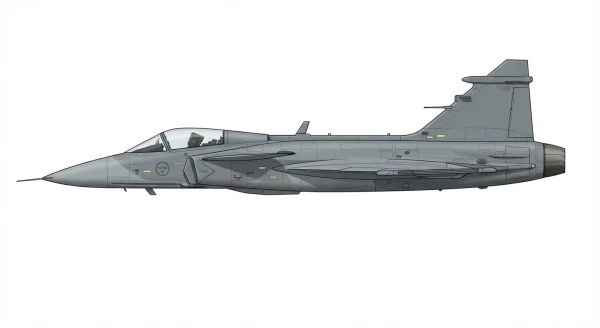
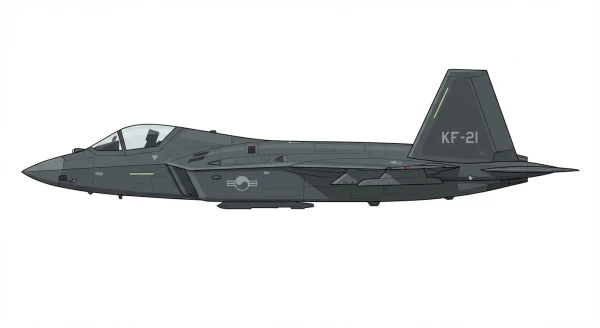
| JAS 39 Gripen | KF-21 Boramae | |
|---|---|---|
| Origin country | 🇸🇪 Sweden | 🇰🇷 South Korea |
| Category | Combat Aircraft | Combat Aircraft |
| Manufacturer | Saab | KAI |
| First flight | 9 December 1988 | 19 July 2022 |
| Year introduced | 1996 | 2026 |
| Number produced | 300 units | N/A |
| Average unit price | $30 million | $87.5 million |
| Wing area | 30.0 m² | 46.0 m² |
| Wingspan | 8.4 m | 11.2 m |
| Height | 4.5 m | 4.8 m |
| Length | 14.9 m | 16.8 m |
| Maximum speed | 2100 km/h | 2200 km/h |
| Operational range | 4,000 km | 2,900 km |
| Service ceiling | 15,240 m | 16,764 m |
| Max. takeoff weight | 14,000 kg | 25,401 kg |
| Empty weight | 6,800 kg | 11,793 kg |
| Total thrust | 1 x 8,209 kgf | 2 x 9,983 kgf |
Detailed Comparison
The Saab JAS 39 Gripen functions as a light, single-engine multirole fighter prioritized for logistical efficiency and dispersed operations, while the KAI KF-21 Boramae constitutes a medium-weight, twin-engine platform designed to bridge fourth and fifth-generation capabilities. The Gripen represents a mature system optimized for the specific defensive doctrine of the Swedish Air Force, characterized by small ground crews and highway strip operations. In contrast, the KF-21 reflects a modern South Korean initiative to replace heavy interceptors like the F-4 Phantom II, incorporating low-observable shaping and higher payload capacities intrinsic to a larger airframe.
Development and Design
The JAS 39 Gripen utilizes a close-coupled delta wing and canard configuration to achieve stability and high angle-of-attack performance. Saab emphasized a modular avionics architecture, allowing rapid integration of new hardware and software without extensive airframe modifications. This philosophy extends to the RM12 engine (a Volvo-modified GE F404), selected for reliability and maintenance simplicity.
The KF-21 Boramae follows a design lineage similar to the F-22 and F-35, featuring canted vertical stabilizers and fuselage chines intended to reduce Radar Cross Section (RCS). Unlike the Gripen, the KF-21 is powered by two General Electric F414 engines, providing redundancy and greater total thrust. While the airframe geometry supports stealth, initial Block I and II variants carry weapons on external hardpoints, with internal bays planned for the future Block III/EX variants to fully utilize its stealth potential.
Specifications and Performance
The physical disparity between the two aircraft is significant. The KF-21 has a Maximum Takeoff Weight (MTOW) of 25,401 kg, nearly double the Gripen’s 14,000 kg. This mass difference correlates with the KF-21's higher total thrust output of 12,246 kgf from its twin engines, compared to the single-engine Gripen's 5,507 kgf. Consequently, the KF-21 offers a longer operational range of 1,000 km versus the Gripen's 805 km, and a higher external payload capacity of 7,700 kg.
Despite the size difference, kinematic performance in terms of top speed is comparable, with the Gripen achieving 2,208 km/h and the KF-21 reaching 2,200 km/h. Both platforms integrate the MBDA Meteor for long-range air-to-air engagements, though the KF-21’s avionics suite centers on a domestically developed AESA radar and integrated IRST, while the Gripen C/D relies on updated pulse-doppler systems (with AESA introduced in the E/F variants).
Deployment and Usage
The JAS 39 Gripen has been operational since 1997, serving as the backbone of the Swedish Air Force. It has seen export success in the Czechia, Hungary, South Africa, Thailand, and Brazil. Operationally, it participated in the 2011 military intervention in Libya, flying reconnaissance missions, and conducts regular Baltic Air Policing duties.
The KF-21 is currently in the flight test phase, with a maiden flight in July 2022 and scheduled service entry in 2026. The Republic of Korea Air Force intends to acquire 120 units by 2032. Development plans include specialized variants, such as the carrier-based KF-21N and the electronic warfare KF-21EA, indicating a broader intended operational scope than the standard Gripen airframe.
Conclusion
The JAS 39 Gripen remains the superior option for nations requiring a cost-efficient, high-readiness asset capable of operating from austere infrastructure with minimal logistical footprints. Its value lies in proven reliability and low lifecycle costs. The KF-21 Boramae addresses a different requirement set, offering a heavier payload, extended range, and a developmental pathway toward fifth-generation stealth capabilities. The KF-21 is better suited for air forces seeking to project power over longer distances and sustain operations in contested airspace where reduced observability is required.