Mi-8 Hip vs UH-60 Black Hawk
Mi-8 Hip vs UH-60 Black Hawk at a glance — top speed 250 vs 294 km/h, range 495 vs 2,221 km, max takeoff weight 12,000 vs 10,659 kg, built 17,000 vs 5,000 units.
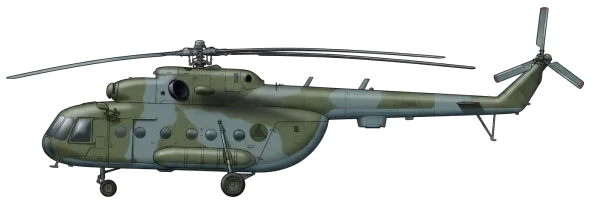
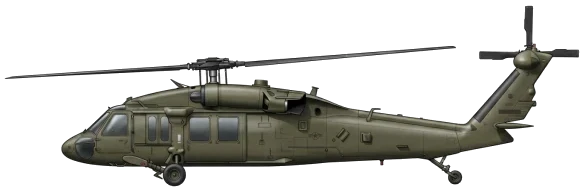
| Mi-8 Hip | UH-60 Black Hawk | |
|---|---|---|
| Origin country | 🇷🇺 Ex-USSR | 🇺🇸 United States |
| Category | Military Helicopters | Military Helicopters |
| Manufacturer | Mil | Sikorsky |
| First flight | 24 June 1961 | 29 November 1974 |
| Year introduced | 1967 | 1979 |
| Number produced | 17000 units | 5000 units |
| Average unit price | $4 million | $21 million |
| Wingspan | 21.3 m | 16.4 m |
| Height | 5.7 m | 4.9 m |
| Length | 25.2 m | 19.5 m |
| Maximum speed | 250 km/h | 294 km/h |
| Operational range | 495 km | 2,221 km |
| Service ceiling | 4,500 m | 5,791 m |
| Max. takeoff weight | 12,000 kg | 10,659 kg |
| Empty weight | 7,160 kg | 4,819 kg |
| Total thrust | 2 x 1,119 kW | 2 x 1,208 kW |
Detailed Comparison
The Mil Mi-8 Hip and Sikorsky UH-60 Black Hawk represent the preeminent utility helicopters of the Eastern and Western blocs, respectively, defining air mobility for over half a century. While the Mi-8 serves as a heavy-duty, high-volume transport often bridging the gap between medium and heavy lift, the UH-60 focuses on tactical agility, crash survivability, and the rapid deployment of squad-sized elements.
Development and Design
The Mi-8, introduced in 1961, prioritizes sheer utility and industrial scalability. Its aluminum airframe and simple five-blade rotor system were designed for ease of maintenance in austere conditions, leading to a massive production run of over 17,000 units. Conversely, the UH-60, entering service in 1979, represented a generational leap in survivability and materials technology. Sikorsky utilized a monocoque fuselage incorporating composites and titanium to enhance crashworthiness—a direct requirement following U.S. experiences in Vietnam. The Black Hawk’s fully articulated rotor system and wheeled landing gear emphasize tactical maneuverability and low-level flight characteristics, whereas the Mi-8’s larger fuselage and fixed gear reflect a design philosophy centered on bulk logistics.
Specifications and Performance
Performance metrics highlight divergent mission profiles. The Mi-8 is significantly larger, with a Max Takeoff Weight of 12,000 kg compared to the Black Hawk's 10,659 kg. This allows the Hip to transport 24 troops, more than double the UH-60's standard capacity of 11. However, the Black Hawk holds a distinct kinematic advantage. It is faster (294 km/h vs. 250 km/h) and possesses a higher service ceiling (5,791 m vs. 4,500 m), making it superior in "hot and high" combat environments. The UH-60 also offers better operational range (590 km) compared to the Mi-8's 495 km, reflecting its requirement for extended tactical insertion without immediate refueling support.
Deployment and Usage
Operationally, the Mi-8 is a ubiquitous workhorse used by over 50 nations. It frequently blurs the line between transport and gunship, capable of carrying heavy armaments like S-8 rocket pods and AT-2 Swatter missiles while deploying troops, a doctrine heavily utilized during the Soviet-Afghan War. The UH-60 remains the backbone of U.S. air assault operations. From the Gulf War to Afghanistan, it functions primarily as a rapid maneuver asset. While capable of carrying Hellfire missiles or Hydra 70 rockets on external pylons, the standard Black Hawk configuration prioritizes speed, door-gunner defensive fire, and advanced countermeasures over the heavy offensive firepower found on armed Mi-8 variants.
Conclusion
The Mi-8 Hip and UH-60 Black Hawk are arguably the most successful rotary-wing aircraft in history, but they occupy different tactical niches. The Mi-8 provides unmatched volume and lift capability for its widely accessible $4.0 million price point, making it the preferred solution for cost-conscious militaries requiring rugged, heavy lift. The $21.0 million UH-60 provides superior survivability, speed, and avionics integration, optimized for technologically advanced forces that prioritize force protection and rapid tactical maneuver over raw payload capacity.