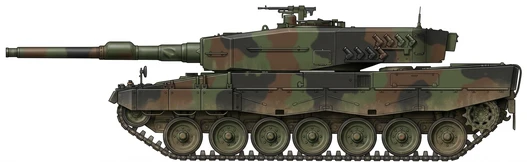
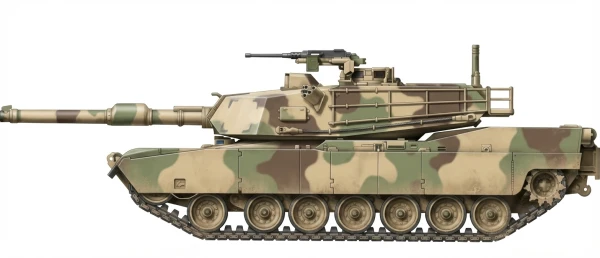
The Krauss-Maffei Leopard 2 and the General Dynamics M1A1 Abrams originated from the canceled joint MBT-70 project of the 1970s. The M1A1 was optimized for a high-intensity Soviet armored thrust, prioritizing crew survivability at the cost of logistical footprint. The Leopard 2 was built around tactical mobility and diesel efficiency to fight a fluid defensive war across West Germany.
Development and Design
Following the MBT-70 termination in 1970, the U.S. and West Germany pursued divergent national designs. Germany introduced the Leopard 2 in 1979, establishing a production run of 3,600 units. Krauss-Maffei prioritized modularity, allowing the vehicle to evolve from the vertical-turreted A4 to the sloped A5-A7 variants without requiring total hull replacement. The U.S. XM1 project culminated in the M1 entering service in 1980. The M1A1 variant arrived in 1986, integrating the M256 120mm gun and depleted uranium (DU) armor arrays into a platform that would see 9,200 units built.
Protection and Firepower
Both tanks utilize composite armor, but their survivability models diverge sharply in ammunition stowage:
The M1A1 isolates its entire 40-round main gun complement behind blast doors with blowout panels.
The Leopard 2 limits turret bustle stowage to 15 rounds, placing 27 rounds in a hull rack next to the driver without blast isolation.
This hull rack has proven vulnerable to side-penetration in recent conflicts. Firepower overlaps heavily. The M1A1 relies on the M256—a license-built Rheinmetall L/44. Newer Leopard 2 variants upgraded to the longer L/55, increasing penetrator velocity and extending effective range against heavy armor.
Mobility and Logistics
Both platforms weigh roughly 63 tons and generate 1,500 horsepower, but their powerplants dictate distinct logistical tails. The Abrams' Honeywell AGT1500 gas turbine consumes high volumes of aviation fuel, demanding an unbroken supply chain, though it achieves a 465 km operational range. The Leopard’s MTU MB 873 diesel engine trades that range (340 km) for fuel efficiency and easier field maintenance. The Leopard 2 reaches a maximum speed of 70.0 km/h, slightly outpacing the M1A1’s 66.0 km/h.
Deployment and Combat Record
The M1A1 destroyed hundreds of Soviet-export T-72s during the 1991 Gulf War without a single loss to enemy tank fire. Subsequent conflicts in Iraq and Yemen exposed vulnerabilities to side-aspect IEDs and ATGMs. The Leopard 2 saw low-intensity deployment in Kosovo and Afghanistan before Turkish A4s took heavy losses to ISIS ATGMs in Syria due to static deployment. In Ukraine, both platforms faced dense minefields, artillery, and FPV drones. Leopard 2s suffered hull-detonations from anti-tank missiles, while M1A1s experienced sensor-blinding and top-down drone strikes that forced tactical withdrawals.
Conclusion
The M1A1 Abrams holds a definitive edge in high-intensity combat where crew survivability is the absolute metric. Its isolated ammunition stowage prevents the catastrophic internal detonations that destroy Leopard 2s when hull armor is breached. Conversely, the Leopard 2 provides the structural edge for states lacking U.S.-level logistical infrastructure. Its diesel engine and ease of field maintenance allow militaries to sustain operational tempo in theaters where the Abrams' turbine supply requirements would halt an advance.