M1 Abrams vs T-80
M1 Abrams vs T-80 at a glance — weight 66,800 vs 46,000 kg, top speed 72 vs 70 km/h, range 426 vs 415 km, crew — vs 3.
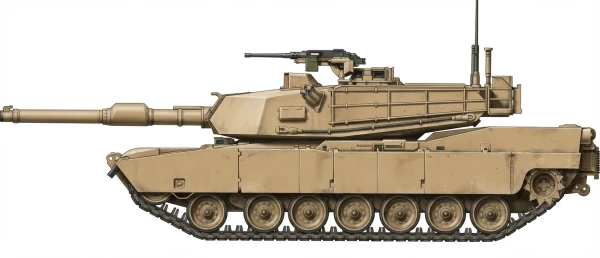
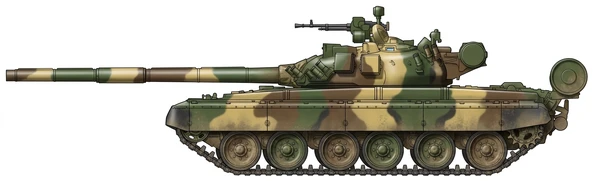
| M1 Abrams | T-80 | |
|---|---|---|
| Origin country | 🇺🇸 United States | 🇷🇺 Ex-USSR |
| Category | Main Battle Tank | Main Battle Tank |
| Type | Heavy Main Battle Tank | Medium Main Battle Tank |
| Manufacturer | General Dynamics Corp. | Malyshev HMB Plant |
| Number produced | 10,300 units | 5,500 units |
| Estimated unit price | $8.5 million | $2.5 million |
| Combat weight | 66.8 tons | 46.0 tons |
| Maximum speed | 72 km/h | 70 km/h |
| Operational range | 426 km | 415 km |
| Length | 9.77 m | 9.65 m |
| Width | 3.66 m | 3.60 m |
| Height | 2.44 m | 2.20 m |
| Crew | 4 (commander, gunner, loader, driver) | 3 |
| M1 Abrams | T-80 | |
|---|---|---|
| Main armament | 120 mm L/44 M256 smoothbore gun (40 rounds) | 125 mm 2A46M-1 gun |
| Secondary weapon | 1 × 0.50 caliber (12.7 mm) M2HB heavy machine gun with 900 rounds | 7.62 mm PKT coax MG |
| Engine | Honeywell AGT1500 multi-fuel turbine engine 1,500 shp (1,120 kW) | GTD-1250 turbine |
Detailed Comparison
The 66.8-ton American M1 Abrams and the 46.0-ton Soviet-designed T-80 rely on gas turbine propulsion but execute fundamentally different armored warfare doctrines. The Abrams prioritizes crew survivability and sensor overmatch in a heavy platform, while the T-80 minimizes silhouette and weight, relying on an autoloader to achieve tactical mobility at the expense of post-penetration survivability.
Development and Design
Emerging from the MBT-70 program, Chrysler designed the Abrams in the 1970s to counter Soviet armor. It introduced the Honeywell AGT1500 multi-fuel turbine (1,500 shp) and compartmentalized ammunition. Entering service in 1976, the T-80 evolved from the T-64. Designed by Nikolay Popov, it was the first mass-produced MBT to use a gas turbine (later the 1,250 hp GTD-1250). Soviet weight limits resulted in a compact turret and a hull 2.15 meters shorter than the Abrams, achieved by replacing the human loader with a Korzina mechanical carousel.
Protection and Firepower
The Abrams employs composite Chobham armor, upgraded with depleted uranium meshes in later variants. Its survivability and lethality rely on specific design choices:
- A 120 mm L/44 M256 smoothbore gun firing depleted uranium APFSDS projectiles.
- Turret bustle ammunition storage equipped with blow-out panels.
- A four-man crew separated entirely from main gun propellant.
The T-80 utilizes a 125 mm 2A46M-1 gun, fed by a 28-round autoloader capable of firing 9M119 Refleks missiles. Base protection relies on composite arrays supplemented by explosive reactive armor (Kontakt-5, Relikt). The vertical placement of propellant charges in the T-80's carousel directly underneath the crew ensures catastrophic turret ejections upon hull penetration.
Mobility and Logistics
Both reach speeds of 70-72 km/h, but their operational footprints diverge. The 46-ton T-80 navigates soft soil and 50-ton weight-limit bridges inaccessible to the 66.8-ton Abrams. Both turbines consume fuel rapidly; the Abrams yields a 426 km range but demands a heavy logistics tail, reliant on M88 recovery vehicles and specialized fuelers. The T-80 operates within the austere supply lines of Russian motor rifle brigades.
Deployment and Combat Record
The Abrams destroyed Iraqi armor during Desert Storm (1991), scoring kills beyond 2,500 meters. Urban combat in Iraq necessitated the TUSK upgrade to mitigate RPG threats. The T-80's combat debut in Grozny (1994) exposed vulnerabilities; columns suffered heavy attrition from close-quarters anti-tank fire. In the Russo-Ukrainian War, T-80 variants take heavy losses from top-attack munitions and FPV drones. Ukraine's US-supplied M1A1SAs proved vulnerable to the same drone saturation, yet their blowout panels regularly allow crews to survive disabling strikes.
Conclusion
The M1 Abrams holds the definitive edge in kinetic engagements and crew survivability. Its thermal optics and compartmentalized ammunition allow it to detect targets early and survive hits that destroy Russian platforms. The T-80 only retains an advantage in operational mobility across degraded infrastructure; its 20-ton weight deficit permits passage over standard Eastern European bridges. Ultimately, the T-80's autoloader carousel renders it structurally obsolete on battlefields saturated with top-attack and loitering munitions, where armor penetration guarantees immediate crew fatality.