Tu-160 Blackjack
Soviet strategic bomber, operational during the Cold War era, known for its supersonic speed and nuclear deterrence flights. Key figures: top speed 2,220 km/h, range 12,300 km, service ceiling 16,000 m, max takeoff weight 274,877 kg, unit price $250M, built 37. In service with 1 air force as of 2026 — Russia (17).
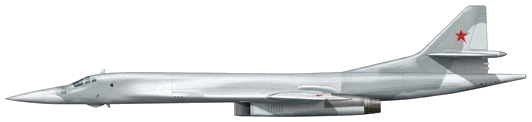
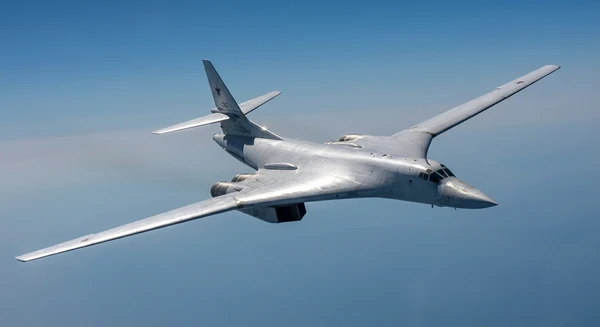
| Crew | 4 |
| Length | 54.1 m (177.5 ft) |
| Wingspan | 55.7 m (182.7 ft) |
| Height | 13.1 m (43.0 ft) |
| Wing area | 232 m² (2497.2 sqft) |
| Empty weight | 109,769 kg (241,999 lbs) |
| Max. takeoff weight | 274,877 kg (605,999 lbs) |
| Powerplant | 4 × turbofans Kuznetsov NK-32 24,983 kgf each |
| Ejection seat | Zvezda K-36DM |
| Maximum speed | 2220 km/h (Mach 2.1) |
| Operational range | 12,300 km (7,643 mi) |
| Endurance | 15 hours |
| Service ceiling | 16,000 m (52,493 ft) |
| Climb rate | 70.0 m/s (229.7 ft/s) |
| Takeoff distance | 2,200 m (7,218 ft) |

- Air-to-Surface Raduga Kh-15 (AS-16 Kickback)
- Cruise Missiles Raduga Kh-55 (AS-15 Kent)


Description
The Tupolev Tu-160 (NATO reporting name Blackjack; "Bely Lebed", White Swan, to Russian airmen) is a four-engine, variable-sweep-wing supersonic strategic bomber and cruise-missile carrier designed by the Tupolev Design Bureau in the 1970s and built by the Kazan Aircraft Production Association (KAPO). It first flew on 18 December 1981 and entered service with Soviet Long Range Aviation in April 1987, the last strategic bomber designed for the Soviet Air Forces. Its Kuznetsov NK-32 turbofans are among the most powerful ever fitted to a combat aircraft. Russia's fleet, 17 strong in 2022 and put at about 16 operational aircraft in mid-2025, made its combat debut over Syria in November 2015 and has fired Kh-101 cruise missiles at Ukraine since 2022.
Development
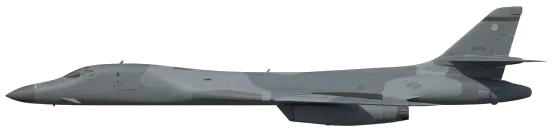
A 1972 Soviet requirement called for a Mach 2.3 variable-geometry heavy bomber to answer the US B-1. Tupolev's Aircraft 160M, a lengthened blended-wing layout borrowing from the Tu-144, was selected over the Myasishchev M-18 and Sukhoi T-4. The prototype first flew on 18 December 1981; production was authorised in 1984 at KAPO. Serial production was ended in January 1992 with 35 aircraft completed.
Modernisation began with a 2002 agreement between the Defence Ministry and KAPO covering 15 aircraft: the first able to carry the Kh-555 conventional cruise missile was delivered in April 2008, and a Tu-160 with new radar and avionics was delivered as the Tu-160M in December 2014. Resumed production was announced on 29 April 2015, by which time Kuznetsov had a contract to restart the NK-32 line as the improved NK-32-02. A bomber assembled from an unfinished airframe was rolled out on 16 November 2017 and flew publicly on 25 January 2018, when a contract for ten Tu-160M2s was signed. The first fully modernised Tu-160M, re-engined with NK-32-02s, flew at Kazan on 2 February 2020; the first new-build Tu-160M flew on 12 January 2022 and was handed to the Defence Ministry on 30 December 2022 for state trials, the manufacturer stating that modernised systems made up 80 percent of the aircraft.
Four aircraft were presented at Kazan on 21 February 2024, at which point, according to one Western analyst, about three new-build Tu-160Ms had been completed and none assigned to the operational unit. Yle reported in June 2025 that the plant handed its first two Tu-160M2s to the air force in 2024 and completed two Tu-160Ms, and the Institute for the Study of War that two Tu-160M2s and two Tu-160Ms were commissioned that year. The Federation of American Scientists noted in May 2026 that four Tu-160Ms were reportedly due in 2025 but only two had been transferred to the armed forces by early January 2026; Russian media reported that the Defence Ministry expects ten by 2027.
Design
The Tu-160 is 54.1 m (177 ft 6 in) long, with a wing spanning 55.7 m (182 ft 9 in) at 20° sweep and 35.6 m (117 ft) at 65°, and empty and maximum take-off weights of 110,000 kg (242,500 lb) and 275,000 kg (606,300 lb). Titanium makes up about 30 percent of the structure; control is by fly-by-wire, with full-span leading-edge slats, double-slotted flaps and a cruciform tail. The crew of four — pilot, co-pilot, bombardier and defensive-systems operator — sit on K-36LM ejection seats. Four Kuznetsov NK-32 afterburning turbofans, each rated at 137.3 kN (30,900 lbf) dry and 245 kN (55,100 lbf) in afterburner, drive the aircraft to 2,220 km/h (1,380 mph; Mach 2.05) at 12,200 m (40,000 ft), fed through variable intake ramps. Cruise is 960 km/h (600 mph; Mach 0.9), service ceiling 16,000 m (52,500 ft), and 130 tonnes (286,600 lb) of internal fuel give a practical range of 12,300 km (7,640 mi) without refuelling; a probe-and-drogue refuelling system is fitted but rarely used. The aircraft carries a TsNPO Leninets Obzor-K (NATO Clam Pipe) radar for ground and air targets and a separate Sopka terrain-following radar, and its anti-flash white finish earned it the "White Swan" name.
The NK-32-02 keeps the original thrust but has new compressor and turbine blades and improved cooling, which Russian media reports say adds about 1,000 km (620 mi) of range; the Tu-160M pairs it with a new radar, digital cockpit displays, new flight-control and navigation systems and a new self-protection suite.
Armament
Two internal bays each hold 22,500 kg (49,600 lb) of free-fall weapons or a rotary launcher, for a total load of 45,000 kg (99,200 lb). Each launcher takes six Raduga Kh-55SM, Kh-101, Kh-102, Kh-555 or Kh-BD cruise missiles or twelve Kh-15 short-range nuclear missiles. On 16 September 2023 the commander of Long Range Aviation announced that the bombers had received the Kh-BD cruise missile, with a range of 6,500 km (4,040 mi), twelve per aircraft. Over Ukraine the bombers routinely launch with less than a full load. No defensive weapons are fitted, making it the first Soviet strategic bomber in service without them.
Operational History
The 184th Guards Heavy Bomber Regiment at Pryluky, Ukrainian SSR, received the Tu-160 in April 1987. The Soviet collapse left 19 aircraft in Ukraine and 13 in Russia. Ukraine began scrapping its grounded fleet under the Nunn–Lugar Cooperative Threat Reduction programme in November 1998, but a US$285 million agreement in 1999, offset against gas debt, transferred eight Tu-160s, three Tu-95MS and 575 Kh-55SM missiles to Russia, the first aircraft flying to Engels-2 on 5 November 1999; of the other 11, all but one, preserved at the Poltava museum, were scrapped. Russia's 121st Guards Heavy Bomber Regiment at Engels-2 reached 15 aircraft by February 2001 and 16 by April 2008; Engels remains home to the type's only squadron.
Strategic patrols resumed on 17 August 2007. Two Tu-160s flew to Venezuela on 10 September 2008, and on 10 June 2010 two aircraft flew a 23-hour patrol over the Arctic and Pacific planned at 18,000 km (11,200 mi). On 17 November 2015, Tu-160s and Tu-95MSs fired Kh-101s from over the Mediterranean at Idlib and Aleppo in the type's combat debut. On 23 October 2019 two aircraft landed at AFB Waterkloof, South Africa, the type's first visit to Africa.
In the invasion of Ukraine, Ukrainian sources reported a Tu-160 and a Tu-95MS launching eight cruise missiles at Vinnytsia airport from the Black Sea on 6 March 2022 and four to six Kh-101s at Kyiv from the Caspian on 26 June 2022. Ukraine launched a drone attack on the Kazan plant on 20 January 2025, and claimed four Tu-160s hit at Russian airfields in Operation Spiderweb on 1 June 2025, but satellite imagery confirmed Tu-95MS and Tu-22M3 losses and no Tu-160 loss has been confirmed; according to the Federation of American Scientists, Russia has since stopped deploying Tu-160s to Belaya and dispersed the fleet, typically with three to five at Ukrainka, one or two at Engels and three at times at Ugolny near Anadyr, and, reportedly from April 2025, began building at Engels what The War Zone counted in June 2026 as at least 17 large protective shelters sized for its Tu-160s and Tu-95MSs. India was reported in late 2022 to be in talks for six aircraft.
Variants
- Tu-160 (Tu-160S): Production bomber, the "S" distinguishing serial aircraft from the test and pre-production airframes.
- Tu-160M1: First-stage upgrade operational from late 2014, with new navigation and autopilot systems and the legacy bomb sight removed.
- Tu-160M: Upgrade with new weapons, electronics and avionics, first delivered in December 2014 and, in fully modernised form with NK-32-02 engines, flown in February 2020.
- Tu-160M2: New-build standard with a glass cockpit, new communications and control systems, a new defensive system, new weapons and more efficient engines for greater range; ten ordered in January 2018, though new-build aircraft are now generally also called Tu-160M.
- Tu-160SK: Proposed demilitarised commercial version shown at Singapore in 1994 to launch Burlak satellite boosters from under the fuselage.
- Tu-160PP: Proposed stand-off jamming and electronic-countermeasures version.
Frequently Asked Questions
What type of aircraft is the Tu-160 Blackjack?
What is the maximum speed of the Tu-160 Blackjack?
What is the range of the Tu-160 Blackjack?
When did the Tu-160 Blackjack first fly?
How many Tu-160 Blackjack have been built?
Which countries operate the Tu-160 Blackjack?
How much does a Tu-160 Blackjack cost?
What is the service ceiling of the Tu-160 Blackjack?
- OCT 32026 Updated Description expanded with the NK-32-02 engine restart, Tu-160M production and fleet dispersal since 2025
- OCT 32026 Updated Description expanded with Soviet development, the Ukrainian fleet transfer, Tu-160M production and strikes on Ukraine
- AUG 212026 Updated Dropped the bare Blackjack alias, which the RQ-21 Blackjack drone also carries
- AUG 52026 Updated Powerplant and thrust updated
- JUL 232026 Updated Sources and cross-references refreshed
- JUN 122026 Updated Description updated
- APR 72026 Updated Sources and cross-references refreshed