UR-416
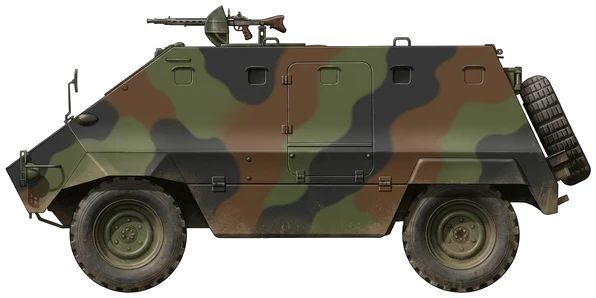
The UR-416 is a German-made 4x4 armored personnel carrier introduced in 1969, used primarily for internal security and troop transport, distinguished by its fully amphibious, welded steel hull. Key figures: weight 7.6 t, top speed 85 km/h, range 700 km, built 1,030. In service with 5 armies — Peru (150), Morocco (70), Kenya (52) and 2 others.
| Sub-type | Armoured personnel carrier |
| Crew | 2 + 8 infantry personnels |
| Range | 700 km |
| Mass | 7.6 tons |
| Height | 2.52 m (8.3 ft) |
| Width | 2.25 m (7.4 ft) |
| Length | 5.21 m (17.1 ft) |
| Max. speed | 85 km/h (53 mph) |
| Engine | Daimler-Benz OM352 turbo diesel, 120 hp |
| Weapon 1 | Light machine gun |
| Weapon 2 | 20mm gun turret (optional) |
| Weapon 3 | Water cannon (optional) |
| Weapon 4 | Smoke grenade dischargers |
Description
The UR-416 is a wheeled armoured personnel carrier developed as a private venture by Rheinstahl Maschinenbau, later Thyssen Maschinenbau and subsequently Henschel Wehrtechnik GmbH. The first prototype was completed in 1965, using the chassis of the Mercedes-Benz U1100 Unimog 416 cross-country truck fitted with an armoured body. Series production began in 1969 and ran to 1,030 vehicles, built almost entirely for export. The design was intended primarily for internal security work, with secondary roles in command and communications, reconnaissance and field maintenance. It was withdrawn from marketing and succeeded by the TM 170.
The hull is of all-welded steel up to 9 mm thick. The driver and commander sit at the front, the engine is centrally located, and eight infantrymen are carried in the rear compartment. Access is through a single medium-sized door on each side; there is no rear door. Two firing slits are provided per side. Standard armament is normally a light machine gun, though water cannon, machine gun cupolas and 20 mm turrets could be mounted. Optional equipment included spherical firing ports with vision devices, fire detection and suppression, air conditioning, heater, run-flat tyres, smoke grenade dischargers, passive or active night vision, megaphones, a 5-tonne winch and a hydraulically adjustable obstacle-clearing blade. The internal security cupola rotates through 360°, is lockable in any position, mounts bulletproof vision blocks and ball mounts, and incorporates a nozzle fed from tear gas tanks holding up to 500 litres. Automotive spares are common with the Unimog truck and available commercially. Factory variants included ambulance, command and communications, reconnaissance, internal security, police and maintenance/repair workshop models, the latter with an A-frame and front stabilisers for engine changes.
Unlicensed copies were built in the late 1970s by states and organisations under arms embargo. PLO factions in Lebanon assembled about eight vehicles in workshops in the West Beirut refugee camps, first shown at a Beirut parade in April 1981, armed with roof-mounted Browning M1919A4 or M2HB machine guns and occasionally AT-3 Sagger or ENTAC launchers. One was captured by the IDF in 1982 and is displayed at the Batey Ha-Osef Museum, Tel Aviv; seven were salvaged by the Lebanese Forces, who used them at the Sidon bridgehead in 1985 against the Popular Nasserist Organization, one being captured and retained by the PNO until 1990. In Rhodesia, the Selous Scouts built two copies, nicknamed 'Pig', at Inkomo Garrison in October 1976 from Iscor 6 mm plate; lacking mine protection, they were used in Operation Mardon (October 1976) and Operation Miracle (September 1979) against ZANLA camps in Mozambique and later passed to the Zimbabwe National Army. The type informed the Rhodesian Mine Protected Combat Vehicle of 1978–79.
El Salvador received ten vehicles between 1971 and 1975 and employed them in convoy escort and counter-insurgency during the civil war, some fitted with wire mesh anti-RPG screens and appliqué armour. The Philippines procured nine in 1973 for the Marine Corps and Constabulary, later scrapped. Operators include Ecuador, Kenya, Morocco, Pakistan, Peru, Qatar, Saudi Arabia, Spain, Togo and Venezuela; a Togolese MINUSMA vehicle was destroyed by JNIM on 29 May 2016.
Frequently Asked Questions
What type of vehicle is the UR-416?
What is the weight of the UR-416?
What is the maximum speed of the UR-416?
What is the operational range of the UR-416?
How many crew members does the UR-416 require?
How many UR-416 have been built?
What weapons does the UR-416 carry?
- SEP 42026 Verified Weight verified against the published specifications
- AUG 152026 Created UR-416 page created (specifications, overview, 20 operators)