Hughes MD-500
Summary
| Category | Military Helicopters |
| Origin country | 🇺🇸 United States |
| Manufacturer | Hughes |
| First flight | 28 January 1982 |
| Year introduced | 1967 |
| Number produced | 4700 units |
| Average unit price | $4 million |
Technical specifications
| Version: MD-500 | |
|---|---|
| Crew | 1 pilot |
| Operational range | 430 km (267 mi) |
| Maximum speed | 282 km/h (175 mph) |
| Wingspan | 8.3 m (27.3 ft) |
| Height | 2.6 m (8.4 ft) |
| Length | 9.4 m (30.8 ft) |
| Service ceiling | 4,877 m (16,001 ft) |
| Empty weight | 672 kg (1,482 lbs) |
| Max. takeoff weight | 1,361 kg (3,000 lbs) |
| Climb rate | 9.0 m/s (29.5 ft/s) |
| Powerplant | 1 x turboprop Allison 250-C20B delivering 313 kW each |
Current operating countries
| Country | Units | ||
|---|---|---|---|

|
South Korea | 251 | |

|
North Korea | 84 | |

|
United States | 47 (+74) | |

|
Italy | 38 | |

|
Saudi Arabia | 35 | |

|
Philippines | 24 | |

|
Kenya | 15 | |

|
Mexico | 13 | |

|
Jordan | 12 | |

|
Argentina | 8 | |

|
Chile | 8 | |

|
Finland | 7 | |

|
Taiwan | 7 | |

|
Malaysia | 6 | |

|
Afghanistan | 5 | |

|
Lebanon | 5 | |

|
El Salvador | 5 | |

|
Colombia | 4 | |

|
Panama | 1 | |

|
Nigeria | 0 (+36) | |
All operators
Description
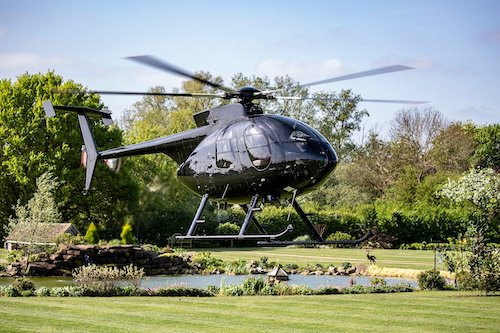
The Hughes 500/MD 500 series originated in the early 1960s, driven by a U.S. Army requirement for a Light Observation Helicopter (LOH). Hughes' Model 369 was selected, leading to the maiden flight of the OH-6 Cayuse on February 27, 1963. Concurrently, Hughes developed a civilian variant, the Hughes 500. In 1976, the Hughes 500D became the primary model, incorporating an engine upgrade, a T-tail, and a five-blade main rotor. In January 1984, Hughes Helicopters was acquired by McDonnell Douglas, which subsequently rebranded the 500E and 530F variants. The civil helicopter lines were later sold to MD Helicopters in early 1999 following the merger between Boeing and McDonnell Douglas.
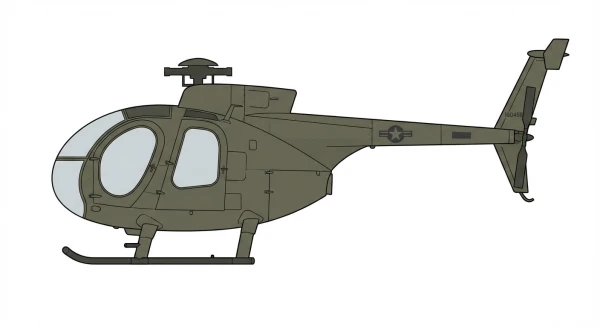
The MD 500 series features shock-absorbing landing skid struts, a turboshaft engine positioned at a 45-degree angle toward the rear, a fuel cell beneath the floor, and the battery in the nose. The engine exhaust is located underneath the tailboom at the end of the cabin. The design includes a short-diameter main rotor system and a short tail. The MD 520N variant incorporated the NOTAR (NO TAil Rotor) system, which replaces the conventional anti-torque tail rotor. This system directs exhaust from a fan through slots in the tailboom, utilizing the Coandă effect to counteract main rotor torque, with a controllable thruster at the tailboom's end providing yaw control.
The MD 500 series, specifically the military variants marketed as the MD 500 Defender, can be equipped with various weapons systems. For instance, during the Salvadoran Civil War, Salvadoran Air Force MD 500s were deployed as gunships, armed with XM27 7.62 mm Minigun subsystems and unguided 70mm rocket pods, alongside aerial reconnaissance and liaison roles. North Korea is alleged to have modified some acquired MD 500s into gunships, reportedly integrating Soviet-designed AT-3 Sagger anti-tank wire-guided missiles. Weapon configurations and payload capacity can vary depending on the model and user-specific modifications.
The MD 500 series has been utilized in both civilian and military capacities. The Salvadoran Air Force employed MD 500D and MD 500E variants as gunships during the Salvadoran Civil War, arming them with 7.62 mm Miniguns and 70mm rocket pods for reconnaissance and liaison missions. North Korea acquired a fleet of MD 500s through clandestine means, with allegations of some being modified into gunships, later publicly displayed during a 2013 parade in Pyongyang, exhibiting modifications for light attack roles, including the capability to fire AT-3 Sagger anti-tank missiles.
Main Variants:
-
MD 500C (369H): An improved five-seat commercial variant powered by an Allison 250-C18B engine, certified in 1966.
-
MD 500M Defender (369HM): A military export version of the MD 500, certified in 1968.
-
MD 500D (369D): A commercial version introduced in 1976, equipped with an Allison 250-C20B engine.
-
MD 520N: A NOTAR (NO TAil Rotor) version of the 500E, certified in 1991, using the NOTAR system instead of a conventional tail rotor.
-
MD 530F (369F): A version optimized for "hot and high" conditions, certified in 1984 and powered by a Rolls-Royce (formerly Allison) 250-C30HU engine.