MiG-19 Farmer
Soviet fighter jet, operational during the Cold War, notably used in various conflicts like the Vietnam and Indo-Pakistan Wars. Key figures: top speed 1,455 km/h, range 2,200 km, service ceiling 17,500 m, max takeoff weight 8,832 kg, unit price $2M, built 2,172. In service with 5 air forces as of 2026 — North Korea (97), Bangladesh (9), Sudan (8) and 2 others.
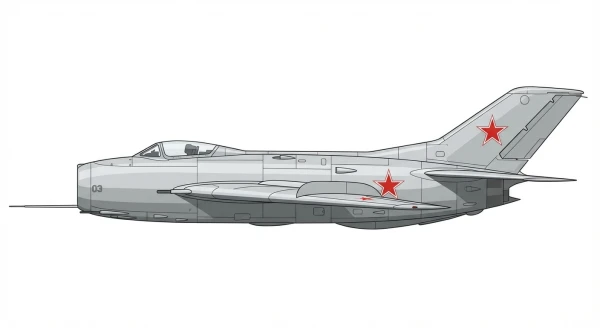
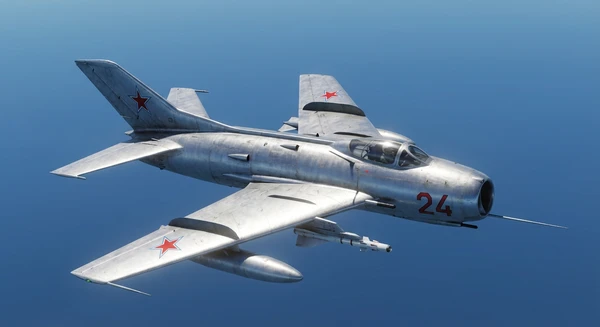
| Crew | 1 |
| Length | 12.5 m (41.1 ft) |
| Wingspan | 9.2 m (30.2 ft) |
| Height | 3.9 m (12.7 ft) |
| Wing area | 25.2 m² (270.8 sqft) |
| Empty weight | 5,447 kg (12,009 lbs) |
| Max. takeoff weight | 8,832 kg (19,471 lbs) |
| Powerplant | 2 × turbojets Tumansky RD-9B 3,243 kgf each |
| Ejection seat | Severin KS-1 |
| Maximum speed | 1455 km/h (Mach 1.46) |
| Operational range | 2,200 km (1,367 mi) |
| Service ceiling | 17,500 m (57,415 ft) |
| Climb rate | 180.0 m/s (590.6 ft/s) |
| Takeoff distance | 900 m (2,953 ft) |


Description
From the introduction of the MiG-17 Fresco, Soviet aircraft manufacturers began working on a new generation of fighters capable of reaching and sustaining supersonic speeds in horizontal flight. This led to the development of the MiG-19 Farmer.
Design
The MiG-19 displayed excellent performance, surpassing that of the F-100 Super Sabre. However, early versions suffered from significant reliability issues. Its landing was treacherous, control at supersonic speeds was difficult, and poor fuel tank insulation caused mid-air explosions. Most of these flaws were discovered during test flights, but due to the urgent need for production, they were later rectified on in-service aircraft.
In 1956, an improved version called the MiG-19S Farmer-C entered service in the Russian Air Force. The MiG-19S underwent several aerodynamic modifications to enhance stability and was equipped with a longer-range "Svod" radar. The MiG-19S was quickly replaced by the MiG-19P version, featuring an "Izumrud" radar that required modifications to the nose of the aircraft and the removal of one of its three cannons. Not only was this radar unreliable, but its installation also diminished the aircraft's performance and cockpit visibility.
Armament
The MiG-19 Farmer's armament varied depending on the version and could consist of two or three highly effective NR-23 or NR-30 cannons, as well as rocket pods, bombs, and later on, K-13 / AA-2 Atoll Sidewinder air-to-air missiles. The MiG-19 proved its capabilities in combat during the later stages of the Vietnam War against American fighters.
Operational History
However, the MiG-19 gained a poor reputation among Soviet pilots, which led to its replacement by the iconic MiG-21 Fishbed. Nevertheless, China produced approximately 3,000 MiG-19 aircraft under license at the Shenyang workshops, designated as the J-6. Some J-6 aircraft were exported and designated as F-6. The MiG-19 remained in service for a considerable period in countries of the former Warsaw Pact.
Frequently Asked Questions
What type of aircraft is the MiG-19 Farmer?
What is the maximum speed of the MiG-19 Farmer?
What is the range of the MiG-19 Farmer?
When did the MiG-19 Farmer first fly?
How many MiG-19 Farmer have been built?
Which countries operate the MiG-19 Farmer?
How much does a MiG-19 Farmer cost?
What is the service ceiling of the MiG-19 Farmer?
- AUG 122026 Updated Range corrected to the ferry range with drop tanks
- AUG 52026 Updated Thrust updated
- AUG 12026 Updated Manufacturer updated
- JUL 232026 Updated Sources and cross-references refreshed
- APR 72026 Updated Sources and cross-references refreshed
- JAN 242026 Updated Thrust updated
- JAN 122026 Updated Range updated in a site-wide editorial pass