T-45 Goshawk
British-American trainer jet, integral to U.S. Navy pilot training, operational since the late 20th century. Key figures: top speed 1,038 km/h, range 1,300 km, service ceiling 12,954 m, max takeoff weight 6,387 kg, unit price $21M, built 221. In service with 1 air force as of 2026 — United States (189).
| Crew | 2 |
| Length | 12.0 m (39.3 ft) |
| Wingspan | 9.4 m (30.8 ft) |
| Height | 4.1 m (13.4 ft) |
| Wing area | 17.7 m² (190.5 sqft) |
| Empty weight | 4,460 kg (9,833 lbs) |
| Max. takeoff weight | 6,387 kg (14,081 lbs) |
| Powerplant | 1 × turbojet Rolls-Royce-Turbomeca F405-RR-401 2,507 kgf each |
| Ejection seat | Martin-Baker Mk 14 |
| Maximum speed | 1038 km/h (Mach 1.04) |
| Operational range | 1,300 km (808 mi) |
| Service ceiling | 12,954 m (42,500 ft) |
| Climb rate | 40.6 m/s (133.2 ft/s) |

Recent Events — T-45 Goshawk
2 events →
Description
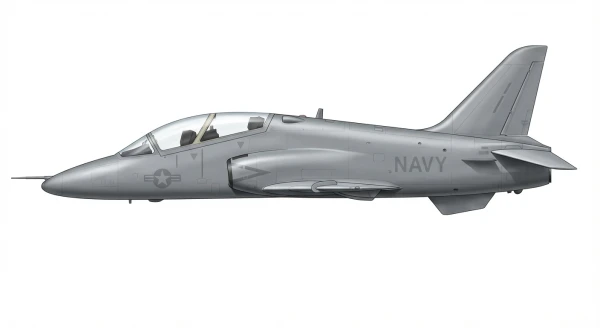
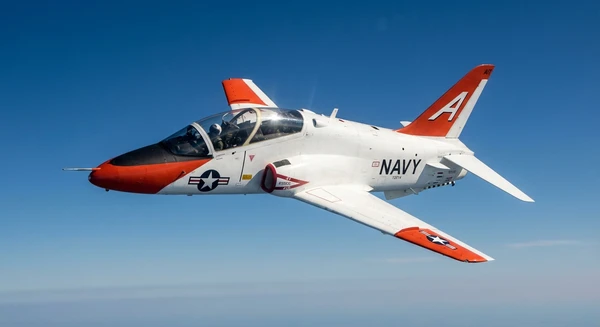
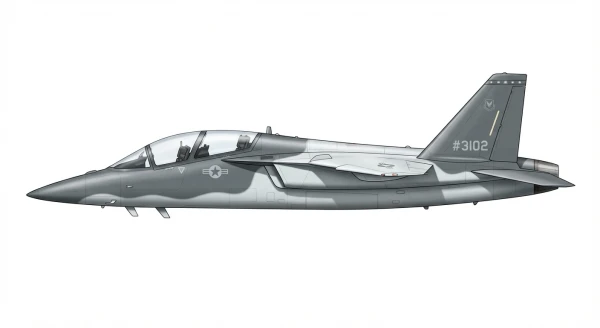
The McDonnell Douglas (later Boeing) T-45 Goshawk is a carrier-capable jet trainer developed jointly by McDonnell Douglas and British Aerospace (later Boeing and BAE Systems) from the British BAE Systems Hawk. Operated by the United States Navy and United States Marine Corps, it entered service in 1991 as the replacement for the T-2C Buckeye and TA-4J Skyhawk, and is the only jet trainer in US service qualified for catapult launches and arrested landings.
Development
The US Navy began searching for a single replacement for the T-2 Buckeye and TA-4 Skyhawk in the mid-1970s, formally launching the VTXTS advanced trainer programme in 1978. British Aerospace and McDonnell Douglas offered a navalised Hawk against bids including the Dassault/Dornier Alpha Jet and a Lockheed submission. The competition covered the aircraft, simulators, academic materials, logistic support and programme management; McDonnell Douglas was prime contractor, BAe the airframe subcontractor, Rolls-Royce supplied the Adour engine and Sperry the simulators. The Hawk was selected in November 1981, with a Full Scale Engineering Development contract awarded in September 1982; roughly 60 per cent of the work was performed in Britain. The first T-45A flew on 16 April 1988. BAE Systems built the aft fuselage, air inlets and vertical stabilizer at Samlesbury and the wings at Brough, with final assembly by Boeing at St. Louis, Missouri, transferred from Long Beach, California. A T-45A flew with the ITEC F124 turbofan on 7 October 1996, but the Adour was retained. The 200th aircraft was delivered on 16 March 2007 and the 221st and final aircraft in November 2009.
Design
The T-45 is derived from the Hawk Mk.60, with strengthened landing gear and airframe for catapult launches and 4.3 m/s (14 ft/sec) sink-rate landings. Changes include a catapult tow bar on the twin-wheel nose gear oleo strut, an arresting hook, increased-span tailplane, side-mounted airbrakes and SMURFS stabilator vanes. Navy flight evaluation led to a ventral fin ahead of the hook, a 6-inch fin extension, squared wingtips and leading-edge slats. The short catapults and arrester gear of the training carrier USS Lexington drove much of the design. Power comes from one Rolls-Royce Turbomeca F405-RR-401 turbofan rated at 5,527 lbf. Avionics include the AN/ASN-180 navigation guidance system, AN/ARN-144 VOR/ILS, AN/APN-194 radar altimeter, AN/ASN-166 inertial guidance set with LN-100G ring laser gyro and GPS, AN/ARC-182 radio and AN/APX-100 IFF. From 2008, 19 T-45Cs received a virtual mission training system simulating the APG-73 radar for Super Hornet and EA-18G rear-crew training.
Armament
The T-45 normally carries no weapons. One hardpoint under each wing can carry practice bomb racks with up to 12 Mk-76 practice bombs, rocket pods or 156 US gal drop tanks, while a centerline hardpoint accepts a baggage cargo pod.
Operational History
The T-45 serves with Training Air Wing One at NAS Meridian, Mississippi, and Training Air Wing Two at NAS Kingsville, Texas, with Naval Flight Officer training added at Training Air Wing Six, NAS Pensacola, in 2008. Naval Air Systems Command operates a small number at NAS Patuxent River. Export marketing to Australia, Israel, Greece and India produced no orders. In April 2017 the fleet was grounded after more than 100 instructor pilots refused to fly over hypoxia incidents attributed to the Cobham GGU-7 oxygen system; restrictions were fully lifted in August 2017 following monitoring and water-separation upgrades, and GGU-25 units were later fitted. The fleet was grounded again on 14 October 2022 for two weeks over a low-pressure compressor blade fault. About 34 aircraft have been lost in accidents. Service is planned to continue to 2035 or later.
Variants
- T-45A: Initial production two-seat trainer with analog cockpit, operational from 1991.
- T-45B: Proposed land-based Hawk with US Navy cockpit and no carrier capability, abandoned in 1984 in favour of TA-4J and T-2C updates.
- T-45C: Glass-cockpit version with HUD and inertial navigation, first delivered December 1997; all T-45As were converted to this standard from 2003.
- T-45D: Tentative designation for a proposed upgrade with manufacturing improvements and helmet-mounted displays.
Frequently Asked Questions
What type of aircraft is the T-45 Goshawk?
What is the maximum speed of the T-45 Goshawk?
What is the range of the T-45 Goshawk?
When did the T-45 Goshawk first fly?
How many T-45 Goshawk have been built?
Which countries operate the T-45 Goshawk?
How much does a T-45 Goshawk cost?
What is the service ceiling of the T-45 Goshawk?
- SEP 52026 Updated Overview rewritten: development, carrier modifications, groundings and fleet status
- AUG 12026 Updated Manufacturer updated
- JUL 232026 Updated Sources and cross-references refreshed
- APR 72026 Updated Sources and cross-references refreshed
- JAN 122026 Updated Range updated in a site-wide editorial pass