F-16 Fighting Falcon vs Mitsubishi F-2
F-16 Fighting Falcon vs Mitsubishi F-2 at a glance — top speed 2,178 vs 2,124 km/h, range 4,217 vs 4,000 km, max takeoff weight 19,200 vs 22,090 kg, built 4,604 vs 98 units.
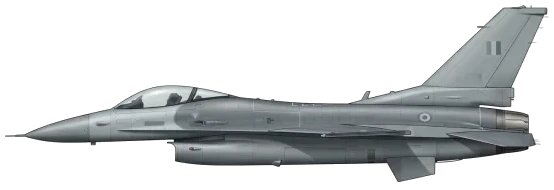
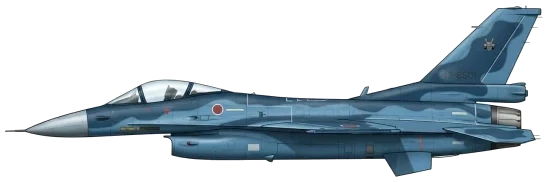
| F-16 Fighting Falcon | Mitsubishi F-2 | |
|---|---|---|
| Origin country | 🇺🇸 United States | 🇯🇵 Japan |
| Category | Combat Aircraft | Combat Aircraft |
| Manufacturer | General Dynamics | Mitsubishi |
| First flight | 2 February 1974 | 7 October 1995 |
| Year introduced | 1978 | 2000 |
| Number produced | 4604 units | 98 units |
| Average unit price | $18.8 million | $100 million |
| Wing area | 27.9 m² | 34.8 m² |
| Wingspan | 10.0 m | 11.1 m |
| Height | 4.9 m | 4.7 m |
| Length | 15.1 m | 15.5 m |
| Maximum speed | 2178 km/h | 2124 km/h |
| Operational range | 4,217 km | 4,000 km |
| Service ceiling | 15,240 m | 17,983 m |
| Max. takeoff weight | 19,200 kg | 22,090 kg |
| Empty weight | 8,570 kg | 9,525 kg |
| Total thrust | 1 x 12,701 kgf | 1 x 13,381 kgf |
Detailed Comparison
General Dynamics developed the F-16 in the 1970s as a lightweight, daytime dogfighter, resulting in a 4,600-unit production run that defined Western multirole aviation. Two decades later, Japan's Mitsubishi Heavy Industries heavily modified the F-16 design to create the F-2, a specialized maritime strike platform tailored to counter Soviet naval threats. While the F-16 prioritizes raw agility and mass production, the F-2 scales up the airframe to integrate specific anti-ship payloads and early active electronically scanned array (AESA) radar technology.
Development and Design
The U.S. Air Force Lightweight Fighter program drove the F-16’s creation, mandating a fly-by-wire control system, relaxed static stability, and a high thrust-to-weight ratio. It was built for volume and affordability. Japan’s FS-X program, by contrast, was a compromise. Tokyo wanted an indigenous replacement for the Mitsubishi F-1, but Washington forced a co-development deal based on the F-16 to reduce trade deficits and maintain interoperability. Mitsubishi enlarged the F-16’s wing area by 25% using graphite-epoxy composites to accommodate four heavy anti-ship missiles. Mitsubishi also integrated the world's first operational AESA radar, the J/APG-1, into a wider, elongated nose, adapting the dogfighter into a maritime interdictor.
Specifications and Performances
The aerodynamic modifications fundamentally altered the F-2's flight envelope compared to the F-16. The F-16 reaches 2,410 km/h with an empty weight of 8,570 kg, maximizing energy retention in air-to-air engagements. The F-2 trades this top-end speed (2,124 km/h) for lift and payload capacity. At 9,525 kg empty, the F-2 is nearly a metric ton heavier, allowing a maximum takeoff weight of 22,090 kg—2,890 kg more than the F-16.
- The F-2's 833 km range outpaces the F-16's standard 546 km radius, a necessity for Pacific maritime patrols.
- The heavier F-2 relies on the F110-GE-129 (7,711 kgf) which struggles to offset the larger airframe's drag at high speeds compared to the F-16's F110-GE-100 (7,777 kgf).
Deployment and usage
The F-16 has logged hundreds of thousands of combat hours across Desert Storm, Allied Force, and Middle Eastern operations, primarily conducting SEAD, close air support, and air superiority missions. Its combat record includes over 70 air-to-air kills with zero losses in dogfights. The F-2 operates exclusively within the Japan Air Self-Defense Force and has never seen combat. Its deployment is strictly defensive, tasked with airspace monitoring and intercepting Russian and Chinese aircraft entering Japan's Air Defense Identification Zone (ADIZ). The F-2 fleet suffered its worst attrition from a natural disaster when the 2011 tsunami destroyed or damaged 18 airframes at Matsushima Air Base.
Conclusion
The F-16 holds the edge in contested airspace and dogfights. Its lighter weight, higher top speed, and massive global supply chain make it the superior choice for high-tempo, multi-domain operations where attrition and rapid turnaround matter. The F-2 wins definitively in the maritime strike role. Its composite wings, extended range, and bespoke integration of ASM-3 supersonic anti-ship missiles allow it to project localized naval denial that the standard F-16 cannot match without heavily penalizing its flight profile. Japan paid a 33% premium per airframe ($100 million vs $75 million) to secure a niche interceptor, sacrificing the F-16's aerodynamic purity for localized maritime dominance.
-
 United States
846
-
 Turkey
235
-
 Egypt
220
- All 24 operators →
