F-22 Raptor vs X-31 EFM Vector
F-22 Raptor vs X-31 EFM Vector at a glance — top speed 2,414 vs 1,448 km/h, max takeoff weight 38,000 vs 7,303 kg, built 195 vs 2 units.
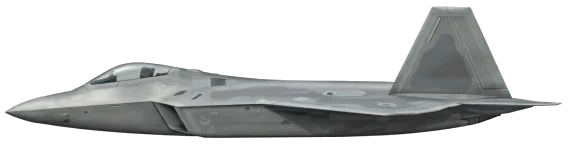
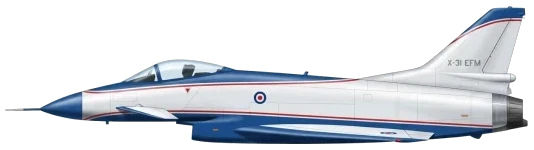
| F-22 Raptor | X-31 EFM Vector | |
|---|---|---|
| Origin country | 🇺🇸 United States | 🇩🇪 Germany🇺🇸 United States |
| Category | Combat Aircraft | Military Special Mission Aircraft |
| Manufacturer | Lockheed Martin | Rockwell-MBB |
| First flight | 7 September 1997 | 11 October 1990 |
| Year introduced | 2003 | -- |
| Number produced | 195 units | 2 units |
| Average unit price | $150 million | -- |
| Wing area | 78.0 m² | 21.0 m² |
| Wingspan | 13.6 m | 7.3 m |
| Height | 5.1 m | 4.4 m |
| Length | 18.9 m | 13.2 m |
| Maximum speed | 2414 km/h | 1448 km/h |
| Operational range | 3,220 km | -- km |
| Service ceiling | 19,812 m | 12,192 m |
| Max. takeoff weight | 38,000 kg | 7,303 kg |
| Empty weight | 19,700 kg | 5,175 kg |
| Total thrust | 2 x 15,876 kgf | 1 x 7,257 kgf |
Detailed Comparison
The F-22 Raptor and X-31 EFM Vector sit at opposite ends of aerospace development: the former is a $150 million operational stealth fighter, while the latter was an unarmed, bi-national testbed built to validate high-angle-of-attack aerodynamics. The X-31 tested extreme post-stall maneuvering in the early 1990s using 3D thrust vectoring. The F-22 integrated a conservative 2D version of that technology, combining it with low observability and supercruise to control beyond-visual-range (BVR) engagements.
Development and Design
The Advanced Tactical Fighter program (1981) birthed the F-22 to counter Soviet advances, prioritizing internal weapons bays and radar-absorbent materials to minimize radar cross-section. Lockheed Martin and Boeing utilized titanium alloys and composites to balance the aircraft's structure. In contrast, the joint US-German X-31 program (Rockwell/MBB) constructed a disposable airframe heavily reliant on off-the-shelf components, including F-16 landing gear. The X-31 utilized three external carbon-epoxy jet deflectors and movable canards to manipulate thrust directly at the exhaust, forcing the aircraft through maneuvers impossible with conventional aerodynamic control surfaces.
Specifications and Performances
The F-22 generates 31,752 kgf of thrust from twin Pratt & Whitney F119-PW-100 turbofans, driving a 38,000 kg MTOW platform to Mach 2+ speeds (2,414 km/h) and enabling sustained supercruise without afterburners. The X-31’s single General Electric F404-GE-400 engine produces 4,808 kgf of thrust for a 7,303 kg MTOW, limiting it to 1,448 km/h. While the X-31 achieved a 218 m/s climb rate to map flight control laws at low speeds and extreme angles of attack, the F-22 traded 3D vectoring paddles for 2D pitch-axis nozzles. This compromise preserved the F-22's stealth profile and thermal management while enabling a 19,812 m service ceiling and 3,000 km range.
Deployment and usage
The X-31 completed 108 flights between two airframes before the program ended in 1995, never seeing combat. Its telemetry directly informed flight control software for later fighters. The F-22 achieved Full Operational Capability in 2007, but production was permanently capped at 195 units in 2009 due to $377 million per-unit lifecycle costs and a doctrine shift toward asymmetric warfare.
The Raptor's combat record is defined by uncontested or semi-contested airspace operations:
- Forward deployments to Kadena Air Base (2007) and Europe (2014) for regional deterrence.
- Initial combat during Operation Inherent Resolve (2014), deploying GBU-32 JDAMs and acting as an airborne command node over Syria.
- Early operational groundings caused by onboard oxygen generating system (OBOGS) failures.
Conclusion
The F-22 dictates tactical combat scenarios. Its AN/APG-77 radar, low-observable shaping, and internal AIM-120 payload allow it to destroy threats long before merging into the within-visual-range arenas the X-31 was built to study. The X-31 held the edge strictly in aerodynamic research, generating the raw telemetry required to mature thrust-vectoring control laws. The X-31 fulfilled its narrow mandate as a disposable testbed, while the F-22 successfully militarized those kinematic theories but remains constrained by low fleet numbers, extreme operating costs, and a closed production line.