F/A-18 Hornet vs J-11 Responsive Dragon
F/A-18 Hornet vs J-11 Responsive Dragon at a glance — top speed 1,915 vs 2,500 km/h, range 2,017 vs 3,530 km, max takeoff weight 23,541 vs 33,000 kg, built 1,480 vs 442 units.
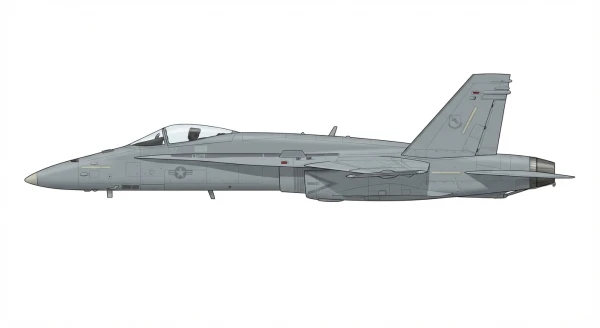
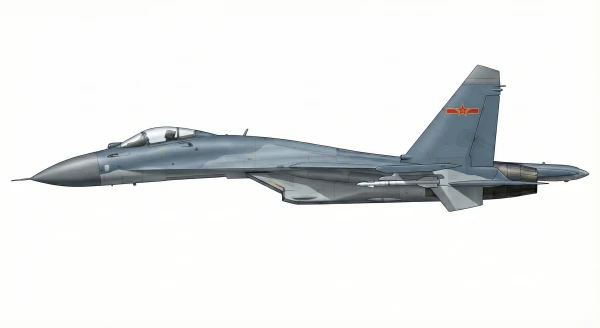
| F/A-18 Hornet | J-11 Responsive Dragon | |
|---|---|---|
| Origin country | 🇺🇸 United States | 🇨🇳 China |
| Category | Combat Aircraft | Combat Aircraft |
| Manufacturer | McDonnell Douglas | Shenyang |
| First flight | 18 November 1978 | 1 January 1998 |
| Year introduced | 1983 | 1998 |
| Number produced | 1480 units | 442 units |
| Average unit price | $29 million | $30 million |
| Wing area | 38.0 m² | 52.8 m² |
| Wingspan | 12.3 m | 14.7 m |
| Height | 4.7 m | 5.9 m |
| Length | 17.1 m | 21.9 m |
| Maximum speed | 1915 km/h | 2500 km/h |
| Operational range | 2,017 km | 3,530 km |
| Service ceiling | 15,000 m | 18,500 m |
| Max. takeoff weight | 23,541 kg | 33,000 kg |
| Empty weight | 10,433 kg | 16,380 kg |
| Total thrust | 2 x 8,051 kgf | 2 x 13,460 kgf |
Detailed Comparison
The F/A-18 Hornet and the Shenyang J-11 represent divergent paths in combat aviation, with the former being a purpose-built, carrier-capable multirole platform and the latter a land-based air superiority fighter derived from a Russian design. The F/A-18's design emphasizes mission flexibility and robustness for naval operations, while the J-11 capitalizes on the raw kinematic performance of its Su-27 lineage. This core difference in origin and intended role dictates their respective capabilities and operational employment.
Development and Design
The F/A-18 was developed for the U.S. Navy as a versatile aircraft to complement the F-14 Tomcat, blending fighter and attack roles. Its design incorporates features essential for carrier operations, such as a compact, durable airframe and foldable wings. Innovations like its digital fly-by-wire system and leading-edge extensions (LEX) provide a balance of stability for attack runs and high agility for air-to-air combat. Its evolution into the larger F/A-18E/F Super Hornet—reflected in the provided specifications—demonstrates a path of incremental, combat-driven upgrades. In contrast, the J-11's development began with a license-production agreement for the Su-27. The program shifted to a path of indigenous development with the J-11B, which integrates Chinese avionics, a lighter airframe with composite materials, and domestic WS-10 engines, representing a significant effort to create a sovereign high-performance fighter.
Specifications and Performances
The J-11 holds a distinct advantage in raw performance metrics, a direct legacy of its Su-27 airframe. It possesses a higher maximum speed (2500 km/h vs. the F/A-18's 1915 km/h), a greater service ceiling (18,500 m vs. 15,240 m), and a substantially longer range (3530 km vs. 730 km), making it a potent long-range interceptor. The F/A-18's performance is a compromise optimized for its multirole, carrier-based mission. Its strengths lie not in pure kinematics but in its sophisticated systems and payload. While the J-11's armament has evolved to include capable Chinese BVR missiles like the PL-12 and PL-15, the F/A-18 carries a broader, more mature arsenal of precision-guided munitions for air-to-ground, anti-ship, and defense suppression roles, supported by advanced targeting pods like the LITENING or ATFLIR.
Deployment and usage
The operational histories of the two aircraft are starkly different. The F/A-18 has a long and extensive combat record, serving as a primary strike and fighter asset for the U.S. Navy and Marine Corps in every major conflict since the 1980s, from the Gulf War to operations in Iraq and Afghanistan. This has proven its effectiveness and reliability across a wide spectrum of missions. The J-11's operational use has been confined to service within China's PLAAF and PLANAF. Its employment has consisted of air sovereignty patrols, exercises, and aggressive intercepts, such as the 2014 encounter with a U.S. Navy P-8 Poseidon. Its combat performance remains largely untested.
Conclusion
The F/A-18 is a combat-proven, highly versatile workhorse, whose design prioritizes multirole mission success from sea-based platforms over peak kinematic performance. The J-11, by contrast, is a formidable air superiority fighter optimized for air dominance and interception, reflecting China's strategic focus on controlling its near-abroad airspace. While the J-11's performance on paper is superior in key flight envelopes, the F/A-18's value is demonstrated by its battlefield adaptability, mature systems, and extensive operational history.