Su-30 Flanker-C vs Su-35 Flanker-E
Su-30 Flanker-C vs Su-35 Flanker-E at a glance — top speed 2,125 vs 2,400 km/h, range 3,000 vs 4,500 km, max takeoff weight 33,000 vs 34,500 kg, built 630 vs 151 units.
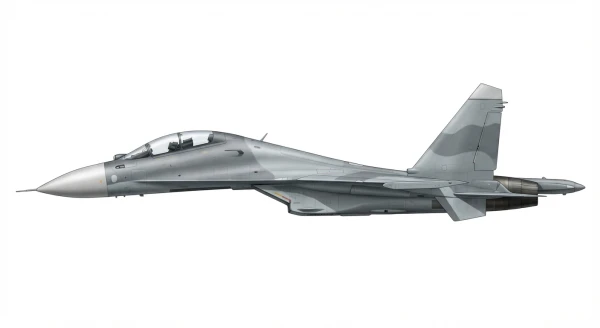
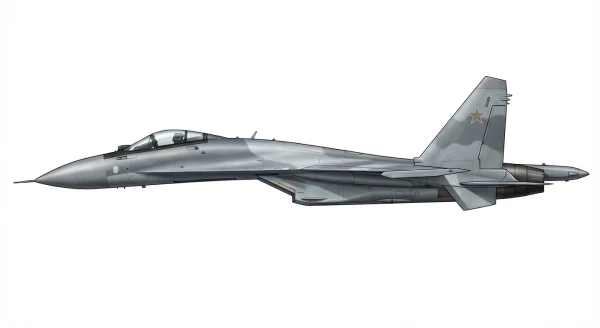
| Su-30 Flanker-C | Su-35 Flanker-E | |
|---|---|---|
| Origin country | 🇷🇺 Ex-USSR | 🇷🇺 Russia |
| Category | Combat Aircraft | Combat Aircraft |
| Manufacturer | Sukhoi | Sukhoi |
| First flight | 30 December 1989 | 19 February 2008 |
| Year introduced | 1996 | 2014 |
| Number produced | 630 units | 151 units |
| Average unit price | $37 million | $83 million |
| Wing area | 62.0 m² | 62.0 m² |
| Wingspan | 14.7 m | 15.3 m |
| Height | 6.4 m | 5.9 m |
| Length | 21.9 m | 21.9 m |
| Maximum speed | 2125 km/h | 2400 km/h |
| Operational range | 3,000 km | 4,500 km |
| Service ceiling | 17,500 m | 18,000 m |
| Max. takeoff weight | 33,000 kg | 34,500 kg |
| Empty weight | 17,700 kg | 19,000 kg |
| Total thrust | 2 x 12,500 kgf | 2 x 14,000 kgf |
Detailed Comparison
Sukhoi’s Su-30 and Su-35 diverge fundamentally in crew architecture and mission priority. The Su-30 utilizes a tandem-seat layout, distributing the cognitive load of strike and electronic warfare tasks between a pilot and a weapon systems officer (WSO). The Su-35 reverts to a single-seat configuration, relying on high-automation avionics and the Irbis-E passive electronically scanned array (PESA) radar to manage an air-superiority-first mission profile.
Development and Design
Developed in the 1990s, the Su-30 prioritized export markets requiring multirole platforms. Variants like India’s Su-30MKI introduced canards and thrust-vectoring nozzles to compensate for aerodynamic instability at low speeds. Sukhoi engineers eliminated canards on the Su-35, introduced in 2014, relying instead on 3D thrust-vectoring Saturn AL-41F1S engines to achieve supermaneuverability while reducing drag and radar cross-section. The Su-35 design centers around the Irbis-E radar, which tracks up to 30 airborne targets, though it lacks the active electronically scanned array (AESA) technology standard in modern Western aircraft.
Specifications and Performances
The aerodynamic refinements and powerplant upgrades of the Su-35 yield measurable kinematic advantages over the older Flanker-C. The Su-35 expands the engagement envelope:
- Maximum speed reaches 2500 km/h, outpacing the Su-30’s 2125 km/h limit.
- Engine thrust peaks at 27,400 kgf via twin AL-41F1S engines, exceeding the Su-30's 24,994 kgf.
- Unrefueled range extends to 3600 km, surpassing the Su-30 by 600 km.
Both aircraft carry up to 8,000 kg of munitions across 12 hardpoints. The Su-35, however, integrates the ultra-long-range R-37M air-to-air missile, altering its engagement capabilities against high-value airborne assets.
Deployment and usage
Sukhoi produced over 630 Su-30s, securing wide adoption across Indian, Chinese, and Algerian air forces. The Indian Air Force utilizes the Su-30MKI for nuclear delivery and border patrols. The Su-35, with 151 units built, commands Russia's domestic air combat fleet. In Syria, Su-35s flew escort profiles for strike packages, while Su-30SMs executed direct ground attacks. During the invasion of Ukraine, both platforms suffered verified losses to ground-based air defenses, exposing vulnerabilities in their electronic warfare suites. The Su-35’s export trajectory collapsed recently; impending CAATSA sanctions from the United States forced Indonesia and Egypt to cancel procurement contracts, leaving China as its only foreign operator.
Conclusion
The Su-35 holds the absolute advantage in beyond-visual-range (BVR) air-to-air engagements. Its combination of the Irbis-E radar, R-37M integration, and higher kinematic performance dictates the terms of engagement before the Su-30 can detect it. However, the Su-30 remains the more practical platform for low-altitude interdiction and anti-ship missions. A single pilot in a Su-35 will experience task saturation managing sensors, countermeasures, and precision ground ordnance simultaneously. The Su-30’s WSO divides this workload, making the older, $37 million aircraft a more cost-effective strike asset than the $83 million Su-35.