Leopard 2 vs Type 10
Leopard 2 vs Type 10 at a glance — weight 62,500 vs 48,000 kg, top speed 70 vs 70 km/h, range 340 vs 500 km, crew 4 vs 3 (commander, gunner and driver).
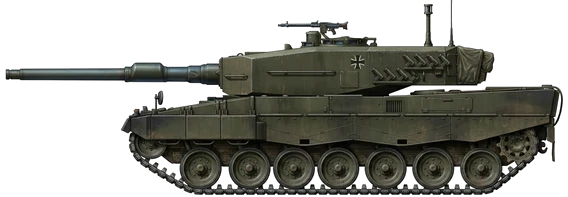
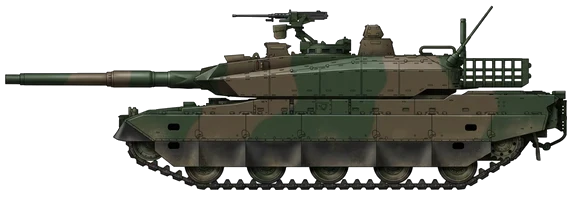
| Leopard 2 | Type 10 | |
|---|---|---|
| Origin country | 🇩🇪 Germany | 🇯🇵 Japan |
| Category | Main Battle Tank | Main Battle Tank |
| Type | Heavy Main Battle Tank | Main battle tank |
| Manufacturer | Krauss-Maffei | Mitsubishi Heavy Industries |
| Number produced | 3,600 units | 117 units |
| Estimated unit price | $29 million | $11.3 million |
| Combat weight | 62.5 tons | 48.0 tons |
| Maximum speed | 70 km/h | 70 km/h |
| Operational range | 340 km | 500 km |
| Length | 9.97 m | 9.49 m |
| Width | 3.76 m | 3.24 m |
| Height | 3.00 m | 2.30 m |
| Crew | 4 | 3 (commander, gunner and driver) |
| Leopard 2 | Type 10 | |
|---|---|---|
| Main armament | Rheinmetall 120 mm L/55 | Japan Steel Works 120 mm L/44 calibers-long smoothbore cannon with automatic loader |
| Secondary weapon | 7.62 mm MG3A1 or 7.62 mm FN MAG | Type 90 12.7 mm machine gun |
| Engine | MTU MB 873 MTCA Diesel Engine with 1500 hp | 4-stroke 22.6-litre diesel V8 MHI 8VA34WTK 1,200 hp/2,300 rpm |
Detailed Comparison
Krauss-Maffei’s Leopard 2 is a 62.5-ton Cold War heavy platform iteratively upgraded over four decades to counter armored threats across Europe and the Middle East. Mitsubishi’s Type 10 is a 48-ton, fourth-generation vehicle built strictly for the Japanese Ground Self-Defense Force, prioritizing network integration and domestic infrastructure constraints over raw mass.
Development and Design
The Leopard 2 emerged in 1979 from West German requirements for a heavy main battle tank. Its design prioritizes frontal arc protection and manual crew operations, expanding to 3,600 units across NATO and global partners. The Type 10, entering service in 2012, was developed under the TK-X project because the older Type 90 lacked internal volume for the 10NW C4I system. Mitsubishi engineered a localized platform utilizing a three-man crew and an autoloader, capping production at 117 units due to Japanese export restrictions and budget constraints.
Protection and Firepower
The Leopard 2 mounts the Rheinmetall 120 mm L/55 smoothbore in its later variants, generating higher muzzle velocity for kinetic penetrators than the Type 10’s Japan Steel Works 120 mm L/44. The Japanese tank offsets this with an autoloader cycling a round every 3.5 seconds. Protection architectures differ based on weight allowances:
- The Leopard 2 relies on passive spaced multilayer armor augmented by wedge-shaped appliqué. Combat in Syria and Ukraine exposed a structural vulnerability: secondary ammunition stored in the hull lacks blow-off panels, risking catastrophic detonation if the hull is breached.
- The Type 10 utilizes modular ceramic composite armor with integrated top-attack protection against explosively formed penetrators. Its 48-ton total mass mathematically limits its base kinetic energy defeat capabilities against large-caliber penetrators compared to the 62.5-ton German tank.
Mobility and Logistics
Japan limits the Type 10 to 48 tons to traverse 84% of its domestic bridges. Its 1,200 hp V8 diesel and continuously variable transmission enable 70 km/h speeds in both forward and reverse, allowing rapid shoot-and-scoot maneuvers. The 62.5-ton Leopard 2 uses a 1,500 hp MTU V12 diesel. It achieves 70 km/h forward but requires heavier recovery vehicles and wider rail gauges, complicating operations in soft soil or degraded infrastructure, as observed during mud seasons in Eastern Europe.
Deployment and Combat Record
The Type 10 has no combat record, with deployment restricted to the Japanese archipelago. The Leopard 2 possesses a dense operational history. ISAF deployments in Afghanistan validated its mine resistance. Turkish A4 variants in Syria suffered heavily from Kornet ATGMs, exposing weak side armor. In the Russo-Ukrainian War, Leopard 2A4 and 2A6 models faced dense minefields, Lancet loitering munitions, and Ka-52 strikes. While the platform absorbs frontal hits, mobility kills from mines frequently force crew abandonment.
Conclusion
The Leopard 2 holds the edge in high-intensity, peer-on-peer European conflicts where heavy frontal armor, L/55 kinetic overmatch, and established multinational supply chains dictate attrition rates. The Type 10 wins in confined, infrastructure-poor island defense scenarios. Its 14.5-ton weight advantage, 70 km/h reverse speed, and integrated C4I make it a superior localized ambush platform, whereas the Leopard 2's mass becomes a logistical liability outside developed road networks.