M1A1 Abrams vs T-90
M1A1 Abrams vs T-90 at a glance — weight 63,000 vs 48,000 kg, top speed 66 vs 60 km/h, range 465 vs 550 km, crew 4 vs 3.
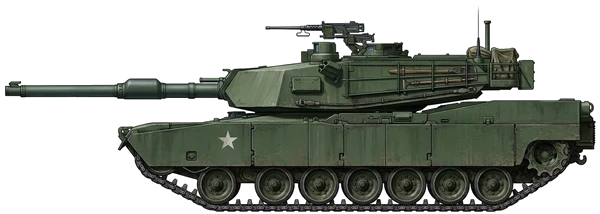
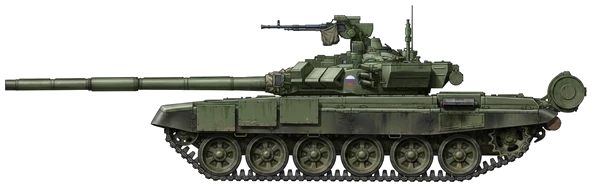
| M1A1 Abrams | T-90 | |
|---|---|---|
| Origin country | 🇺🇸 United States | 🇷🇺 Russia |
| Category | Main Battle Tank | Main Battle Tank |
| Type | Heavy Main Battle Tank | Medium Main Battle Tank |
| Manufacturer | General Dynamics Corp. | Malyshev HMB Plant |
| Number produced | 9,200 units | 4,000 units |
| Estimated unit price | $4.3 million | $4.5 million |
| Combat weight | 63.0 tons | 48.0 tons |
| Maximum speed | 66 km/h | 60 km/h |
| Operational range | 465 km | 550 km |
| Length | 9.83 m | 9.63 m |
| Width | 3.65 m | 3.78 m |
| Height | 2.43 m | 2.22 m |
| Crew | 4 | 3 |
| M1A1 Abrams | T-90 | |
|---|---|---|
| Main armament | 1 M256 120mm smoothbore barrel (40 shells) gun | 2A46M-5 125 mm smoothbore gun |
| Secondary weapon | 1 M-2HB 12.7mm machine gun (1000 rounds) | 12.7mm Kord Heavy machine gun |
| Engine | AGT-1500 Turbine with 1500 hp | V-92S2F |
Detailed Comparison
At 63 tons, the American M1A1 Abrams outweighs the 48-ton Russian T-90 by 15 tons, a mass differential that dictates their respective combat applications. The M1A1 relies on mass, volume, and passive kinetic energy absorption to protect its crew. The T-90 prioritizes a low profile, automated systems, and explosive reactive armor (ERA) to achieve protection within a lighter, more easily transportable envelope.
Development and Design
The M1A1 evolved from the terminated US-West German MBT-70 project, scaling up the 1980 baseline M1 with a 120mm Rheinmetall-derived gun and depleted uranium (DU) armor inserts. General Dynamics produced 9,200 units, standardizing a four-man crew with a manual loader. The T-90 emerged as a cost-effective synthesis to replace Soviet-era armor, merging the T-72's hull and autoloader with upgraded fire control systems. Entering service in 1992, Russian plants produced 4,000 units. The T-90 restricts its crew to three, reducing internal volume and limiting vehicle height to 2.22 meters compared to the Abrams' 2.43 meters.
Protection and Firepower
The Abrams integrates Chobham composite armor and DU arrays, achieving high baseline kinetic and chemical energy resistance. Its M256 120mm smoothbore gun fires single-piece ammunition stored in an isolated turret bustle. The T-90 offsets its thinner base steel and composite armor with Kontakt-5 or Relikt ERA to disrupt incoming projectiles, supplemented by the Shtora active protection system. Its 125mm 2A46M-5 gun employs a carousel autoloader positioned beneath the turret ring. This configuration allows the firing of AT-11 anti-tank guided missiles but introduces structural disparities in survivability:
- Hull penetrations in the T-90 frequently ignite the unprotected ammunition carousel, resulting in catastrophic turret separation.
- The M1A1 isolates its 40 main gun rounds behind blowout panels, venting explosions outward to keep the crew intact.
Mobility and Logistics
Powered by a 1,500 hp AGT1500 gas turbine, the M1A1 reaches 66 km/h but consumes fuel at high rates, limiting operational range to 465 km. The turbine requires specialized maintenance and a heavy logistics tail. The T-90 uses a V-92S2F diesel engine, yielding a 550 km range and a maximum speed of 60 km/h. At 48 tons, the T-90 crosses lighter bridges and utilizes standard rail transport infrastructure more readily than the 63-ton M1A1.
Deployment and Combat Record
The M1A1 destroyed Iraqi armor during the 1991 Gulf War with zero losses to enemy tank fire. In urban environments like Iraq and Yemen, it proved vulnerable to flanking infantry anti-tank weapons. The T-90 sustained hits from older TOW missiles in Syria, where its ERA prevented hull breaches. However, the Russian invasion of Ukraine exposed severe limitations in the T-90's design. Top-attack munitions and drones systematically bypass its ERA, while modern ATGMs defeat its base armor.
Conclusion
The M1A1 Abrams holds a clear advantage in direct armored combat and crew survivability. Its isolated ammunition storage ensures the crew survives hull penetrations, a metric where the T-90 consistently fails. The T-90 possesses an edge strictly in expeditionary logistics for militaries lacking heavy lift capabilities; its lighter weight and diesel engine ease transport and supply. For active battlefield engagements, the Abrams' architecture provides a higher margin of combat persistence.