Boom or Drogue: Why the RAF Tanker Sent to Saudi Arabia Cannot Refuel Its F-15s
Britain announced on September 22, 2026 that it will send a Voyager tanker to Saudi Arabia, but its hose-and-drogue pods can serve only the Typhoons and Tornados, not the 232 F-15s that make up 60 percent of the Saudi combat fleet.
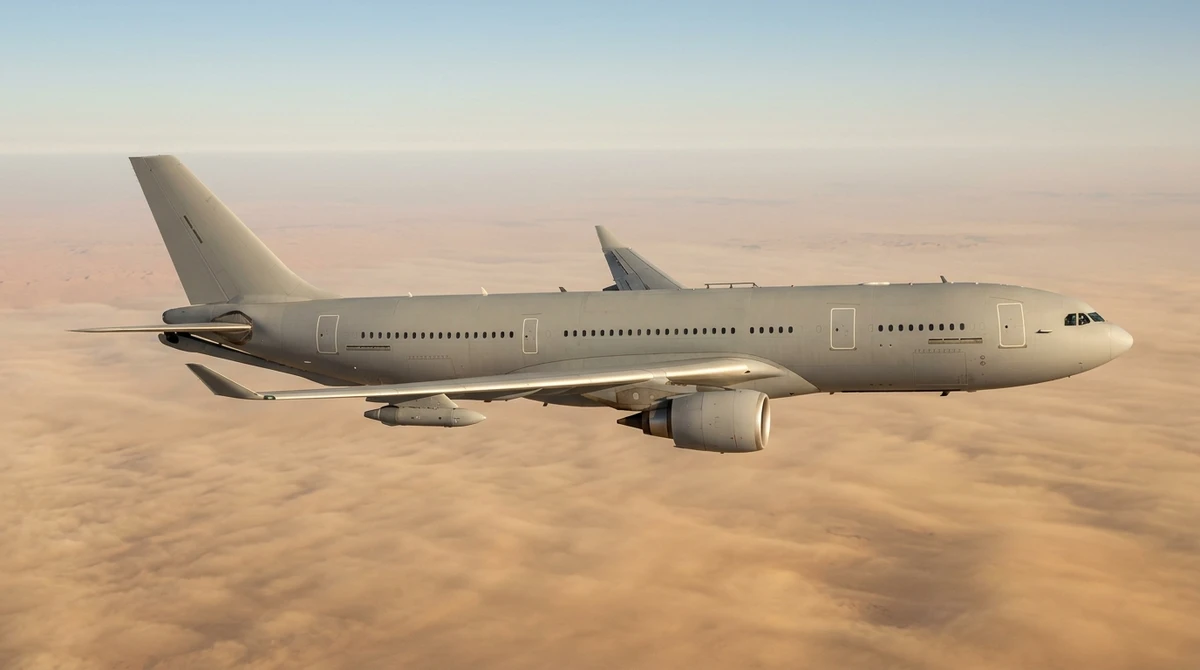
On September 22, 2026, UK Prime Minister Andy Burnham said he had approved a request from Saudi Arabia for tanker support. "We have received a request from the Kingdom of Saudi Arabia for military support, and on the advice of the defence secretary and the foreign secretary, last night I agreed to that request for defensive air-to-air refuelling," he said, according to Al Jazeera. Forces News reported that a single RAF Voyager will operate from RAF Akrotiri in Cyprus, that the mission is expected to begin within days, and that it is limited to supporting Saudi aircraft defending the country against drones and missiles, not strikes against the Houthis. The deployment is time-limited and kept under review, although officials told Forces News it could last weeks. The request comes as Al Jazeera reports that the Houthis have taken the port city of Mocha and key Red Sea islands, giving them control of the Bab al-Mandeb strait.
The choice of aircraft matters. The Voyager, the Royal Air Force's version of the Airbus A330 MRTT, refuels by hose and drogue only. It has no flying boom. That one design fact decides which Saudi jets it can serve, and it excludes the largest part of the fleet.
The flying boom is a rigid, telescoping tube mounted under the tanker's tail, fitted with movable flight control surfaces. A boom operator aboard the tanker flies it into a receptacle on the receiving aircraft while the receiving pilot holds position behind the tanker. The method moves fuel quickly: the KC-135 Stratotanker's boom transfers up to 1,000 US gallons, about 6,500 pounds, per minute, and the Aerial Refuelling Boom System of the A330 MRTT offloads up to 1,200 US gallons per minute, according to Airforce Technology. The trade-off is that a boom can refuel only one aircraft at a time. The US Air Force standardized on it, which is why its large aircraft and its fighters carry a receptacle rather than a probe.
Probe-and-drogue reverses the roles. The tanker trails a flexible hose that ends in a basket, the drogue, and the receiving pilot flies a probe fitted to the aircraft into it. On the A330 MRTT, each Cobham 905E under-wing pod delivers a maximum of 420 US gallons, or 2,800 pounds, per minute, according to Airforce Technology; with a pod under each wing, two aircraft can take fuel at once. The US Navy, the US Marine Corps and most European air forces use this method.
The two systems do not mix. An aircraft built with a receptacle cannot take fuel from a drogue; only a boom can refuel it. Some boom tankers can be fitted with a hose adapter on the boom for probe-equipped receivers, but no adapter works the other way. A boom moves fuel roughly three times as fast as a single wing pod, 1,200 against 420 gallons per minute, but only into aircraft built to take it. The point was made in June 2025, when the UK Defence Journal explained why British tankers could not refuel Israeli jets, which use the boom: "The two systems are not interchangeable. RAF Voyagers do not have booms and cannot be modified to carry them without extensive structural redesign." The RAF fleet comes in two versions, the KC2 with two Cobham 905E wing pods and the KC3 with a Cobham 805E fuselage refuelling unit added; neither carries a boom. Up to 14 Voyagers are available to the RAF under a private-finance arrangement that runs until 2035, according to The War Zone, and GMN's inventory lists the same 14.
Applied to the Royal Saudi Air Force's inventory, that limit is stark. The fleet figures that follow are GMN's 2026 inventory records. The Saudi combat fleet counts 385 aircraft:
- 232 F-15 Eagles, split between 84 F-15SA, 80 F-15C/D and 68 F-15SR, all of them boom receivers;
- 72 Eurofighter Typhoons, probe-equipped;
- 81 Tornado IDS, probe-equipped.
The Voyager can therefore refuel 153 of the 385 combat jets, about 40 percent. The 232 F-15s, 60 percent of the force and the backbone of the Saudi fighter fleet, cannot refuel from it. Whatever role Saudi planners give the British aircraft, the mechanism sets the boundary: the Voyager adds capacity only for the probe-equipped part of the fleet.
Saudi Arabia is not without tankers of its own. GMN's records list 22: six A330 MRTTs in service with four more on order, fitted with both the boom and two Cobham 905E wing pods, so able to serve the F-15s and the Typhoons on the same sortie; seven KE-3As, tankers derived from the Boeing 707; and nine KC-130 Hercules, seven KC-130H and two KC-130J, which are hose-and-drogue only. In equipment terms, the Saudi MRTTs are the same airframe as the Voyager, with the boom the British aircraft lacks.
That gap is one Britain has said it will close. On September 3, 2026, Defence Minister Luke Pollard said the RAF's probe-and-drogue capability will be "complemented by a boom system" to provide "a sovereign air-to-air refueling capability for the future Royal Air Force fleet", according to The War Zone. No timeline was given. The need is not only about allies. According to The War Zone, the RAF's own boom-dependent types are:
- the P-8A Poseidon maritime patrol aircraft;
- the RC-135W Rivet Joint signals intelligence aircraft;
- the C-17A Globemaster III transport;
- the E-7A Wedgetail airborne early warning aircraft;
- the planned F-35A.
Until a boom arrives, none of them can be refueled by a British tanker. As GMN noted in its earlier piece on the world's tanker fleets, aerial refueling remains a capability few air forces possess at all. For the weeks the Saudi deployment may last, the Voyager flying out of Akrotiri will do exactly what its hoses allow: keep the Kingdom's Typhoons and Tornados on station, while the F-15s draw their fuel elsewhere.
More News
All news →
Nuclear vs Air-Independent Propulsion: How a Submarine Runs Without Air, and What Japan Is Weighing
After Japan's defense minister declined on September 11, 2026 to rule out nuclear-powered submarines, a technical explainer on how a reactor, a Stirling engine, a fuel cell and a lithium-ion battery each keep a boat under water, and what each one buys.
Japan Will Not Rule Out Nuclear-Powered Submarines as Six Navies Field 140 Between Them
Japan's defense minister said on 11 September 2026 that nuclear-powered submarines "will not be ruled out" in the year-end revision of the country's security documents, an option that would put the JMSDF alongside the six navies operating 140 nuclear boats today.
Saudi Arabia Cleared to Buy 48 F-35 Fighters in $24.3 Billion State Department Approval
The U.S. State Department on 17 September 2026 approved a possible Foreign Military Sale of 48 F-35 Lightning II fighters and 49 F135 engines to Saudi Arabia, a package estimated at $24.3 billion that now goes to Congress for review.

Only Four Air Forces Fly High-Altitude Surveillance Drones, and Japan Has Just Lost One of Its Three
A Japan Air Self-Defense Force RQ-4B Global Hawk went down over international waters north of Tottori prefecture on 15 September 2026, the first loss of a Japanese Global Hawk and one of only 39 high-altitude surveillance drones GlobalMilitary.net records in service worldwide.
UK Confirms 2027 Steel Cut for First SSN-AUKUS Submarine and £15 Billion Warhead Investment
The UK government's Defence Nuclear Enterprise annual update, published September 15, 2026, says steel will be cut on the first SSN-AUKUS attack submarine in 2027 and confirms £15bn for the warhead program and £6bn for submarine infrastructure at Barrow-in-Furness and Raynesway.
South Korean Warships Serve in Seven Foreign Navies, but Only Three Bought Them New
Hanwha Ocean was named preferred bidder for the Royal Thai Navy's next frigate on September 9, 2026; GlobalMilitary.net's inventories count 15 Korean-designed warships in seven foreign navies, nine of them second-hand corvettes.