DHC-1 Chipmunk
Canadian tandem two-seat piston primary trainer of the late 1940s, built in Canada, Britain and Portugal, and the standard ab initio trainer of the RAF and RCAF. Key figures: top speed 222 km/h, range 417 km, service ceiling 4,816 m, max takeoff weight 998 kg, built 1,284.
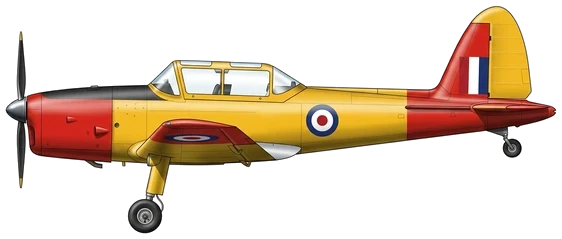
| Crew | 2 (student, instructor) |
| Length | 7.8 m (25.4 ft) |
| Wingspan | 10.5 m (34.3 ft) |
| Height | 2.2 m (7.1 ft) |
| Wing area | 16.0 m² (172.0 sqft) |
| Empty weight | 688 kg (1,517 lbs) |
| Max. takeoff weight | 998 kg (2,200 lbs) |
| Powerplant | 1 × piston engine de Havilland Gipsy Major 1C 108 kW each |
| Maximum speed | 222 km/h (138 mph) |
| Operational range | 417 km (259 mi) |
| Service ceiling | 4,816 m (15,801 ft) |
| Climb rate | 4.6 m/s (15.1 ft/s) |
Description
The de Havilland Canada DHC-1 Chipmunk is a tandem two-seat, single-engine primary trainer designed by de Havilland Canada. It first flew on 22 May 1946 and entered service the same year. The Royal Canadian Air Force (RCAF), Royal Air Force (RAF) and other air forces adopted it as their standard primary trainer, replacing the de Havilland Tiger Moth biplane. It was the company's first postwar project. Hundreds remain airworthy in civilian hands, and as of 2018 the Portuguese Air Force operated six with Esquadra 802.
Development
The design team was led by a Polish pre-war engineer. The prototype, CF-DIO-X, first flew at Downsview, Toronto, flown by a test pilot seconded from the parent de Havilland company. De Havilland Canada built 217 aircraft at Downsview, completing the last in 1956. De Havilland in the United Kingdom built 1,000 under licence, first at Hatfield and later at Hawarden. OGMA built a further 66 at Alverca, Portugal, between 1955 and 1961. Later Canadian-built aircraft received a bubble canopy in place of the multi-panelled sliding canopy. A side-by-side derivative was studied but not built, and its designation later passed to the DHC-2 Beaver. The type certificate is now held by De Havilland Aircraft of Canada Limited, founded in 2019.
Design
The Chipmunk is a cantilever low-wing monoplane with an enclosed tandem cockpit and conventional tailwheel landing gear. The airframe is mostly stressed-skin alloy. The control surfaces, and the wing aft of the spar, are fabric-covered. Anti-spin strakes and inboard stall breaker strips control spin and stall behaviour. Equipment includes:
- Hand-operated single-slotted flaps and disc brakes.
- A solid alloy propeller.
- An engine-driven vacuum pump for the instruments.
- Electric or Coffman cartridge starters.
- Radio.
The prototype used a 145 hp (108 kW) Gipsy Major IC, and production aircraft used the Gipsy Major 8. Early aircraft were semi-aerobatic, while later production was almost entirely fully aerobatic. Civilian glider tugs are often re-engined with the 180 hp (130 kW) Lycoming O-360. Maximum speed is 222 km/h and range is 417 km.
Operational History
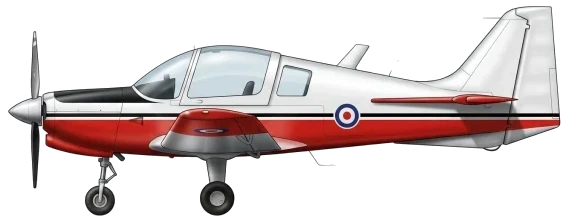
After evaluation of three aircraft at the A&AEE at Boscombe Down, the Air Ministry issued specification T.8/48 around the type, and it was selected over the Fairey Primer. The RAF received 735 Chipmunk T.10s for Reserve Flying Squadrons and University Air Squadrons. In 1958–1959, eight aircraft of No. 114 Squadron flew internal security sorties in Cyprus. From 1956 to 1990, the RAF Gatow Station Flight used Chipmunks for covert BRIXMIS reconnaissance over Berlin. Air Experience Flight use ended in 1996, when the Scottish Aviation Bulldog replaced them. In 1997, two RAF Chipmunks circumnavigated the northern hemisphere, covering 26,166 km in 64 days.
The RCAF accepted its first aircraft in 1948 and retired the type in 1972. Of its 113 aircraft, 79 served as ab initio trainers and 34 with flying clubs. Canadian-built aircraft were also exported to Egypt, Lebanon and Thailand.
Portugal received 76 aircraft from 1951 and replaced them with 18 TB 30 Epsilons in 1989. From 1997, seven Chipmunks re-engined with the O-360 conducted pilot screening with Esquadra 802; one was written off on 17 March 1998.
Variants
- DHC-1B-2-S3 (Chipmunk T.2): Canadian-built, Gipsy Major 10-powered version for RCAF refresher training with Royal Canadian Flying Clubs.
- Chipmunk T.10: British-built, Gipsy Major 8-powered version for the RAF, with 735 built.
- Chipmunk Mk 20: Military export version of the T.10 with the Gipsy Major 10 Series 2, also built by OGMA in Portugal.
- Chipmunk Mk 22: T.10 converted for civilian use.
- Super Chipmunk: Single-seat aerobatic conversion with a 260 hp (194 kW) Lycoming GO-435, revised flying surfaces and retractable landing gear.
Frequently Asked Questions
What type of aircraft is the DHC-1 Chipmunk?
What is the maximum speed of the DHC-1 Chipmunk?
What is the range of the DHC-1 Chipmunk?
When did the DHC-1 Chipmunk first fly?
How many DHC-1 Chipmunk have been built?
Which countries operate the DHC-1 Chipmunk?
What is the service ceiling of the DHC-1 Chipmunk?
- OCT 12026 Created Page created: DHC-1 Chipmunk