British Aerospace Hawk
Summary
| Category | Military Training Aircraft |
| Origin country | 🇬🇧 United Kingdom |
| Manufacturer | British Aerospace |
| First flight | 21 August 1974 |
| Year introduced | 1976 |
| Number produced | 1000 units |
| Average unit price | $18 million |
Technical specifications
| Version: Hawk | |
|---|---|
| Crew | 2 pilots |
| Operational range | 2,520 km (1,566 mi) |
| Maximum speed | 1028 km/h (639 mph) |
| Wing area | 16.7 m² (179.6 sqft) |
| Wingspan | 9.4 m (30.8 ft) |
| Height | 4.1 m (13.4 ft) |
| Length | 11.9 m (38.9 ft) |
| Service ceiling | 15,000 m (49,213 ft) |
| Empty weight | 3,635 kg (8,014 lbs) |
| Max. takeoff weight | 8,340 kg (18,387 lbs) |
| Powerplant | 1 x Rolls-Royce/Turboméca Adour 151 delivering 2420 kgf each |
Current operating countries
| Country | Units | ||
|---|---|---|---|

|
India | 119 | |

|
Saudi Arabia | 81 (+10) | |

|
Finland | 35 | |

|
Australia | 33 | |

|
United Kingdom | 28 | |

|
Indonesia | 28 | |

|
Oman | 23 | |

|
South Africa | 22 | |

|
Malaysia | 16 | |

|
United Arab Emirates | 12 | |

|
Qatar | 9 | |

|
Bahrain | 6 | |

|
Kuwait | 6 | |

|
Zimbabwe | 4 | |
All operators
Description
In 1964, the Royal Air Force identified the need for a new fast jet trainer to replace the Folland Gnat, formalized in 1970 with Air Staff Target (AST) 397. Hawker Siddeley Aviation (HSA) began preliminary studies in 1968 for a simpler aircraft, designated as special project (SP) 117 and led by Ralph Hooper. This design featured tandem seating and a combat capability to enhance export potential, and was submitted to the Ministry of Defence. On 1 October 1971, the RAF selected the HS.1182, signing a contract for 175 aircraft in March 1972. The prototype XX154, piloted by Duncan Simpson, completed its first flight on 21 August 1974, reaching 20,000 ft in 53 minutes. The Hawk T1 entered RAF service in late 1976, while the first export Hawk 50, designed as a lightweight fighter and advanced trainer, flew on 17 May 1976, offering greater weapons capacity. The Hawk was produced at BAe Brough until 2020 in the UK, and continues to be produced under licence in India by Hindustan Aeronautics Limited (HAL).
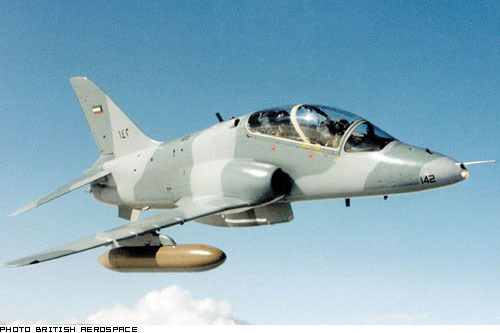
The BAE Systems Hawk is an advanced two-seat trainer notable for its tandem cockpit configuration and low-mounted cantilever wing. Designed under the leadership of Ralph Hooper, the aircraft's fuselage features a height differential between the seats, optimizing visibility for the instructor seated in the rear. Both cockpits are equipped with Martin-Baker Mk 10B zero-zero rocket-assisted ejection seats, enhancing crew safety. Power is delivered by a rear-mounted Rolls-Royce Turbomeca Adour engine, fed by intakes located on each of the forward wing roots. The aircraft was also designed to be manoeuvrable and can reach Mach 0.88 in level flight and Mach 1.15 in a dive, allowing trainees to experience transonic flight. It also features a durable airframe stressed for +9 g, with a normal limit of +7.5/-4 g in RAF service. A dual hydraulic system powers flight controls, flaps, airbrakes, and landing gear, with a ram air turbine for backup power in case of engine failure, and a gas turbine auxiliary power unit is housed directly above the engine.
The Hawk is designed to carry a centerline gun pod, typically housing a 30 mm ADEN cannon, along with two under-wing pylons. It can also accommodate up to four hardpoints for the attachment of various armaments and equipment. In Royal Air Force service, Hawks have been configured to deploy the Sidewinder air-to-air missiles. Furthermore, British Aerospace explored arming the Hawk with the Sea Eagle anti-ship missile for export purposes in the early 1990s. The Hawk T1 is capable of carrying up to 1,500 lb (680 kg) of ordnance, limited to one centerline and two wing pylons. The Hawk 128, in particular, can carry up to 6,800 lb (3,085 kg) of weapons on its five hardpoints, including up to 4× AIM-9 Sidewinder or ASRAAM or A-Darter on wing pylons and wingtip rails, as well as 2x Umbani or Al Tariq.
The Hawk has seen operational use across multiple continents and diverse military roles. In the United Kingdom, the Hawk entered Royal Air Force service in 1976, replacing the Folland Gnat and Hawker Hunter in advanced and weapons training. Some Hawks were even modified as short-range interceptors during the 1980s, armed with AIM-9L Sidewinder missiles. The Hawk also replaced the English Electric Canberra in target towing duties. Canada utilized the Hawk, designated CT-155 Hawk, for training pilots for front-line fighter aircraft until its retirement in March 2024. Finland acquired Hawk Mk. 51s in 1980 and later Mk. 66s from Switzerland, arming them with various Soviet and Western missiles, rockets, and gun pods. In India, the Hawk Mk. 132 entered service in 2008, manufactured both by BAE Systems and Hindustan Aeronautics Limited (HAL), with plans for HAL to perform upgrades and potentially export combat variants. The Indonesian Air Force has operated more than 40 Hawks since the 1980s, although further exports were blocked due to human rights concerns. Malaysia has employed Hawk 208s in combat during the 2013 Lahad Datu standoff. Saudi Arabia acquired Hawk Mk. 65/65As and later Hawk AJTs under the Al-Yamamah arms deal, some of which were assembled locally. Zimbabwe used its Hawks, acquired in the 1980s, in the Second Congo War, conducting airstrikes in support of Congolese forces, and later faced arms embargoes due to the nation's military interventions and human rights record.
Main Variants:
-
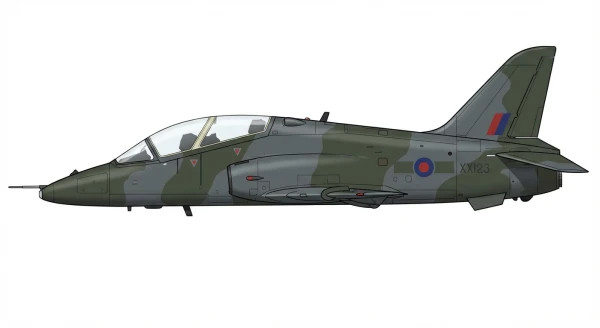
Hawk T1: The original version used by the RAF, the T1 served as an advanced trainer and weapons training platform.
-
Hawk T1A: This is a modified T1, equipped with AIM-9L Sidewinder air-to-air missiles and a 30 mm ADEN cannon for tactical weapons training, replacing the Hawker Hunter in RAF service.
-
Hawk 50: As the initial export trainer variant, the Hawk 50 also boasted a limited attack capability, appealing to nations like Finland, Indonesia, and Kenya.
-
Hawk 60: Another export version succeeding the Hawk 50, this variant featured increased weapons carriage and was designed for both conversion and weapons training purposes.
-
Hawk 100: This advanced weapons trainer has enhanced avionics, including an optional forward-looking infrared camera, a redesigned wing, and hands-on stick-and-throttle controls for superior handling.