F-15EX Eagle II vs F-35 Lightning II
F-15EX Eagle II vs F-35 Lightning II at a glance — top speed 2,655 vs 1,960 km/h, range 3,889 vs 2,800 km, max takeoff weight 36,741 vs 27,216 kg, built 154 vs 965 units.
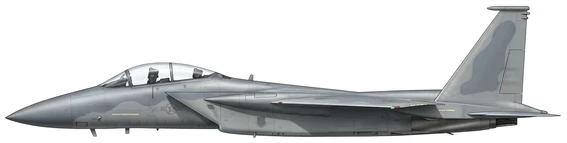
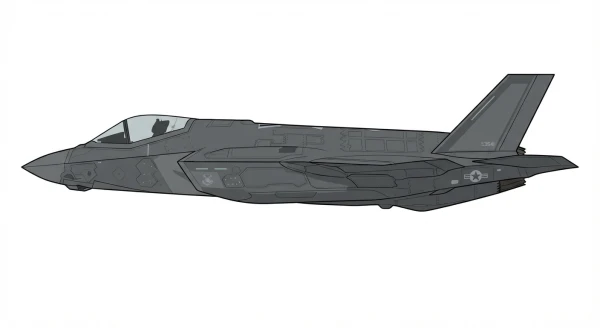
| F-15EX Eagle II | F-35 Lightning II | |
|---|---|---|
| Origin country | 🇺🇸 United States | 🇺🇸 United States |
| Category | Combat Aircraft | Combat Aircraft |
| Manufacturer | Boeing | Lockheed Martin |
| First flight | 2 February 2021 | 15 December 2006 |
| Year introduced | 2024 | 2013 |
| Number produced | 154 units | 965 units |
| Average unit price | $90 million | $103 million |
| Wing area | 56.5 m² | 43.0 m² |
| Wingspan | 13.1 m | 11.0 m |
| Height | 5.7 m | 4.4 m |
| Length | 19.4 m | 15.6 m |
| Maximum speed | 2655 km/h | 1960 km/h |
| Operational range | 3,889 km | 2,800 km |
| Service ceiling | 18,000 m | 15,000 m |
| Max. takeoff weight | 36,741 kg | 27,216 kg |
| Empty weight | 16,103 kg | 14,651 kg |
| Total thrust | 2 x 129 kN | 1 x 19,500 kgf |
Detailed Comparison
Twelve AMRAAMs on the F-15EX against four in the F-35A's internal bays is the cleanest expression of what separates these two aircraft. Boeing's Eagle II carries a 29,500 lb payload across 25 hardpoints and cruises to 3,889 km on internal fuel and CFTs; the F-35A hauls 18,000 lb only when it abandons the low-observable configuration that justifies its existence. One is a magazine, the other is a sensor node that happens to shoot.
Development and Design
The F-15EX is not a rebuilt F-15C. It descends from the Advanced Eagle line Boeing developed on Saudi and Qatari money — the F-15SA (2013) and F-15QA (2020) — which the USAF then adopted after the 2018 Mitchell Institute and OSD CAPE arguments that the F-15C fleet's longerons and wing structure could not be re-lifed affordably. The digital flight control system matters more than the marketing suggests: it unlocked wing stations 1 and 9, dormant since the 1970s for flutter reasons, taking the air-to-air load from 8 to 12. EPAWSS (AN/ALQ-250) and the APG-82(V)1 are shared with the F-15E's Radar Modernization Program, which lowers sustainment risk.
The F-35 came from JSF, where the X-35's shaft-driven lift fan beat Boeing's X-32 in 2001. Its design bet was that sensor fusion — APG-81, AAQ-37 DAS, ASQ-239 — plus all-aspect signature reduction would substitute for kinematics. The bet held; the schedule did not. Block 4 and TR-3 slipped so badly that Lockheed parked roughly 100 airframes through 2024 pending software acceptance.
Specifications and Performances
The Eagle II retains genuine performance margin: Mach 2.5, 18,000 m ceiling, 250 m/s climb, two F110-GE-129s for 258 kN. The F-35A is Mach 1.6, 15,000 m, single F135. In a beyond-visual-range fight, the Eagle's launch altitude and speed add measurable energy to an AIM-120 or AIM-260 shot — a real advantage the F-35 cannot replicate.
Against that, the F-15EX's radar cross-section is that of a 1970s airframe with conformal tanks. Inside an S-400 or HQ-9 engagement zone, that is disqualifying. The $90M unit cost versus $103M is misleading; the Eagle's cost per flying hour (~$29,000) runs well above the F-35A's, which has fallen toward $33,000 — but on a fleet approaching a thousand airframes rather than the two dozen F-15EXs delivered so far.
Deployment and usage
The F-35 has been shot at. Israeli F-35Is struck Syria from May 2018, penetrated Iranian airspace in October 2024 and again during the June 2025 strikes, and operated against Yemeni air defenses. USMC F-35Bs flew from Essex over Afghanistan in 2018. The F-15EX reached IOC on 10 July 2024 with the 142nd Wing at Portland — a homeland defense and Pacific dispersal role, not a penetrating one. Its first overseas basing follows the same logic: the first Kadena-bound airframe left St. Louis on 28 August 2026, with the permanent transition now running into FY2027.
Conclusion
The F-35 wins any contested airspace scenario, and that is most scenarios worth planning for. The F-15EX earns its place in three narrower roles: homeland alert, standoff missile truck for JASSM and future hypersonics, and NIFC-A-style arsenal plane behind F-35 sensors. The programme of record doubled to 267 aircraft in the FY2027 request of April 2026, from 129 a year earlier — a hedge against F-35 availability rates scaled up, not a competitor. Israel's December 2025 F-15IA order — placed alongside more F-35Is, not instead of them — makes the relationship explicit.