F-15I Ra'am vs F-35 Lightning II
F-15I Ra'am vs F-35 Lightning II at a glance — top speed 2,655 vs 1,960 km/h, range 4,450 vs 2,800 km, max takeoff weight 36,741 vs 27,216 kg, built 25 vs 965 units.
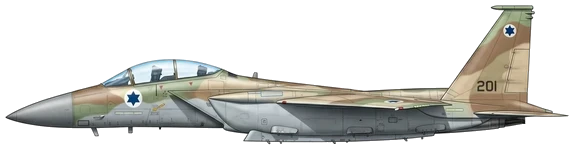
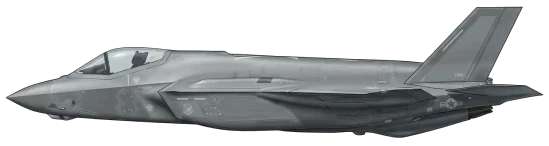
| F-15I Ra'am | F-35 Lightning II | |
|---|---|---|
| Origin country | 🇺🇸 United States | 🇺🇸 United States |
| Category | Combat Aircraft | Combat Aircraft |
| Manufacturer | McDonnell Douglas | Lockheed Martin |
| First flight | 12 September 1997 | 15 December 2006 |
| Year introduced | 1998 | 2013 |
| Number produced | 25 units | 965 units |
| Average unit price | $45 million | $103 million |
| Wing area | 56.5 m² | 43.0 m² |
| Wingspan | 13.1 m | 11.0 m |
| Height | 5.6 m | 4.4 m |
| Length | 19.4 m | 15.6 m |
| Maximum speed | 2655 km/h | 1960 km/h |
| Operational range | 4,450 km | 2,800 km |
| Service ceiling | 18,288 m | 15,000 m |
| Max. takeoff weight | 36,741 kg | 27,216 kg |
| Empty weight | 14,379 kg | 14,651 kg |
| Total thrust | 2 x 13,200 kgf | 1 x 19,500 kgf |
Detailed Comparison
Twenty-five F-15Is bought for roughly $1.76 billion in 1994 gave Israel a strike radius that no F-16 variant could match; 50-plus F-35Is bought two decades later gave it the ability to fly into defended airspace and come back. Both aircraft now fly the same missions from Israeli bases, and Operation Rising Lion in June 2025 showed exactly how the division of labour works.
Development and Design
The F-15I traces directly to the Scud campaign of January 1991, which exposed Israel's inability to hunt targets in western Iraq. Lockheed offered an F-16 derivative, McDonnell Douglas offered the F/A-18 and the F-15E; Israel chose the two-seat Strike Eagle in January 1994, adding four airframes in November 1995. The delivered aircraft is a de-rated F-15E: an APG-70I with synthetic-aperture resolution cut by about a third, no US radar warning receiver (a counterweight sits where the ALQ-128 antenna would be), and an Elisra SPS-2110 suite, new central computer and embedded GPS/INS substituted by Israel. The Elbit DASH helmet sight for both crew was, in 1998, ahead of anything the USAF flew.
The F-35 solved a different problem. The X-35 beat Boeing's X-32 in October 2001 on a requirement to replace F-16, F/A-18 and AV-8B across three services, with signature reduction, sensor fusion and the AN/ASQ-239 EW suite as the design drivers rather than payload-radius. Israel again inserted its own EW and weapons architecture into the F-35I, the only variant with sanctioned national modification rights.
Specifications and Performances
The gap is not close where it matters for reach. The F-15I carries about 10,400 kg of ordnance to roughly 4,450 km ferry range on two F100-PW-229s and conformal tanks; the F-35A carries 18,000 lb externally, but only about 2,600 kg internally if the low-observable state is to be preserved, at 2,800 km. Max takeoff weight tells the story: 36,741 kg against 27,216 kg. The Ra'am is faster (Mach 2.5 versus Mach 1.6), climbs harder, and is the only Israeli platform cleared for the GBU-28. What it cannot do is survive against modern S-300/S-400 coverage without external support.
Deployment and usage
No. 69 Squadron flew the Ra'am as a strategic asset from the outset — the 4 September 2003 flypast over Auschwitz, flown from Radom during a Polish air show deployment, was a message rather than a training sortie. Since October 2023 it has struck Hodeidah and Ras Isa 1,800 km from Israel (29 September 2024), Houthi targets in December 2024, and Iranian sites in June 2025, where it also shot down one-way attack drones and cruise missiles. The F-35I opened the type's combat account in May 2018 over Syria and, in 2025, went in first against Iranian air defences and radar sites, clearing corridors the F-15Is then used for heavy ordnance.
Conclusion
For penetrating an intact IADS, the F-35 wins outright and the F-15I is not a candidate. For delivering hard-target munitions at 1,500 km against a suppressed or absent defence, the Ra'am has no substitute in the Israeli inventory — which is why Israel signed for 25 F-15IAs in December 2025 rather than simply buying more F-35s. They are sequential, not competing.

-
 United States
724
United States
724
-
 Australia
72
Australia
72
-
 Italy
57
Italy
57
- All 20 operators →