F-16 Fighting Falcon vs J-10 Vigorous Dragon
F-16 Fighting Falcon vs J-10 Vigorous Dragon at a glance — top speed 2,178 vs 2,400 km/h, range 4,217 vs 2,950 km, max takeoff weight 19,200 vs 19,278 kg, built 4,604 vs 602 units.
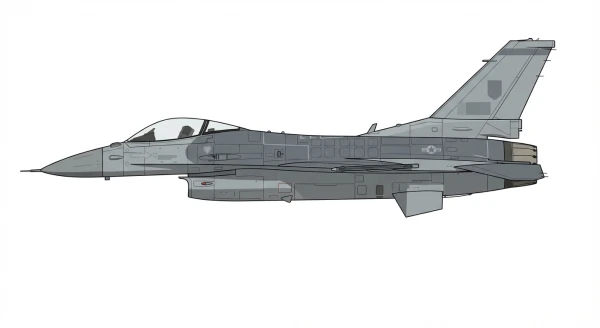
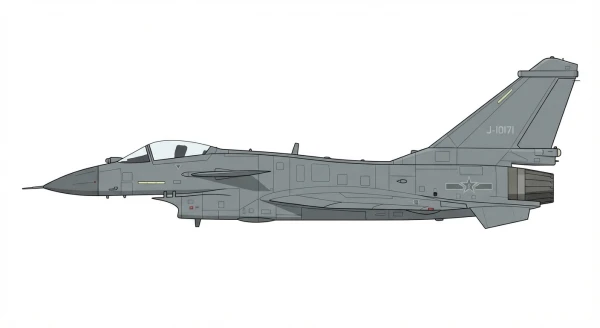
| F-16 Fighting Falcon | J-10 Vigorous Dragon | |
|---|---|---|
| Origin country | 🇺🇸 United States | 🇨🇳 China |
| Category | Combat Aircraft | Combat Aircraft |
| Manufacturer | General Dynamics | Chengdu |
| First flight | 2 February 1974 | 23 March 1998 |
| Year introduced | 1979 | 2005 |
| Number produced | 4604 units | 602 units |
| Average unit price | $18.8 million | $35 million |
| Wing area | 27.9 m² | 39.0 m² |
| Wingspan | 10.0 m | 9.7 m |
| Height | 4.9 m | 4.8 m |
| Length | 15.1 m | 15.5 m |
| Maximum speed | 2178 km/h | 2400 km/h |
| Operational range | 4,217 km | 2,950 km |
| Service ceiling | 15,240 m | 18,000 m |
| Max. takeoff weight | 19,200 kg | 19,278 kg |
| Empty weight | 8,570 kg | 9,750 kg |
| Total thrust | 1 x 12,701 kgf | 1 x 12,500 kgf |
Detailed Comparison
The Chengdu J-10 and the General Dynamics F-16 are single-engine, multirole fighters, but they originate from different eras and strategic imperatives. The F-16 is a mature, widely exported, and combat-proven design from the 1970s, while the J-10 is a more recent Chinese aircraft developed from the 1980s onward to provide the People's Liberation Army Air Force (PLAAF) with a modern, domestically produced equivalent. While both aircraft are conceptually similar, their development paths, design features, and operational histories diverge significantly.
Development and Design
The F-16 was a product of the US Air Force's Lightweight Fighter program, which prioritized agility, low cost, and technological innovation. It pioneered a relaxed static stability/fly-by-wire flight control system, a side-stick controller, and a frameless bubble canopy for superior pilot visibility. Its blended wing-body design optimizes aerodynamic efficiency.
The J-10 was developed two decades later as a key component of China's military modernization. Its defining feature is a canard-delta wing configuration, which provides high agility, particularly at high angles of attack. This design, while not unique, contrasts with the F-16’s more conventional layout. Development was a complex national effort, with reports of influence from the cancelled Israeli IAI Lavi project, which itself drew from F-16 concepts.
Specifications and Performances
On paper, the aircraft exhibit comparable performance envelopes, but with key differences. The F-16 has a higher maximum speed (2,410 km/h vs. the J-10's 2,000 km/h) and a slightly lighter empty weight (8,570 kg vs. 9,750 kg), despite both having a similar maximum takeoff weight of around 19,200 kg. This suggests a higher thrust-to-weight ratio for the F-16 under certain loadouts.
The J-10 features 11 hardpoints to the F-16's nine, potentially allowing for more flexible munitions loads. However, the F-16's primary advantage lies in its integration with a vast and battle-tested arsenal of NATO munitions. Later variants of both aircraft, such as the J-10C and the F-16V, have narrowed the technological gap by incorporating Active Electronically Scanned Array (AESA) radars and advanced beyond-visual-range missiles.
Deployment and usage
The most significant difference is their operational history. The F-16 has an extensive, decades-long combat record with the USAF and over 25 other nations, having been proven in major conflicts from Operation Desert Storm to the Balkans. Its effectiveness and reliability are well-documented.
In contrast, the J-10 has no significant combat experience. Its service has been limited to PLAAF patrols in contested areas like the South China Sea, training exercises, and a single export order to Pakistan. While it serves as a credible deterrent and a symbol of China's growing air power, its capabilities in a high-intensity conflict remain untested.
Conclusion
The F-16 Fighting Falcon is a benchmark for lightweight multirole fighters, defined by its combat-proven design, continuous evolution, and global proliferation. Its success stems from a balanced combination of performance, cost-effectiveness, and adaptability. The J-10 Vigorous Dragon represents a major milestone for China's aerospace industry, fielding a capable 4.5-generation fighter that provides the PLAAF with a modern workhorse. While its latest variants appear to be on par with upgraded F-16s in terms of sensor and weapon technology, the J-10's lack of a combat record makes a direct comparison of overall effectiveness speculative. The F-16's legacy is written in history, whereas the J-10's is still to be determined.