F-22 Raptor vs Typhoon
F-22 Raptor vs Typhoon at a glance — top speed 2,414 vs 2,495 km/h, range 3,220 vs 3,790 km, max takeoff weight 38,000 vs 23,500 kg, built 195 vs 589 units.
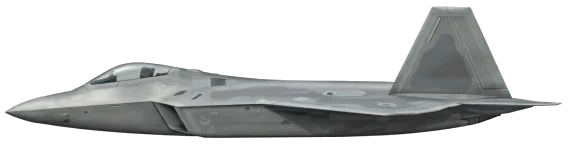
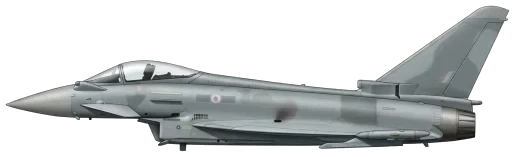
| F-22 Raptor | Typhoon | |
|---|---|---|
| Origin country | 🇺🇸 United States | 🇩🇪 Germany🇪🇸 Spain🇬🇧 United Kingdom🇮🇹 Italy |
| Category | Combat Aircraft | Combat Aircraft |
| Manufacturer | Lockheed Martin | Eurofighter |
| First flight | 7 September 1997 | 27 March 1994 |
| Year introduced | 2003 | 2003 |
| Number produced | 195 units | 589 units |
| Average unit price | $150 million | $90 million |
| Wing area | 78.0 m² | 51.2 m² |
| Wingspan | 13.6 m | 11.0 m |
| Height | 5.1 m | 5.3 m |
| Length | 18.9 m | 16.0 m |
| Maximum speed | 2414 km/h | 2495 km/h |
| Operational range | 3,220 km | 3,790 km |
| Service ceiling | 19,812 m | 16,765 m |
| Max. takeoff weight | 38,000 kg | 23,500 kg |
| Empty weight | 19,700 kg | 11,000 kg |
| Total thrust | 2 x 15,876 kgf | 2 x 9,163 kgf |
Detailed Comparison
The United States Air Force procured the F-22 Raptor strictly as a low-observable air superiority platform, legally barring its export to protect its radar-evading technology. Conversely, the Eurofighter consortium designed the Typhoon as a kinematic interceptor for European air forces, aggressively marketing it abroad to offset development costs. The F-22 dictates engagement terms through stealth, while the Typhoon relies on a canard-delta configuration and raw thrust.
Development and Design
The Advanced Tactical Fighter program birthed the F-22 to counter late-Cold War Soviet Flankers. Lockheed Martin prioritized Very Low Observable (VLO) shaping and radar-absorbent materials over payload volume, restricting the F-22 to internal weapons bays carrying six AIM-120 and two AIM-9 missiles. The Eurofighter project, fragmented by multinational procurement disputes and France's exit, produced a 4.5-generation fighter. Unburdened by a stealth requirement, European engineers maximized aerodynamics and integrated a 13-hardpoint external payload capacity. The F-22 deployed with an Active Electronically Scanned Array (AESA) radar, the AN/APG-77, at its 2005 IOC. The Typhoon flew with the mechanically scanned CAPTOR-M for two decades, only recently retrofitting AESA systems.
Specifications and Performances
Both airframes utilize twin engines to achieve supercruise, but they optimize for different flight regimes.
- The F-22 relies on Pratt & Whitney F119 engines producing 31,752 kgf of combined thrust for a 38,000 kg MTOW. Its 2D thrust vectoring nozzles grant pitch authority at high angles of attack.
- The Typhoon weighs less at a 23,500 kg MTOW, powered by Eurojet EJ200 engines. This yields a 315 m/s climb rate and a high instantaneous turn rate.
In Within Visual Range (WVR) engagements, Typhoon pilots repeatedly strip F-22s of their energy advantage during joint exercises, exploiting the canard-delta’s aerodynamics. However, the F-22 operates at a service ceiling of 19,812 m, 3,000 m higher than the Typhoon, granting its AMRAAMs higher kinetic energy at launch.
Deployment and usage
Congress capped F-22 production at 187 operational units. Its $150 million unit cost and intensive stealth maintenance severely limit its sortie generation rate. In Operation Inherent Resolve, USAF planners primarily utilized the F-22 as a forward sensor and airborne command node, vacuuming up electronic intelligence and distributing targets to legacy fighters. The Typhoon, with 589 units built, operates as a daily workhorse. Royal Air Force and Italian Air Force Typhoons executed air-to-ground strikes during the 2011 Libyan intervention using Paveway munitions. Export operators, notably the Royal Saudi Air Force, have logged thousands of combat hours conducting strike missions in Yemen, validating the airframe's transition to a strike platform.
Conclusion
The F-22 wins the Beyond Visual Range (BVR) fight on Day 1 of a peer-state conflict. Its VLO profile allows it to penetrate contested airspace and eliminate enemy airborne early warning platforms before detection. However, the Typhoon is the better platform for sustained campaigns. The integration of the MBDA Meteor ramjet missile closes the kinematic BVR gap, while its lower operating costs, external payload capacity, and established air-to-ground integration make it a functional multirole tool. An air force needing to dismantle an integrated air defense system requires the F-22; an air force needing to bomb surface targets and execute daily air policing requires the Typhoon.