Eurofighter Typhoon Tranches, Upgrade Phases and Radars
How to read a Eurofighter's tranche, Phase Enhancement package and radar fit, why Tranche 1 sits outside the common upgrade path, and which air forces fly which standard in 2026.
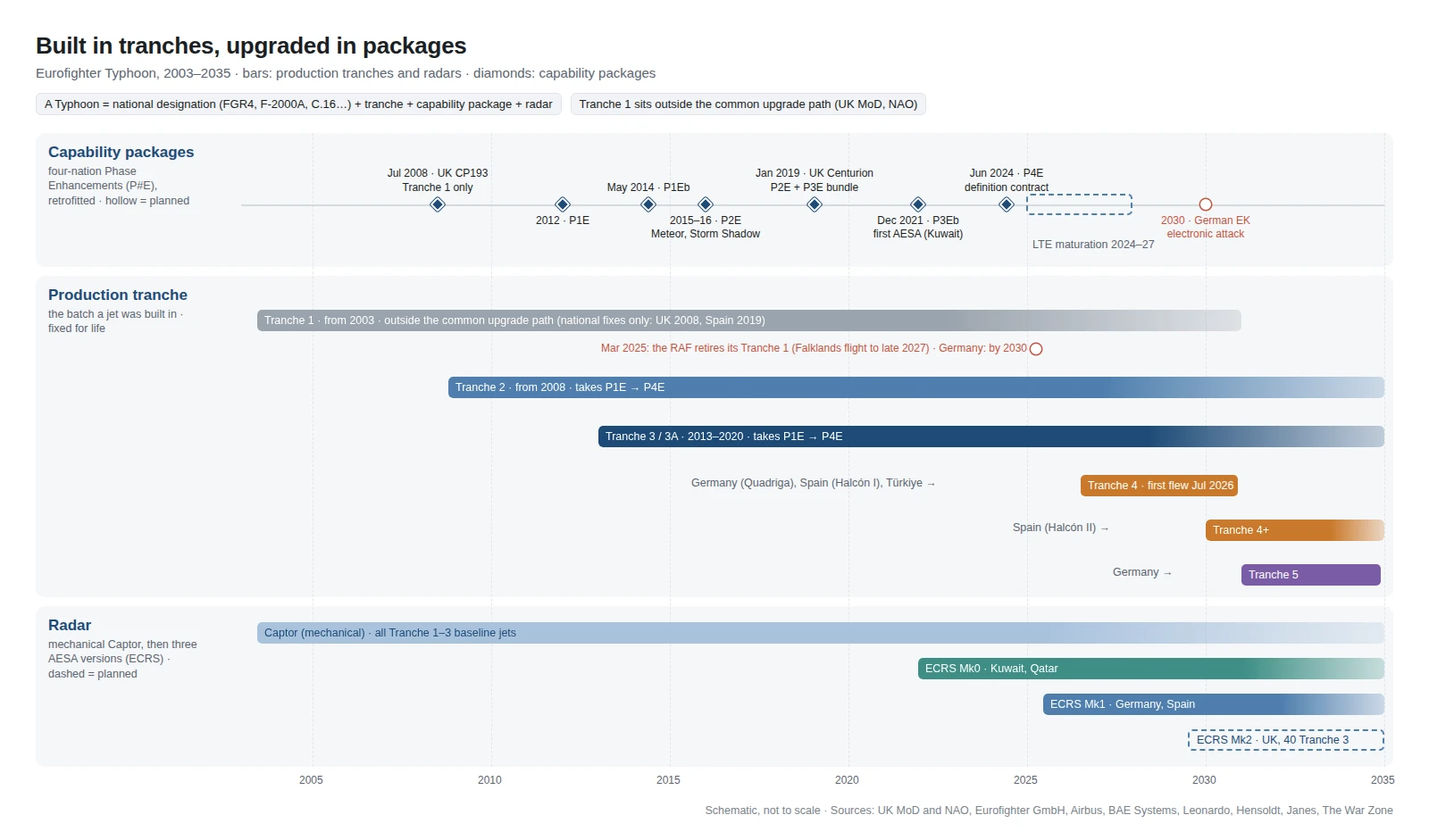
Every Eurofighter Typhoon carries three separate labels. The first says what the airframe is: the aircraft is built single- or two-seat, in a numbered production tranche, under a national designation such as the RAF's FGR4, and that never changes. The second says what it runs: a Phase Enhancement package, P1E to P4E, qualified by the four partner nations and retrofitted to aircraft in service. The third says what radar it carries: the original mechanically scanned Captor-M or one of three different ECRS electronically scanned radars, chosen by customer. The principle is the same as for the Rafale standards (GMN's Rafale guide), except that the oldest tranche was left outside the common path.
All three were changing in 2025–2026: the first German Tranche 4 aircraft flew on 14 July 2026, Germany contracted 20 Tranche 5 jets on 15 October 2025, Türkiye signed for 20 new-build aircraft on 27 October 2025, and the UK's Defence Investment Plan of 30 June 2026 committed £5.4bn to keep its 107 Typhoons flying into the 2040s.
- Tranche: a production and funding batch under a multinational contract, fixed at build. Tranches 1 to 3A were delivered to the four partners from 2003 to 2020; Tranche 4 follows from 2026, Spain's "Tranche 4+" and Germany's Tranche 5 from 2030 and 2031.
- Phase Enhancement (P#E): the four-nation capability package, qualified through NETMA and fitted to aircraft in service: P1E and P1Eb (air-to-ground), P2E (Meteor and Storm Shadow), P3E (Brimstone, then the ECRS Mk0 radar) and P4E, in system definition since 5 June 2024.
- Radar: Captor-M on every Tranche 1 to 3 aircraft as built; ECRS Mk0 for Kuwait and Qatar, Mk1 for Germany and Spain, Mk2 for the UK.
- Tranche 1: the air-to-air baseline the four-nation packages were not written for. National fixes only (UK ground attack in 2008, a partial Spanish retrofit in 2019); the RAF retired most of its Tranche 1s on 31 March 2025.
- LTE: the long-term framework after P4E (new cockpit, mission and flight-control computing, service "into the 2060s"), its scope still being defined under a three-year maturation phase signed on 19 December 2024.
National designations and seats
Within a tranche the only physical choice is between a single-seater and a two-seater, and two-seaters are trainers that keep their combat capability. The Royal Air Force flies the Typhoon FGR4 and the two-seat T3 (F2 and T1 until ground attack was added in 2008). The Italian Air Force (Aeronautica Militare) uses F-2000A and TF-2000A alongside the generic military designation EF-2000, which is not a national variant; Spain's Ejército del Aire y del Espacio says C.16 and CE.16; Germany and Austria simply say "Eurofighter" or EF2000.
| Single-seat | Two-seat | Note | |
|---|---|---|---|
| United Kingdom (RAF) | Typhoon FGR4F2 until ground attack was added in 2008 | Typhoon T3formerly T1 | Four Tranche 1 FGR4s still fly with 1435 Flight in the Falklands |
| Italy (Aeronautica Militare) | F-2000A | TF-2000A | EF-2000 is the generic military designation, not a variant |
| Spain (Ejército del Aire y del Espacio) | C.16 | CE.16 | First Tranche 3 C.16 arrived at Ala 14 on 27 July 2015 |
| Germany, Austria | Eurofighter / EF2000 | Eurofighter / EF2000 | No separate national suffix in use |
| Saudi Arabia, Oman, Kuwait, Qatar, Türkiye | Typhoon | Typhoon | No national designations in published use |
Before production came the Development Aircraft (DA) and Instrumented Production Aircraft (IPA); DA-2 made its first flight at Warton on 6 April 1994. Early production also carried Block numbers, a production standard that does not line up with the funding batches: Tranche 1 ran from Block 1 to Block 5 (PIRATE infrared sensor from Block 5), Tranche 2 from Block 8.
The production tranches
A tranche is a purchase batch, not a capability level. The UK Ministry of Defence (MoD) says both its Tranche 2 and Tranche 3 fleets will receive the same upgrades; a Tranche 4 outperforms a Tranche 2 because of the radar and standard it is built with, not its number.
Tranche 1 was the air-to-air baseline, first delivered to the RAF in June 2003. Tranche 2 followed, the first RAF aircraft delivered in October 2008, with what the National Audit Office (NAO) calls "upgraded avionics" in its 2011 report. Tranche 3 was split by the partners, who signed only Tranche 3A, 112 aircraft, in July 2009; Tranche 3B was never ordered, and the NAO describes these aircraft as the Tranche 2 baseline with the multi-role upgrade built in. The UK labels its 40 "Tranche 3" and told Parliament in 2025 that it "does not have any Tranche 3A", while Italy, Spain and Qatar count theirs as Tranche 3A.
Tranche 4 is the current production standard, built with the ECRS Mk1 radar. Germany's 38 aircraft (31 single-seat, 7 two-seat; the Quadriga program, approved by the Bundestag on 5 November 2020) began flying with 34+02 at Manching on 14 July 2026 (GMN's report on the maiden flight). They start with the radar at "Step 0", with Step 1 fitted from mid-2027, and omit the PIRATE sensor, a choice The War Zone reports was made "originally on budget grounds". Spain's Halcón I program covers 20 Tranche 4s and the UK MoD describes Türkiye's 20 as "Tranche 4 aircraft". "Tranche 4+" is Airbus's label for Spain's 25-aircraft Halcón II, reported by Janes from the 2023 International Fighter Conference: "Tranche 4 plus some improvements", which could become a full Tranche 5 if LTE production timing aligns. Tranche 5 is Germany's 20, contracted on 15 October 2025 with the ECRS Mk1 and Saab's Arexis electronic-warfare suite; Airbus defined it at the same conference as the Tranche 4 radar fit "plus elements of the LTE package".
| Orders | Deliveries | Baseline and radar | Upgrade path | |
|---|---|---|---|---|
| Tranche 1 | Four partners; Austria 15 | First to the RAF, June 2003 | Air-to-air; Captor-M | National fixes only (UK 2008, Spain 2019); outside the P#E path |
| Tranche 2 | Four partners; 24 diverted from RAF production to Saudi Arabia | First RAF aircraft, October 2008 | Air-to-air with upgraded avionics; Captor-M | P1E onward; ECRS retrofit planned (UK option on 67, Germany and Spain Mk1) |
| Tranche 3 / 3A | 3A signed July 2009: 112 for the four partnersKuwait 28, Qatar 24; 3B never ordered | UK from 2013; last UK Sept 2019, Germany Dec 2019, Italy 23 Oct 2020; Qatar from Aug 2022 | Tranche 2 plus multi-role upgrade built in; Captor-M, or ECRS Mk0 for Kuwait and Qatar | Same packages as Tranche 2; ECRS Mk2 on the RAF's 40 |
| Tranche 4 | Germany 38 (Quadriga, 5 Nov 2020); Spain 20 (Halcón I); Türkiye 20 (27 Oct 2025) | First German aircraft flew 14 Jul 2026; run through 2030; Türkiye from 2030 | ECRS Mk1 AESAGermany: Step 0, then Step 1 from mid-2027 | P4E, then LTE |
| Tranche 4+ | Spain 25 (Halcón II, 20 Dec 2024, €4.6bn) | 2030–2035 | "Tranche 4 plus some improvements" (Airbus label) | Could reach Tranche 5 if LTE timing aligns |
| Tranche 5 | Germany 20 (15 Oct 2025, €3.75bn) | 2031–2034 | ECRS Mk1 and Arexis EW suite; elements of LTE | EK fit possible from the factory |
Why Tranche 1 sits outside the upgrade path
The common upgrade path begins with Tranche 2. The NAO's 2011 table gives Tranche 1 an "Air-to-Air" baseline and Tranche 2 "Air-to-Air with upgraded avionics", and the four-nation Phase Enhancement packages were written for the Tranche 2 avionics; Janes wrote at the RAF retirement in 2025 that Tranche 1 "lacked the more advanced avionics and mission systems of later tranches". The UK paid £119m for an "austere" air-to-surface fit requested in June 2004, Paveway II laser-guided bombs (the GBU-16) with a Litening III designator pod, combat-ready in July 2008 and the origin of the FGR4 name. Spain went further: Airbus delivered the first Spanish Tranche 1 fitted with selected Tranche 2 and Tranche 3 equipment in February 2019. A partial upgrade was therefore possible, but the four-nation program did not extend to Tranche 1.
The MoD told Parliament that retiring Tranche 1 "enables the reinvestment required in the rest of the Typhoon fleet", and its Tranche 1s were never fitted for the Meteor missile. Of 30 Tranche 1 aircraft on the register in 2022–23 (the MoD's register figure; the NAO counted 53 deliveries in 2011), 26 left service on 31 March 2025 and had been scrapped by 1 July 2025, according to the ministry's written answers. The remaining four fly with 1435 Flight in the Falklands until late November or early December 2027, when four Tranche 2s replace them. Austria is the one operator whose entire fleet is Tranche 1: its 15 single-seaters (six second-hand ex-Luftwaffe), contracted in 2003 as 18 Tranche 2 jets and renegotiated down, fly at what European Security & Defence calls the "SRP 4.3" standard, with no beyond-visual-range missile and no air-to-ground capability, a baseline The War Zone calls "far harder to modernize"; 12 M-346FA light fighters, a purchase finalized on 29 November 2025, will fly alongside them. Germany plans to replace its Tranche 1s by 2030, and Italy has new-build replacements on order.
Upgrade packages and radars
Capability comes from the Phase Enhancement packages, qualified through the four-nation agency NETMA and fitted to Tranche 2 and later aircraft, and from the radar each customer chose: a package is common to the partners, a radar is national.
The Phase Enhancement packages
P1E, Stage 1 of the Tranche 2 upgrade, contracted by all four nations and delivered from 2012 (£445m for the UK, per the NAO), brought Paveway IV bombs, a designator pod and a new multi-role pilot interface. P1Eb, unveiled by Eurofighter GmbH at the ILA show on 22 May 2014, completed the air-to-ground fit with a revised human-machine interface, updates to the DASS and MIDS systems and the groundwork for Storm Shadow. P2E, in flight test in 2015 and 2016, integrated Meteor and Storm Shadow (see GMN's Meteor explainer), and P3E trials around 2016 and 2017 added Brimstone. The UK bundled P2E and P3E into Project Centurion, a £425m national program that put all three weapons on the aircraft by January 2019 to take over the full strike role of the Tornado GR4.
P3Eb, taken up by the Gulf customers, is the first standard to operate an ECRS radar, the Mk0: Kuwait was launch customer and received its first two aircraft in December 2021, and Qatar's aircraft are built to the same standard. P3Ec is UK-led, a £135m contract signed on 6 August 2021 for weapons, DASS and datalink improvements; Janes also listed the Large Area Display cockpit under P3Ec, The Aviationist places it in the LTE maturation phase, and its service entry is not dated here.
P4E is the current four-nation step, whose system-definition contract NETMA signed at ILA on 5 June 2024. Its content, as described by EDR Magazine, is automated sensor management "for all Typhoon radars", an improved cockpit interface, DASS upgrades for every customer, an initial electronic-warfare capability for Germany and an analysis of extending service life into the 2060s. For the UK, the ECRS Mk2 goes onto the Tranche 3 fleet "as part of" P4E, starting "by the end of this decade", according to the MoD. A related Aerodynamic Modification Kit (AMK), reshaped strakes and flaperons for wider weapons clearance, went to a development and certification contract on 5 February 2026.
| Date | What it added | Fitted to | |
|---|---|---|---|
| UK air-to-surface change (CP193) | Combat-ready July 2008 | Paveway II (GBU-16) and Litening III pod; £119m | RAF Tranche 1 only |
| P1E | Delivery from 2012 | Paveway IV, designator pod, multi-role pilot interface | Tranche 2 and 3, four nations |
| P1Eb | Unveiled 22 May 2014 | Full air-to-ground; revised HMI; DASS and MIDS updates; Storm Shadow groundwork | Tranche 2 and 3 |
| P2E | Flight test 2015–16 | Meteor and Storm Shadow | Tranche 2 and 3UK: Project Centurion, fitted January 2019 |
| P3E (P3Ea) | Trials 2016–17 | Brimstone precision strike | Tranche 2 and 3 |
| P3Eb | First aircraft delivered December 2021 | First standard with the ECRS Mk0 radar; Sniper pod | Kuwait, Qatar |
| P3Ec | Contract 6 August 2021, due end 2024 | Weapons, DASS and datalink improvements; £135m | UK-led, Tranche 2 and 3 |
| P4E | System definition 5 June 2024 | Sensor management for all radars, cockpit interface, DASS, Germany's EW capability; ECRS Mk2 for the UK | Four partner nations |
| LTE | Maturation phase 19 December 2024, three years | New cockpit, mission and flight-control computing, communications, armament control | Future and in-service fleets |
The three ECRS radars
"Captor-E" is not one radar: the ECRS family exists in three versions from three design authorities, for three sets of customers. ECRS Mk0, Leonardo's baseline, equips Kuwait and Qatar and entered service with Kuwait's first aircraft in December 2021. ECRS Mk1, "Radar 1", is the German and Spanish radar: Hensoldt is design authority with Indra, Airbus integrates it, and it adds a digital multi-channel receiver and wideband transmit/receive modules. Defense News reported in December 2021 that it is planned for around 130 existing German and Spanish aircraft, and it is the build standard of Tranche 4 and 5. ECRS Mk2, "Radar 2", is the UK's, a Leonardo UK and BAE Systems multi-function array with an electronic-attack capability, first flown on test aircraft ZK355 on 27 September 2024: a £2.35bn package announced on 15 July 2022, an £870m development and integration contract on 4 July 2023 and a £453m manufacturing contract in January 2026. It is destined for the 40 RAF Tranche 3 aircraft, with an option on the 67 Tranche 2s, and the MoD expects it in service "before the end of the decade"; Italy takes part in its development under a Statement of Principles. Oman's 12 aircraft keep the mechanically scanned Captor-M.
Germany's EK conversions
Germany is also converting aircraft to a new role. The Bundestag approved on 29 November 2023 the conversion of 15 Eurofighters to the EK (Elektronischer Kampf) SEAD and electronic-attack standard, replacing the Tornado ECR, with Saab's Arexis suite in the wingtip positions and the AGM-88E AARGM missile; Airbus describes the aircraft as "currently being equipped", with NATO certification targeted for 2030. Which tranche the 15 airframes come from has not been officially stated: Janes lists Tranche 2, 3 and 4 aircraft as candidates, and The Aviationist reports that Tranche 5 jets may receive the EK fit "possibly from the factory itself".
Which tranche can take what
| Tranche 1 | Tranche 2 | Tranche 3 / 3A | Tranche 4 and later | |
|---|---|---|---|---|
| Captor-M radar | As built, retained | As built | As builtexcept Kuwait and Qatar | No; ECRS Mk1 from build |
| P1E / P1Eb | NoUK national ground-attack fix, 2008 | Yes, from 2012 | Yes | Delivered from 2026, on the P4E and LTE path |
| P2E / P3E | NoRAF Tranche 1 never Meteor-fitted | YesUK: Centurion, January 2019 | Yes | Delivered from 2026, on the P4E and LTE path |
| P3Eb with ECRS Mk0 | No | Not applicable | Kuwait and Qatar, from December 2021 | Not applicable |
| P4E | No | Planned, four partner nations | PlannedUK: ECRS Mk2 as part of P4E | Yes |
| ECRS Mk1 | No | Retrofit planned, Germany and Spain | Retrofit planned, Germany and Spain | From buildStep 1 from mid-2027 |
| ECRS Mk2 | No | UK option on 67 | UK, 40 aircraft, before the end of the decade | Not stated |
| LTE | No | Framework for in-service fleets | Framework for in-service fleets | Tranche 5 carries elements of LTE |
Who flies which standard
Nine air forces fly the Typhoon and a tenth has it on order.
- United Kingdom: 4 Tranche 1, 67 Tranche 2 and 40 Tranche 3 as counted by the MoD in July 2025, "the UK's 107 Typhoons" in its June 2026 wording; Tranche 2 and 3 leave service in 2040 and there is "no plan to purchase additional Typhoon aircraft".
- Germany: 138 in service, according to Airbus, with the Tranche 1s due for replacement by 2030; 38 Tranche 4, 20 Tranche 5 and the 15 EK conversions on order.
- Italy: Tranche 1, 2 and 3A, the last of 21 Tranche 3As delivered on 23 October 2020; up to 24 new-build aircraft contracted on 23 December 2024 to replace the Tranche 1s, their tranche label not officially stated and their radar "still to be confirmed" per Aerospace Global News.
- Spain: Tranche 1 (partly upgraded from 2019), Tranche 2 and 20 Tranche 3A; 20 Tranche 4 under Halcón I and 25 "Tranche 4+" under Halcón II for 2030 to 2035.
- Austria: 15 single-seat Tranche 1 at the SRP 4.3 standard, with 12 M-346FA to come.
- Saudi Arabia: 72 aircraft, the first 24 diverted from RAF Tranche 2 production, the last delivered in June 2017; a follow-on 48 remained unsigned in February 2026, with BAE Systems officials "upbeat" about the prospect, per FlightGlobal.
- Oman: 12 aircraft, the first two delivered on 21 June 2017, with the mechanically scanned Captor-M.
- Kuwait: 28 Italian-built Tranche 3 aircraft at P3Eb with ECRS Mk0, the first two delivered in December 2021.
- Qatar: 24 Tranche 3A at P3Eb with ECRS Mk0, the first delivered in August 2022.
- Türkiye: 20 new-build aircraft worth up to £8bn, signed on 27 October 2025 with the first delivery due in 2030; the UK MoD calls them Tranche 4, Turkish reporting says "Tranche 4+", and their radar has not been officially stated. Turkish Minute, citing TurDef on 20 February 2026, reported 12 ex-Qatari Tranche 3A aircraft with ECRS Mk0 and 12 more "secured" from Qatar or Oman, none publicly confirmed delivered as of October 2026.
P4E, LTE and what comes next
UK upgrades. The £5.4bn committed in the 30 June 2026 Defence Investment Plan covers the ECRS Mk2 on the 40 Tranche 3 aircraft plus communications, avionics, cockpit and helmet upgrades for the Tranche 2 and 3 fleets, and the MoD describes LTE as "not a single procurement programme" but "the framework" for those upgrades. LTE itself began as a €53.7m study signed on 19 June 2019; the partners signed Technology Maturation Phase Part 1 on 19 December 2024 for three years, with service "into the 2060s" as the target. Its shape is still being settled: in June 2025 Aviation Week, via The Aviationist, reported the original LTE plan "placed on hold" and reframed as a mid-life update, and Eurofighter GmbH's chief executive said at the Paris Air Show that month that "the time has come" for one, "reaching the computing capacity" being the trigger; the UK and Airbus both still use the LTE name in 2026.
The new tranches have their own schedules: German Tranche 4 deliveries from late 2026 to 2030, Türkiye's first aircraft in 2030, Spain's Halcón II from 2030 to 2035 and Germany's Tranche 5 from 2031 to 2034. The UK and Italian successor program, GCAP, received its 2026 development contract.