F-35 Lightning II vs Rafale
F-35 Lightning II vs Rafale at a glance — top speed 1,960 vs 1,912 km/h, range 2,800 vs 3,700 km, max takeoff weight 27,216 vs 24,500 kg, built 965 vs 316 units.
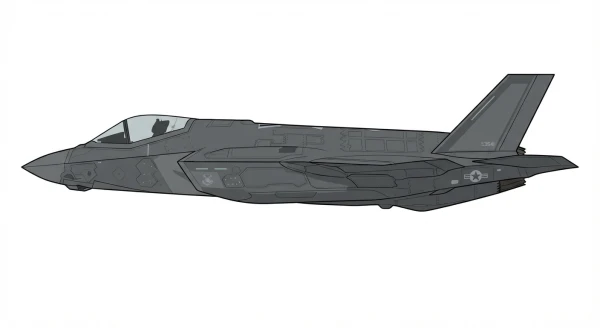
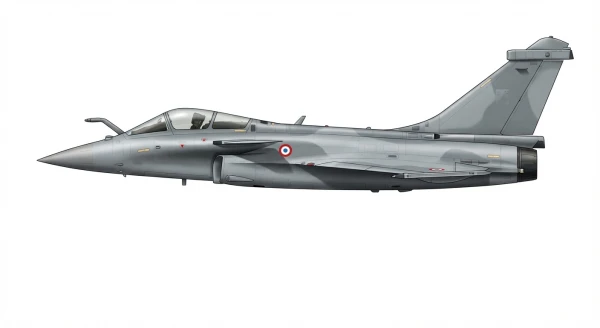
| F-35 Lightning II | Rafale | |
|---|---|---|
| Origin country | 🇺🇸 United States | 🇫🇷 France |
| Category | Combat Aircraft | Combat Aircraft |
| Manufacturer | Lockheed Martin | Dassault |
| First flight | 15 December 2006 | 4 July 1986 |
| Year introduced | 2013 | 2001 |
| Number produced | 965 units | 316 units |
| Average unit price | $103 million | $95 million |
| Wing area | 43.0 m² | 45.7 m² |
| Wingspan | 11.0 m | 10.9 m |
| Height | 4.4 m | 5.3 m |
| Length | 15.6 m | 15.3 m |
| Maximum speed | 1960 km/h | 1912 km/h |
| Operational range | 2,800 km | 3,700 km |
| Service ceiling | 15,000 m | 15,835 m |
| Max. takeoff weight | 27,216 kg | 24,500 kg |
| Empty weight | 14,651 kg | 9,850 kg |
| Total thrust | 1 x 19,500 kgf | 2 x 7,648 kgf |
Detailed Comparison
The Dassault Rafale and Lockheed Martin F-35 Lightning II represent different generational and doctrinal approaches to air combat. The Rafale, a twin-engine 4.5-generation fighter, emerged from France's decision to pursue strategic independence after withdrawing from the Eurofighter program. It is an "omnirole" aircraft, designed for supreme versatility and kinematic performance. In contrast, the F-35 is a single-engine, 5th-generation aircraft born from the multinational Joint Strike Fighter (JSF) program, prioritizing low observability (stealth) and network-centric sensor fusion over traditional agility. While both are multirole, the Rafale is a fighter that can perform many missions, whereas the F-35 is a flying sensor node that also serves as a fighter.
Development and Design
The Rafale's design combines a delta wing with close-coupled canards, an aerodynamically unstable layout managed by digital fly-by-wire controls. This configuration grants it exceptional agility, enabling it to sustain up to 9 g. Rather than full stealth, it employs a reduced radar cross-section (RCS) through shaping and extensive use of composites, complemented by the integrated SPECTRA electronic warfare suite for survivability. Its twin SNECMA M88 engines provide redundancy and robust performance. The F-35's design is dictated by stealth. Its shape, materials, and internal weapons bay are all optimized to minimize its radar signature. Its core capability lies in its sensor suite—the AN/APG-81 AESA radar, Distributed Aperture System (DAS), and Electro-Optical Targeting System (EOTS)—which are fused to provide the pilot with unparalleled situational awareness. This data-centric approach is designed to allow the F-35 to detect and engage threats long before it is detected itself.
Specifications and Performances
A comparison of specifications reveals differing priorities. The Rafale is lighter (10,196 kg empty vs. the F-35A's ~14,651 kg), has a higher service ceiling (15,240 m vs. 15,000 m), and a superior climb rate (305 m/s). It can carry a larger external payload of up to 9 tons on 14 hardpoints. The F-35's primary advantage is its ability to carry weapons internally, preserving its stealth profile. For non-stealth missions, it can use external hardpoints, but this compromises its main tactical advantage. The F-35's powerful single F135 engine gives it a comparable top speed to the Rafale (approx. Mach 1.6). The F-35 program's unique offering is the F-35B variant, which provides Short Takeoff and Vertical Landing (STOVL) capability, a feature the Rafale family does not have.
Deployment and usage
The Rafale is a combat-proven platform with extensive operational history in Afghanistan, Libya, Mali, and Iraq/Syria. It has demonstrated its ability to conduct simultaneous air-to-air, strike, and reconnaissance missions within a single sortie, validating its "omnirole" design. Its adoption by India, Egypt, and Qatar underscores its standing as a mature and capable system. The F-35 entered service later and has been used in combat by Israel and the US. Its primary contribution in large-scale exercises is its role as a force multiplier, using its stealth and sensors to gather and disseminate targeting data to other assets. The existence of three distinct variants—F-35A (CTOL), F-35B (STOVL), and F-35C (carrier-based)—allows it to fulfill roles for air forces, marine corps, and navies within a common logistical framework.
Conclusion
The choice between the Rafale and F-35 reflects a fundamental strategic decision. The Rafale is the culmination of 4.5-generation fighter development, offering a versatile, agile, and combat-tested platform with significant payload capacity. It excels in a wide array of missions without relying on stealth. The F-35 represents a generational shift, where the aircraft's value is defined by its information dominance and ability to survive in high-threat environments through low observability. While its kinematic performance is not its main selling point, its sensor fusion and stealth capabilities are designed to decisively shape the modern battlespace. The Rafale offers a proven, independent multirole solution, while the F-35 provides a system-of-systems approach to air power centered on data and survivability.