How the F-35B Lift Fan Hovers a Supersonic Jet Where the Harrier Needed Four Swiveling Nozzles
Twenty-five years after the Joint Strike Fighter award of 26 October 2001, how the F-35B's shaft-driven lift fan lets a supersonic fighter land vertically where the Harrier used four swiveling nozzles, and what the fan costs it in fuel, payload and price.
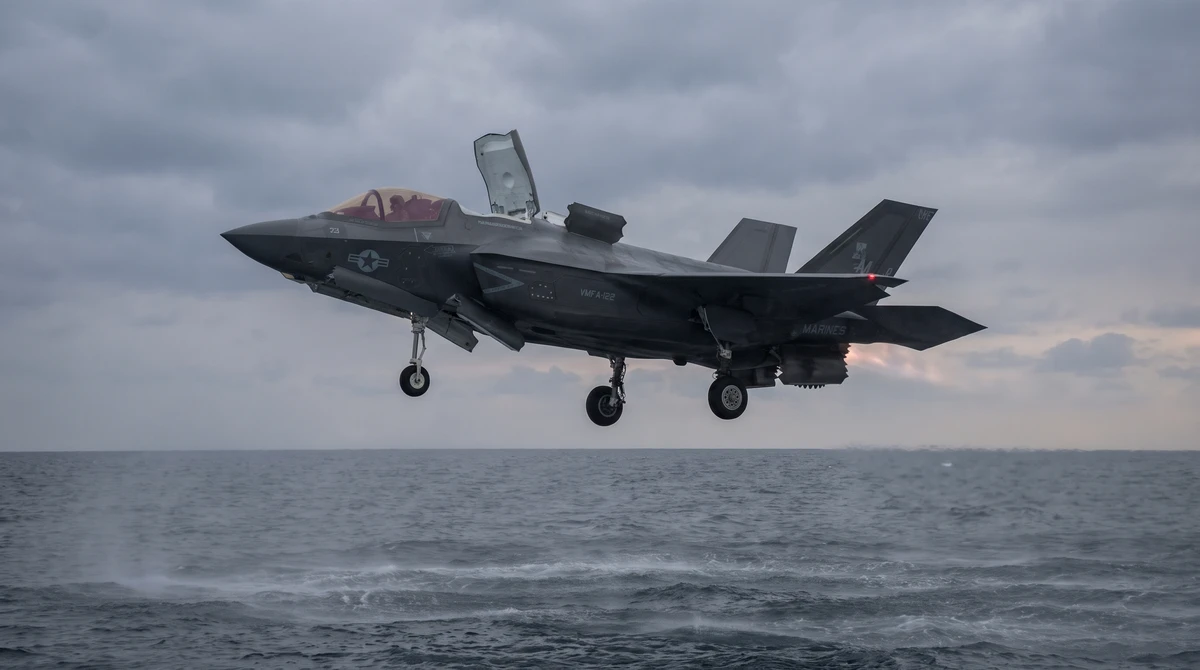
On 26 October 2026 the F-35 Lightning II program passed 25 years since the Joint Strike Fighter development contract went to Lockheed Martin. Three months before that award, on 20 July 2001, the X-35B demonstrator had taken off in less than 500 ft, gone supersonic and landed vertically in a single flight. The anniversary falls in a busy month for the type: on 22 October the Pentagon and Lockheed Martin unveiled a 10-year framework for 850 US jets, pending Congress, and on 6 October the US Marine Corps said the 26th Marine Expeditionary Unit was preparing to sail with the USS Kearsarge Amphibious Ready Group, its first deployment with the F-35B, the CH-53K King Stallion and the Amphibious Combat Vehicle.
The B variant is the one that needs no catapult, no arresting gear and no runway of conventional length. Where steam and electromagnetic catapults solve the launch problem with ship machinery, the F-35B carries its solution on board. To hover, an aircraft needs vertical thrust greater than its weight, and that thrust must be split between the front and the rear of the airframe so that it balances around the center of gravity.
Four nozzles on one engine
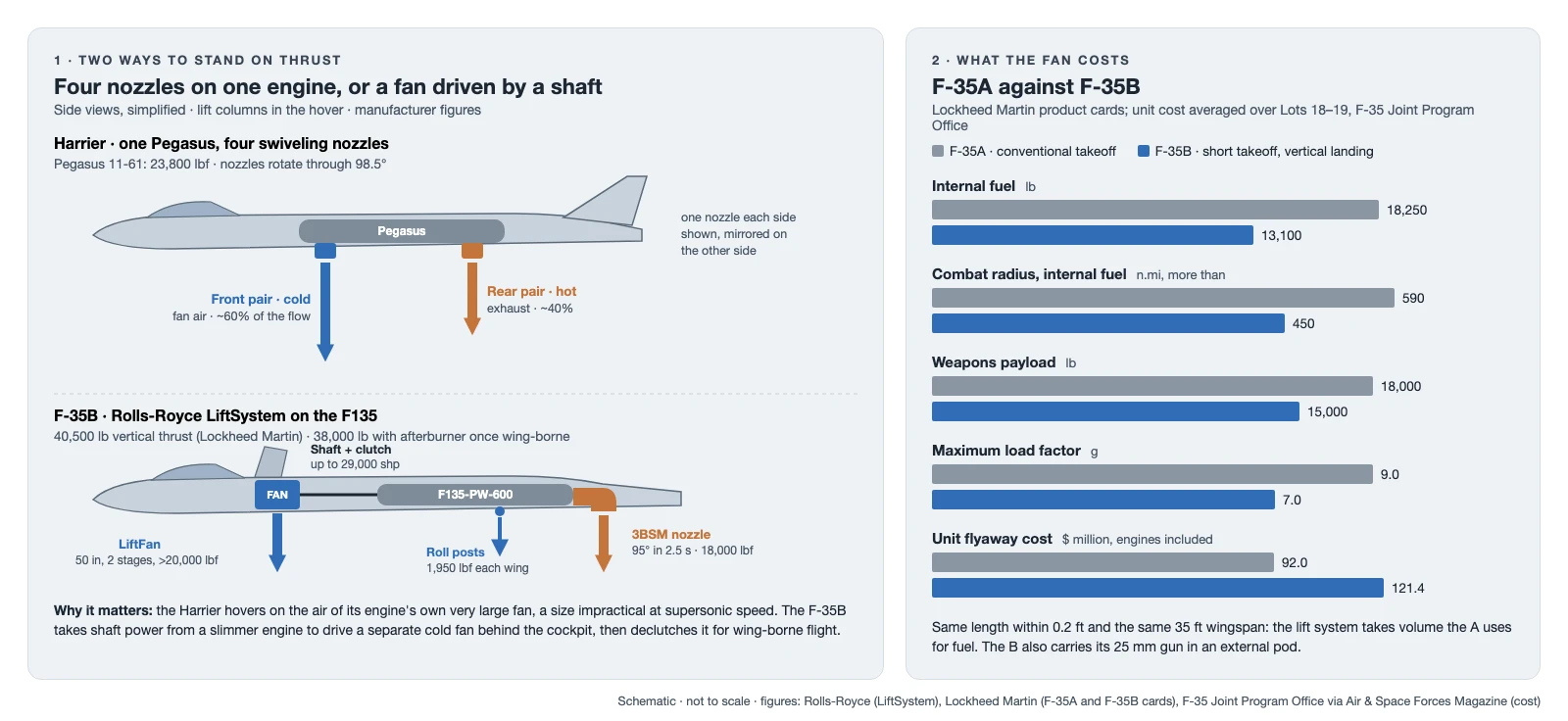
The Harrier entered Royal Air Force service on 1 April 1969 as the first operational ground-attack and reconnaissance aircraft with vertical/short takeoff and landing capability. Its answer to the balance problem is the Rolls-Royce Pegasus, a single engine with four vectorable nozzles. Two sit near the forward, cold end of the engine and exhaust the fan's bypass air; two sit near the rear, hot end and carry the hot core exhaust. The airflow splits about 60/40 between the front and rear pairs. The four nozzles rotate together through a range of 98.5 degrees, from pointing straight aft for wing-borne flight to pointing down, and slightly forward, for the hover.
The latest and most powerful version of the engine, the Pegasus 11-61, designated F402-RR-408 in US service, is rated at 23,800 lbf. It powers the AV-8B Harrier II, introduced in January 1985, which GlobalMilitary.net's inventory data still lists in service with the Spanish Navy (11 aircraft) and the Italian Navy (12).
The arrangement has a ceiling. The Pegasus owes its hover performance to a very large fan, and a fan of that size is impractical on a supersonic aircraft. A jet that had to hover and go supersonic needed to get the Harrier's cool, high-mass airflow from somewhere other than its main engine: the X-35B's powerplant was designed instead as a flow multiplier, moving extra unheated air at low velocity to obtain the same effect.
A fan driven by a shaft
The F-35B's answer is the Rolls-Royce LiftSystem, which the company describes as a descendant of the Pegasus and the first system to enable STOVL operations for a supersonic-capable aircraft. Lockheed Martin designed the shaft-driven fan concept, Rolls-Royce developed the LiftSystem and Pratt & Whitney builds the F135 main engine, in its F135-PW-600 version on the B. The system has four elements:
- The LiftFan, a 50-inch (127 cm), two-stage, counter-rotating fan mounted vertically just behind the cockpit under doors that open on top of the fuselage. It produces more than 20,000 lbf of thrust and forms the forward lift column.
- The driveshaft and clutch, which take power from the main engine's low-pressure turbine and carry it forward through a clutch and gearbox to the fan. Rolls-Royce rates the shaft at up to 29,000 shaft horsepower.
- The three-bearing swivel module, or 3BSM, a jet pipe on the main engine's exhaust that rotates through 95 degrees in 2.5 seconds and directs 18,000 lbf of hot thrust downward, forming the rear lift column.
- The roll posts, one in each wing, which duct main-engine bypass air downward at 1,950 lbf each for roll control and stay closed in normal flight.
Variable inlet guide vanes on the fan vary its thrust from maximum to idle, and a vane-box nozzle beneath it vectors the fan's exhaust fore and aft. Lockheed Martin's product card gives the total vertical thrust as 40,500 lb; in hover-pit tests in April 2009 the company measured 41,100 lb against a requirement of 40,550 lb.
The fan does more than add thrust. According to Lockheed Martin, it gives a lift-to-thrust ratio of about 1.5 to 1, turning the engine's shaft power into more lift than the same power would produce as hot jet exhaust, in effect working as an afterburner for vertical flight. Because it moves a large mass of air at low velocity, it leaves what the company calls a cool, low-pressure footprint and shields the main engine inlet and the forward airframe from re-ingesting hot gas. Lockheed Martin's F-35B card says the approach overcomes many of the temperature, velocity and power challenges of direct-lift systems. Direct lift was the route Boeing took with the rival X-32, whose main engine was reconfigured to blow downward.
Once the aircraft is wing-borne, the sequence reverses. The clutch disengages the fan, the doors close, the 3BSM swivels back to point rearward and the entire output of the F135-PW-600, which Lockheed Martin rates at 38,000 lb with afterburner and 26,000 lb without, goes out the back. The result is a top speed of Mach 1.6, the same as the F-35A.
What the fan costs
The fan, its shaft and its doors occupy space that in the F-35A holds fuel, and the penalties are visible across Lockheed Martin's 2019 product cards for the two variants. Internal fuel is 18,250 lb in the A against 13,100 lb in the B, more than a quarter less. Combat radius on internal fuel falls from more than 590 nautical miles to more than 450. Weapons payload drops from 18,000 lb to 15,000 lb, and the airframe is stressed to 7.0 g rather than 9.0. Externally the two are nearly identical, 51.4 ft long for the A and 51.2 ft for the B on the same 35 ft wingspan, but the A carries its 25 mm cannon internally while the B, like the C, carries it in an external pod, and the B has no tailhook. The site's guide to the three F-35 variants sets out the differences in full.
The price is also higher. Averaged over production Lots 18 and 19 in current-year dollars, with engines and radars included, the F-35 Joint Program Office puts the unit flyaway cost at $121.4 million for the F-35B, against $92.0 million for the F-35A and $110.8 million for the carrier-borne F-35C, according to figures reported by Air & Space Forces Magazine on 3 September 2026.
What buyers get for the premium is a fighter that operates from ships no catapult-equipped jet can use. The F-35B made its first vertical landing on 18 March 2010 at Patuxent River, the day after its first hover, and its first vertical landing at sea aboard USS Wasp on 3 October 2011; the Marine Corps declared initial operational capability on 31 July 2015. US amphibious assault ships of the Wasp and America classes now carry Marine F-35Bs. British and Italian Navy aircraft use a ski-jump ramp, first tested at Patuxent River in June 2015, to take off from HMS Queen Elizabeth and HMS Prince of Wales and from the carrier Cavour. In October 2018, aboard HMS Queen Elizabeth, the type also demonstrated the Shipborne Rolling Vertical Landing, in which the jet lands with forward speed so the wing carries part of the weight, raising the maximum landing weight at which it can come back aboard.
Japan joined the operators when its first three F-35Bs landed at Nyutabaru Air Base on 7 August 2025, ahead of the modification of its Izumo-class ships to operate them; GlobalMilitary.net's inventory data lists 8 F-35Bs in Japan Air Self-Defense Force service with 34 on order. The Italian Navy, whose F-35s are all Bs, has 10 in service and 13 on order by the same data. Each carries the bargain the X-35B struck in July 2001: a fan behind the cockpit that costs fuel, payload and money, in exchange for landing where a Harrier could and flying where one never could; a side-by-side comparison of the AV-8B and the F-35 shows the size of the trade.
More News
All news →
UK to Require Overseas Defense Suppliers to Invest Up to 100% of Contract Value in Britain From April 2027
The UK will require overseas firms winning defense contracts of £50 million or more to invest up to the full contract value in British jobs, factories and technology from April 2027, under an offset policy announced on 30 October 2026 that will not normally cover government-to-government deals.

Switzerland Shortlists Barak MX and SAMP/T NG for Second Long-Range Air Defense System, Keeps Patriot
The Federal Council on October 28 tasked the DDPS with continuing the evaluation of Israel's Barak MX and France's SAMP/T NG as a second long-range ground-based air defense system, to be fielded alongside a Patriot acquisition Bern says it will maintain despite delivery delays.
US Navy Has No Frigates in Service While 50 Other Navies Field 407 as Washington Weighs Foreign Designs
GlobalMilitary.net data shows the US Navy with no frigates in commission against 407 in 50 other fleets, as a White House-ordered plan for new surface combatants falls due in mid-November and foreign designs are offered.
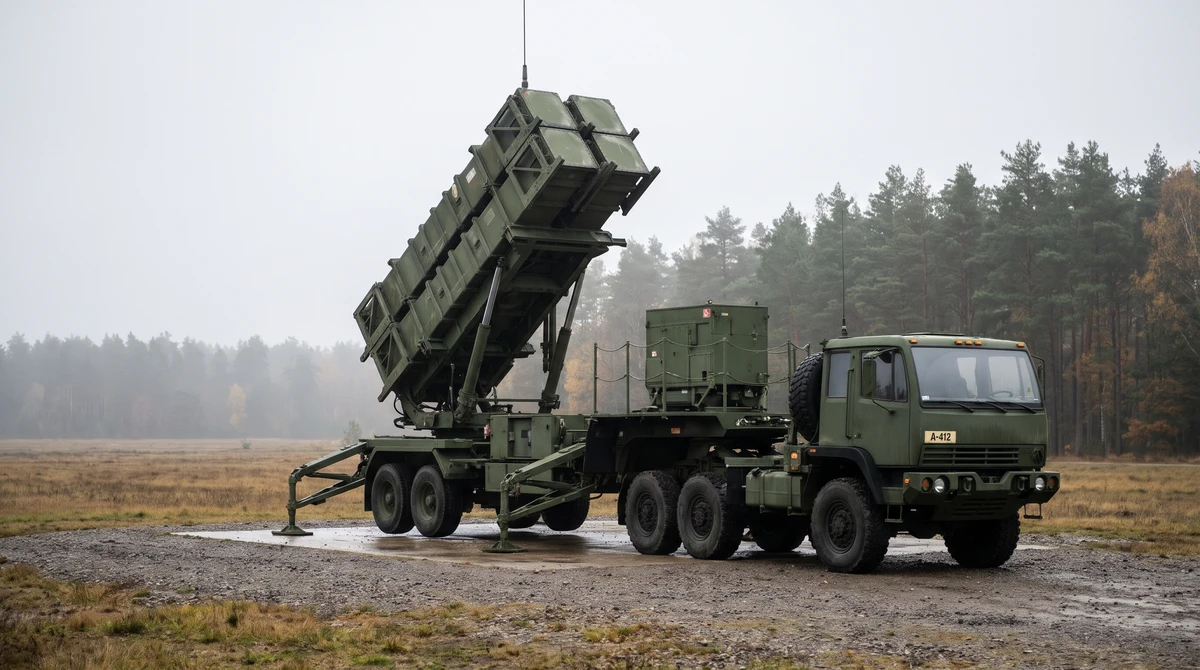
Pentagon Picks Poland to Host Europe's PAC-3 Missile Maintenance Facility
The US government and Lockheed Martin named Poland on October 27 as host of a European maintenance facility for PAC-3 Patriot interceptors, with Germany, the Netherlands and Sweden as original signatories to the agreement.
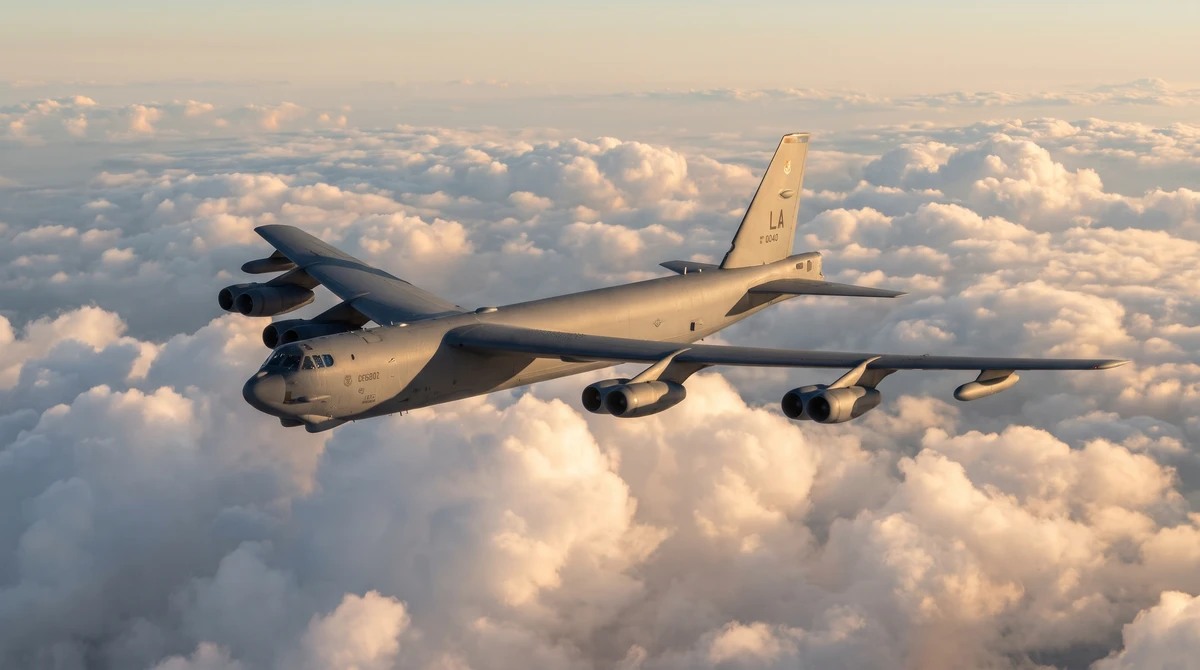
ARRW Hypersonic Missile Enters Production as U.S. Fields 140 Bombers, Russia 116 and China 219 H-6s
The Department of the Air Force has moved the AGM-183A hypersonic missile into production for a U.S. bomber force of 140 aircraft, which GlobalMilitary.net's inventory sets against Russia's 116 bombers and China's 219 H-6s.

USS Colorado to Be First Virginia-Class Submarine Rotated to Australia Under AUKUS From Late 2027
The United States, Australia and the United Kingdom said on October 26, 2026 that USS Colorado (SSN 788) will be the first U.S. Navy Virginia-class attack submarine assigned to Submarine Rotational Force-West at HMAS Stirling, Western Australia, beginning in late 2027.