BTR-80
Summary
| Origin country | 🇷🇺 Russia |
| Category | Armored Personnel Carrier |
| Sub-type | 8x8 Wheeled Armored Personnel Carrier |
| Manufacturer | Arzamas Machine-Building Plant |
| Number built | 5000 units |
Technical specifications
| Crew | 3 (+7 passengers) personnels |
| Range | 600 km |
| Mass | 13.6 tons |
| Height | 2.41 m (7.9 ft) |
| Width | 2.9 m (9.5 ft) |
| Length | 7.7 m (25.3 ft) |
| Max. speed | 80 km/h (50 mph) |
| Engine | KamAZ-7403 diesel, 260 hp |
| Weapon 1 | 14.5 mm KPVT machine gun |
| Weapon 2 | 7.62 mm PKT machine gun |
| Weapon 3 | 6x 81 mm 902V Tucha smoke grenade launchers |
Historical operators
Profile of BTR-80
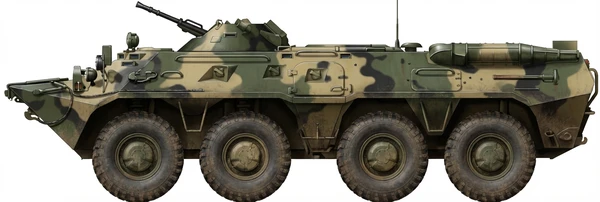
Description
The BTR-80 is an 8×8 wheeled amphibious armored personnel carrier (APC) designed in the Soviet Union. Adopted in 1985 to replace the BTR-60 and BTR-70, the vehicle was first deployed during the Soviet–Afghan War. It served as the basis for the larger BTR-90 developed in the early 1990s.
The vehicle is powered by a single 260-hp V-8 turbocharged water-cooled diesel engine, a configuration that replaced the twin gasoline engines used in previous models. This required a reconfigured rear hull with a squared-off engine compartment. For amphibious operations, the BTR-80 utilizes hydrojets. Standard equipment includes TNPO vision blocks, TKN-3 optical devices for the commander, an OU-3GA2M infrared search light, and six 81 mm smoke grenade launchers.
The turret features a redesigned mantlet that allows the 14.5 mm KPVT and coaxial 7.62 mm PKT machine guns to elevate to 60 degrees. This high angle enables the engagement of targets on steep slopes, in urban environments, and low-flying aerial targets. Infantry can fire from within the vehicle through round, ball-mounted firing ports. Access is provided via horizontally split side doors; the upper portion opens forward to provide protection from small arms fire, while the lower portion folds down to form a step.
Protection is provided by high-hardness steel armor designed to resist small arms ball ammunition and small bomb splinters. The front and sides of the hull and turret utilize 9 mm armor, while the hull rear and roof are 7 mm thick. Internal upgrades in later models like the BTR-82 include spall liners and improved anti-mine protection.
The BTR-80 has been produced in numerous variants. The BTR-80A and BTR-82A function as infantry fighting vehicles, equipped with 30 mm 2A72 autocannons. Fire support versions include the 2S23 Nona-SVK, which mounts a 120 mm gun-mortar. Other specialized variants serve in NBC reconnaissance, command and signals, armored recovery, and medical evacuation roles.
The vehicle is widely exported and remains in service with several countries across Eastern Europe, Asia, Africa, and South America. Beyond its initial use in Afghanistan, the BTR-80 and its derivatives have seen combat in Syria and during the Russian invasion of Ukraine. Domestic modifications and clones have been produced by nations including North Korea, Romania, and Colombia. While most operators maintain active fleets, countries such as Turkey and Estonia have phased the vehicle out of active service in favor of more modern platforms.