Su-25 Frogfoot
Summary
| Category | Combat Aircraft |
| Origin country | 🇨🇳 Ex-USSR |
| Manufacturer | Sukhoi |
| First flight | 22 February 1975 |
| Year introduced | 1981 |
| Number produced | 1000 units |
| Average unit price | $11 million |
Technical specifications
| Version: Su-25 Frogfoot-A | |
|---|---|
| Crew | 1 pilot |
| Operational range | 1,000 km (621 mi) |
| Maximum speed | 970 km/h (603 mph) |
| Wing area | 30.1 m² (324.0 sqft) |
| Wingspan | 14.4 m (47.1 ft) |
| Height | 4.8 m (15.7 ft) |
| Length | 15.5 m (51.0 ft) |
| Service ceiling | 7,000 m (22,966 ft) |
| Empty weight | 9,500 kg (20,944 lbs) |
| Max. takeoff weight | 17,600 kg (38,801 lbs) |
| Takeoff distance | 550 m (1,804 ft) |
| Powerplant | 2 x turbojets Tumansky R-95Sh delivering 8200 kgf each |
| Ejection seat | Zvezda K-36D-5 |
Current operating countries
| Country | Units | ||
|---|---|---|---|

|
Russia | 183 | |

|
Belarus | 55 | |

|
North Korea | 34 | |

|
Turkmenistan | 25 | |

|
Azerbaijan | 20 | |

|
Iraq | 19 | |

|
Ukraine | 19 | |

|
Armenia | 16 | |

|
Kazakhstan | 15 | |

|
Uzbekistan | 13 | |

|
Sudan | 12 | |

|
Georgia | 11 | |

|
Chad | 9 | |

|
Bulgaria | 7 | |
| 🇨🇩 | Congo Democratic Republic | 6 | |

|
Peru | 5 | |
| 🇬🇶 | Equatorial Guinea | 4 | |

|
Ethiopia | 3 | |

|
Niger | 2 | |
| 🇬🇲 | Gambia | 1 | |

|
Angola | 0 | |
All operators
59 recent events involving the Su-25 Frogfoot
| Date | Air Force | Aircraft | Active Δ | Ordered Δ |
|---|---|---|---|---|
| 27 Dec 2025 | 🇷🇺 Russian Air Force | Su-25 | -1 | — |
| Attack aircraft shot down by MANPADS near Kharkiv; pilot killed. Details → | ||||
| 13 Jun 2025 | 🇷🇺 Russian Air Force | Su-25 | -1 | — |
| Crashed near Soledar, Donetsk Oblast during a combat mission; pilot ejected and rescued. Details → | ||||
| 2 Mar 2025 | 🇺🇦 Ukrainian Air Force | Su-25 | -2 | — |
| Wreckage, previously operational, recorded in a Ukrainian documentary. Details → | ||||
| 8 Feb 2025 | 🇷🇺 Russian Air Force | Su-25 | -1 | — |
| Shot down by Ukrainian soldiers using Igla MANPADS near Toretsk; the pilot ejected and escaped. Details → | ||||
| 1 Feb 2025 | 🇷🇺 Russian Air Force | Su-25 | -1 | — |
| Wreckage recorded outside the base of Gvardeyskoye in Crimea. Details → | ||||
| 23 Dec 2024 | 🇷🇺 Russian Air Force | Su-25 | -1 | — |
| Su-25SM damaged in the canopy by a crash with a ZALA drone. Details → | ||||
| 14 Dec 2024 | 🇺🇦 Ukrainian Air Force | Su-25 | -1 | — |
| Shot down by Russian S-400 defence system near Kherson Oblast. Details → | ||||
| 6 Oct 2024 | 🇷🇺 Russian Air Force | Su-25 | -1 | — |
| Wreckage was transported in a truck, airframe likely lost before spring. Details → | ||||
| 29 Jul 2024 | 🇺🇦 Ukrainian Air Force | Su-25 | -1 | — |
| Destroyed on the ground by Russian Lancet strike in Kryvyi Rih. Details → | ||||
| 23 Jul 2024 | 🇷🇺 Russian Air Force | Su-25 | -1 | — |
| Shot down by 110th Mechanized Brigade in Donbas. Details → | ||||
Armament
Missiles payload:
- Air-to-Surface Vympel Kh-25 (AS-10 Karen)
- Air-to-Surface Vympel Kh-29 (AS-14 Kedge)
- Air-to-Air Short-Range Vympel R-3 (AA-2 Atoll)
- Air-to-Air Short-Range Vympel R-60 / K-60 (AA-8 Aphid)
- Air-to-Surface Zvezda Kh-23 (AS-7 Kerry)
Bombs payload:
- Low-Drag FAB-100
- Low-Drag FAB-250
- Low-Drag JSC NPO Basalt FAB-500
- Cluster JSC NPO Basalt RBK-500
- Incendiary JSC NPO Basalt ZB-500Sh
- Guided KAB-500
- Pods Cluster KMGU-2
- Cluster RBK-250
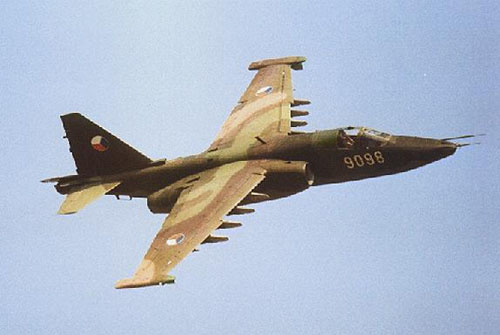
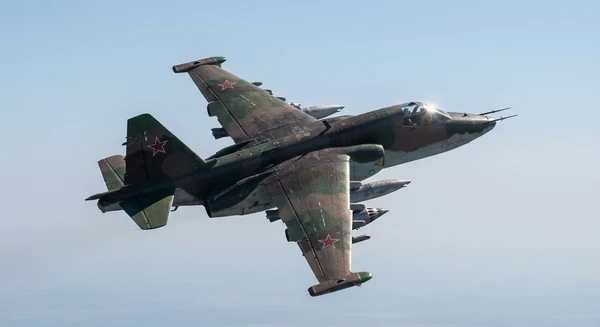
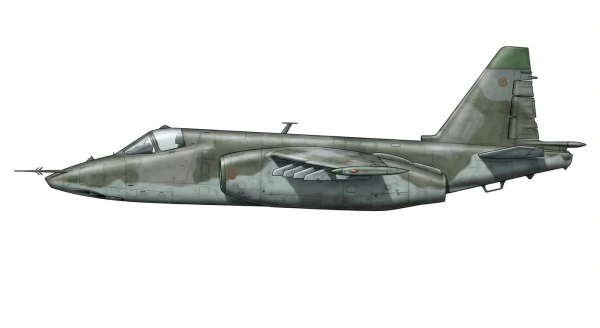
Description
The Su-25 Frogfoot is a Soviet-origin ground-attack aircraft, designed and produced by the Sukhoi Design Bureau. It was developed in the 1970s to provide close air support for ground troops, fulfilling a role similar to that of the American A-10 Thunderbolt II. The aircraft entered service with the Soviet Air Force in 1981 and saw combat for the first time in the Soviet-Afghan War.
The development of the Su-25 Frogfoot began in the early 1970s at the Sukhoi Design Bureau, led by chief designer Pavel Sukhoi. The aim was to create a dedicated ground-attack aircraft to support the Soviet Army, essentially replacing and augmenting the roles previously filled by various fighter-bombers and attack helicopters.
The design philosophy was driven by the need for a rugged, survivable aircraft that could operate from unprepared airfields. This led to features like the armor-protected cockpit, redundant systems, and a simple, robust airframe. The aircraft was to excel in the low-altitude, low-speed flight regime where ground-attack missions occur.
The Su-25 Frogfoot has a conventional aerodynamic layout with a straight-wing design, optimized for low-speed and low-altitude performance, critical for its ground-attack role. It features twin turbojet engines, which provide a good thrust-to-weight ratio, although they are not particularly fuel-efficient. The airframe is built to withstand damage, incorporating redundant systems for increased survivability.
Armament
The Su-25 Frogfoot is equipped with a GSh-30-2 30mm cannon with 250 rounds, mounted in the fuselage. This cannon is particularly effective against armored vehicles and fortified positions. In addition to the built-in cannon, the aircraft has 10 to 11 external hardpoints (depending on the variant) for carrying a wide range of ordnance.
Its payload can include unguided rockets, such as the S-5, S-8, and S-25, as well as guided missiles like the Kh-25 and Kh-29 for air-to-surface roles. It can also carry anti-radar missiles for suppression of enemy air defenses (SEAD) missions. For anti-tank missions, it can be equipped with laser-guided missiles like the Vikhr. Bombs, including general-purpose, cluster, and incendiary, can also be attached to the hardpoints.
Operational history
The Su-25 Frogfoot has an extensive operational history, seeing combat in multiple conflicts since its introduction in 1981. One of its earliest deployments was in the Soviet-Afghan War, where it was used for ground-attack missions against Mujahideen fighters and fortified positions.
After the dissolution of the Soviet Union, the Su-25 was used by Russian forces in the First and Second Chechen Wars for close air support and interdiction missions. It also saw action in the 2008 Russo-Georgian War, and more recently in the 2022 Russian invasion of Ukraine.
The aircraft has been exported and used by several other nations as well. For instance, it was used by the Ukrainian Air Force in the conflict in eastern Ukraine that began in 2014. In the Middle East, the Su-25 has been deployed in the Syrian Civil War by both Russian and Syrian government forces.
Variants
The Su-25 has several variants, including:
- Su-25: The original production version.
- Su-25K: An export variant of the original Su-25.
- Su-25T: An upgraded version focused on anti-tank missions, featuring improved avionics and the ability to carry laser-guided missiles.
- Su-25TM (also known as Su-39): A further modernized version of the Su-25T, featuring updated avionics and improved armament options.
- Su-25SM: A mid-life upgrade for the Russian Air Force's existing Su-25 fleet, with improved avionics, navigation systems, and weapon compatibility.
- Su-25UB: A two-seat trainer variant, also occasionally used for combat missions.
- Su-25KM "Scorpion": A 2001 upgrade package offered for export, featuring advanced avionics and compatibility with Western armaments.
- Su-25UTG: A specialized variant designed for training pilots in carrier operations, featuring an arresting hook but lacking armament.