F-15E Strike Eagle vs F/A-18 E/F Super Hornet
F-15E Strike Eagle vs F/A-18 E/F Super Hornet at a glance — top speed 2,655 vs 1,915 km/h, range 3,889 vs 2,346 km, max takeoff weight 36,741 vs 29,900 kg, built 525 vs 632 units.
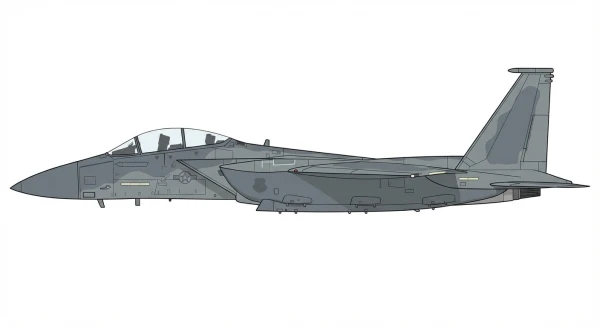
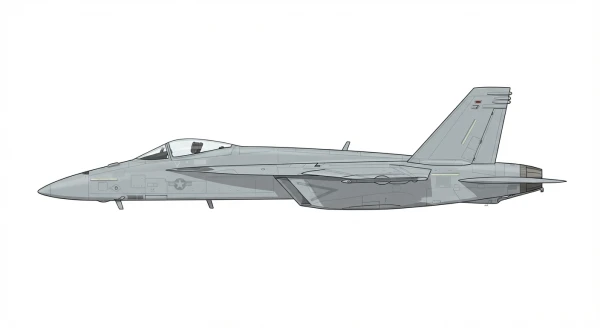
| F-15E Strike Eagle | F/A-18 E/F Super Hornet | |
|---|---|---|
| Origin country | 🇺🇸 United States | 🇺🇸 United States |
| Category | Combat Aircraft | Combat Aircraft |
| Manufacturer | McDonnell Douglas | Boeing |
| First flight | 11 December 1986 | 29 November 1995 |
| Year introduced | 1986 | 2001 |
| Number produced | 525 units | 632 units |
| Average unit price | $31.1 million | $70 million |
| Wing area | 56.0 m² | 46.5 m² |
| Wingspan | 13.1 m | 13.6 m |
| Height | 5.6 m | 4.9 m |
| Length | 19.4 m | 18.3 m |
| Maximum speed | 2655 km/h | 1915 km/h |
| Operational range | 3,889 km | 2,346 km |
| Service ceiling | 18,288 m | 15,940 m |
| Max. takeoff weight | 36,741 kg | 29,900 kg |
| Empty weight | 14,379 kg | 14,550 kg |
| Total thrust | 2 x 13,200 kgf | 2 x 9,979 kgf |
Detailed Comparison
McDonnell Douglas engineered the F-15E Strike Eagle as a heavy, land-based deep interdictor, while Boeing’s F/A-18E/F Super Hornet emerged as a carrier-borne multirole compromise driven by post-Cold War budget constraints. The Strike Eagle prioritizes brute speed, payload, and unescorted penetration; the Super Hornet trades kinetic performance for carrier suitability, low-speed handling, and fleet integration.
Development and Design
The Air Force procured the F-15E to replace the F-111, demanding a platform to haul heavy ordnance over long distances without fighter escort. Adding conformal fuel tanks (CFTs) and a Weapon Systems Officer to the F-15C airframe created a dedicated strike fighter that retained air superiority kinematics. Conversely, the Navy adopted the Super Hornet as a lower-risk alternative after the A-12 cancellation and the mandated retirement of the A-6 and F-14. Enlarged by 20% over the legacy Hornet, the E/F variants incorporated caret inlets and increased wing area. The design sacrificed top-end aerodynamic performance for a 41% range extension, radar cross-section reduction measures, and an organic buddy-tanking capability.
Specifications and Performances
The F-15E possesses a clear kinematic advantage. Powered by twin F100-PW-229 engines generating 26,308 kgf of thrust, it achieves Mach 2.5 and lifts a maximum takeoff weight of 36,741 kg. The Super Hornet, limited by its F414 turbofans (19,958 kgf total thrust) and drag-inducing pylons, tops out at 1,915 km/h. Naval aviators routinely note the E/F’s lack of acceleration compared to legacy fighters, but its enlarged leading-edge extensions grant it superior high-angle-of-attack maneuverability in the low-speed regime. The Strike Eagle’s 1,272 km unrefueled combat radius outlasts the Super Hornet, forcing the E/F to rely heavily on external drop tanks.
Deployment and usage
The F-15E debuted in Operation Desert Storm, executing Scud-hunting missions and deep interdiction against Baghdad without escort. The Super Hornet entered service in 2001, executing CAS, SEAD, and fleet defense from Operation Iraqi Freedom to recent kinetic engagements against Houthi munitions in the Red Sea. In export markets, the platforms experienced divergent trajectories:
- The Strike Eagle spawned advanced derivatives (F-15SA, F-15QA), ultimately funding the USAF's modern F-15EX.
- The Super Hornet struggled against European canards and the F-35, securing only Australia and Kuwait.
The Super Hornet's 2017 downing of a Syrian Su-22 remains the first US air-to-air kill since 1999.
Conclusion
For deep interdiction, heavy payload delivery, and contested airspace penetration where speed and range dictate survival, the F-15E has a definitive edge. Its kinematics allow it to operate independently across vast theaters like the Pacific. The Super Hornet wins in maritime power projection and organic fleet utility. If a mission requires carrier basing, integrated electronic attack (via the EA-18G), or tactical airborne tanking, the F/A-18E/F is the required asset.