F-16 Fighting Falcon vs F-5 Freedom Fighter
F-16 Fighting Falcon vs F-5 Freedom Fighter at a glance — top speed 2,178 vs 1,700 km/h, range 4,217 vs 3,720 km, max takeoff weight 19,200 vs 11,187 kg, built 4,604 vs 1,204 units.
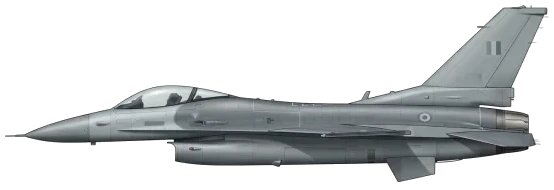
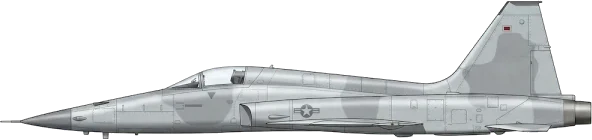
| F-16 Fighting Falcon | F-5 Freedom Fighter | |
|---|---|---|
| Origin country | 🇺🇸 United States | 🇺🇸 United States |
| Category | Combat Aircraft | Combat Aircraft |
| Manufacturer | General Dynamics | Northrop |
| First flight | 2 February 1974 | 30 July 1959 |
| Year introduced | 1978 | 1965 |
| Number produced | 4604 units | 1204 units |
| Average unit price | $18.8 million | $2 million |
| Wing area | 27.9 m² | 17.3 m² |
| Wingspan | 10.0 m | 8.1 m |
| Height | 4.9 m | 4.1 m |
| Length | 15.1 m | 14.5 m |
| Maximum speed | 2178 km/h | 1700 km/h |
| Operational range | 4,217 km | 3,720 km |
| Service ceiling | 15,240 m | 15,789 m |
| Max. takeoff weight | 19,200 kg | 11,187 kg |
| Empty weight | 8,570 kg | 4,349 kg |
| Total thrust | 1 x 12,701 kgf | 2 x 2,268 kgf |
Detailed Comparison
Northrop designed the F-5 Freedom Fighter in 1959 to meet NATO requirements for a low-maintenance export fighter capable of operating from austere airfields. Fifteen years later, General Dynamics developed the F-16 Fighting Falcon to fulfill the US Air Force Lightweight Fighter Program. While both airframes were built to counter the mass and expense of contemporary heavy fighters, their respective designs rely on fundamentally opposed aerodynamic and avionic architectures.
Development and Design
Edgar Schmued engineered the F-5 around a mechanically conventional, twin-engine airframe. By wrapping the fuselage tightly around two compact General Electric J85 turbojets—originally built for the ADM-20 Quail decoy—Northrop prioritized logistical simplicity and high sortie generation rates over raw kinetic performance. The F-16 inverted this model, relying entirely on electronic intervention. General Dynamics utilized energy-maneuverability theory, outfitting the F-16 with a relaxed static stability profile and a fly-by-wire flight control system. This allowed a blended wing-body design, shifting pilot control to a side-mounted stick to manage high G-forces under a frameless bubble canopy.
Specifications and Performances
The thrust and weight metrics define the operational limits of each aircraft. The F-16 utilizes a single GE F110 engine producing 7,777 kgf of thrust to propel a 19,200 kg maximum takeoff weight (MTOW) to 2,410 km/h. The F-5 utilizes twin J85-GE-21B turbojets generating a combined 3,176 kgf for an 11,187 kg MTOW and a 1,700 km/h top speed. This mechanical difference dictates ordnance capacity:
- The F-16 lifts 7,000 kg across nine hardpoints, firing beyond-visual-range AIM-120 AMRAAMs and deploying precision GPS-guided munitions.
- The F-5 manages 3,200 kg across seven stations, generally restricted to unguided Mk 80 series bombs and short-range AIM-9 Sidewinders.
The $75.0 million unit cost of the F-16 compared to the F-5's historical $2.0 million price is directly tied to the integration of modern AESA radar, targeting pods, and electronic warfare suites that the F-5 lacks.
Deployment and usage
The F-5 saw primary combat use in export markets. Ethiopian F-5s secured air superiority against Somali forces during the Ogaden War, and the Republic of Vietnam Air Force utilized the type for ground attack. In US service, the F-5 was relegated to dissimilar air combat training, acting as a Soviet MiG-21 surrogate due to its small radar cross-section. The F-16 deployed immediately as a frontline strike fighter. Israeli F-16s validated the airframe during the 1981 Osirak reactor strike, while USAF F-16s executed suppression of enemy air defenses (SEAD) and interdiction missions during Operation Desert Storm in 1991, destroying over 30 Iraqi aircraft on the ground.
Conclusion
The F-16 holds an absolute advantage in contested airspace and multirole strike profiles. Its fly-by-wire maneuverability, beyond-visual-range radar capabilities, and heavy precision payload make it a requirement for modern peer-to-peer combat. The F-5 retains utility only in specialized dissimilar combat training or extremely low-budget counter-insurgency operations, where its twin-engine reliability and minimal cost per flight hour outcompete complex fourth-generation systems. For air forces requiring theater entry, SEAD, or all-weather strike, the F-5 is obsolete; the F-16 dictates the modern tactical baseline.
-
 United States
846
-
 Turkey
235
-
 Egypt
220
- All 24 operators →