F-35 Lightning II vs J-11 Responsive Dragon
F-35 Lightning II vs J-11 Responsive Dragon at a glance — top speed 1,960 vs 2,500 km/h, range 2,800 vs 3,530 km, max takeoff weight 27,216 vs 33,000 kg, built 965 vs 442 units.
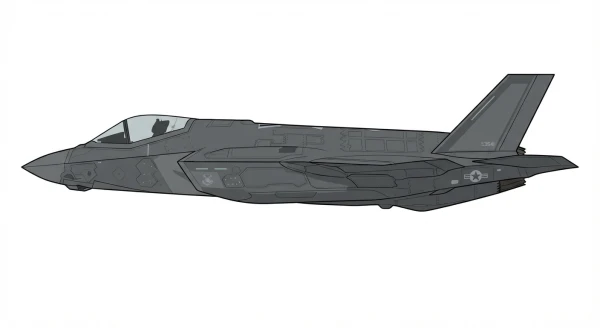
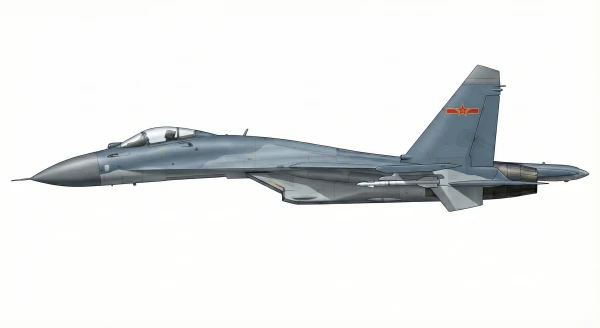
| F-35 Lightning II | J-11 Responsive Dragon | |
|---|---|---|
| Origin country | 🇺🇸 United States | 🇨🇳 China |
| Category | Combat Aircraft | Combat Aircraft |
| Manufacturer | Lockheed Martin | Shenyang |
| First flight | 15 December 2006 | 1 January 1998 |
| Year introduced | 2013 | 1998 |
| Number produced | 965 units | 442 units |
| Average unit price | $103 million | $30 million |
| Wing area | 43.0 m² | 52.8 m² |
| Wingspan | 11.0 m | 14.7 m |
| Height | 4.4 m | 5.9 m |
| Length | 15.6 m | 21.9 m |
| Maximum speed | 1960 km/h | 2500 km/h |
| Operational range | 2,800 km | 3,530 km |
| Service ceiling | 15,000 m | 18,500 m |
| Max. takeoff weight | 27,216 kg | 33,000 kg |
| Empty weight | 14,651 kg | 16,380 kg |
| Total thrust | 1 x 19,500 kgf | 2 x 13,460 kgf |
Detailed Comparison
The F-35 Lightning II is a single-engine, 5th-generation stealth aircraft designed for multirole missions within a networked battlespace, while the Shenyang J-11 is a twin-engine, 4th-generation air superiority fighter derived from the Russian Su-27. The F-35 prioritizes low observability and advanced sensor fusion over raw kinematic performance. Conversely, the J-11, rooted in a late Cold War design, emphasizes speed, altitude, and payload, reflecting a different tactical doctrine. The F-35 was conceived as a common platform for multiple services and allies, whereas the J-11's development showcases China’s effort to indigenize and evolve a foreign design for its specific regional defense needs.
Development and Design
The F-35 originated from the U.S. Joint Strike Fighter (JSF) program, which mandated a high degree of commonality across its three variants (F-35A/B/C) to reduce lifecycle costs. Its design is fundamentally shaped by the requirement for a very low radar cross-section. This is achieved through its external geometry, internal weapons bays, and advanced materials. Its core innovation is not just stealth, but the fusion of data from its AN/APG-81 AESA radar, Distributed Aperture System (DAS), and Electro-Optical Targeting System (EOTS), providing the pilot with unparalleled situational awareness.
The J-11’s lineage began with a 1996 license-production agreement for the Su-27SK. Initial J-11s were assembled from Russian kits, but the program quickly pivoted toward indigenous development with the J-11B variant. This model incorporated Chinese avionics, a lighter airframe with more composites, and eventually, the domestic WS-10 turbofan engine. This evolution represents a significant reverse-engineering and technological maturation effort, turning a Russian airframe into a distinct Chinese platform. Later upgrades, like the J-11BG, have sought to close the technology gap by integrating AESA radars.
Specifications and Performances
A comparison of performance data reveals divergent priorities. The J-11 holds a clear advantage in traditional kinematics, with a higher maximum speed (2500 km/h vs. 1930 km/h), service ceiling (18,500 m vs. 15,000 m), and a powerful climb rate of 300 m/s. Its larger airframe and twin engines give it a substantially greater ferry range (3530 km). However, these metrics are less relevant when facing a stealth opponent. The F-35’s primary performance attribute is its low observability, allowing it to detect and engage adversaries like the J-11 long before it is itself detected. While the F-35's internal payload is limited to maintain stealth, the J-11 carries a large weapons load externally, which further increases its already significant radar signature.
Deployment and usage
The F-35 is deployed globally by the United States and a wide coalition of allies, designed to penetrate sophisticated Integrated Air Defense Systems (IADS). It has seen combat, with Israel being the first to report its operational use in strikes. Its variants provide strategic flexibility, operating from conventional runways (A), amphibious assault ships (B), and aircraft carriers (C). The J-11 serves exclusively with China's People's Liberation Army Air Force (PLAAF) and Naval Air Force (PLANAF). It is a key asset for air defense and power projection in the Indo-Pacific, often used for assertive intercepts, as demonstrated by the 2014 encounter with a U.S. Navy P-8 Poseidon.
Conclusion
The F-35 and J-11 represent different generations and strategic philosophies. The F-35 is a networked, stealth-first asset whose combat value is derived from information dominance and survivability in high-threat environments. The J-11 is a powerful 4th-generation fighter that excels in traditional performance metrics and has been progressively modernized. However, its design foundation makes it highly vulnerable to the capabilities of a 5th-generation opponent. The comparison highlights a strategic contest between an aircraft designed to be an unseen sensor and shooter, and one designed for visible air-to-air dominance through speed and firepower.