M-30
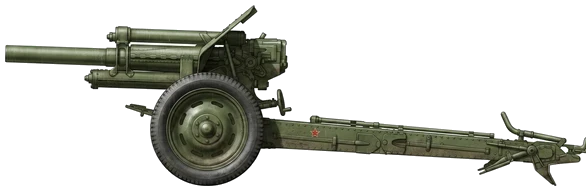
The M-30 is a 122mm towed howitzer developed by the Soviet Union, introduced in 1939, used for divisional artillery support, distinguished by its split-trail carriage design. Key figures: weight 2.45 t, top speed 50 km/h, built 19,266. In service with 13 armies — Pakistan (490), Ethiopia (464), Sudan (400) and 10 others.
| Sub-type | Divisional howitzer |
| Crew | 8 personnels |
| Mass | 2.5 tons |
| Height | 1.82 m (6.0 ft) |
| Width | 1.98 m (6.5 ft) |
| Length | 5.9 m (19.4 ft) |
| Max. speed | 50 km/h (31 mph) |
| Weapon 1 | 122 mm howitzer M1938 (M-30) |
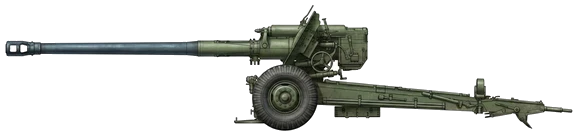
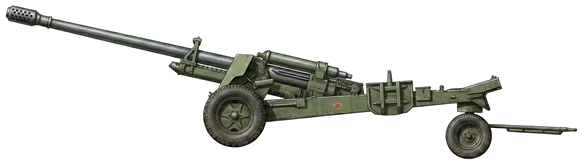
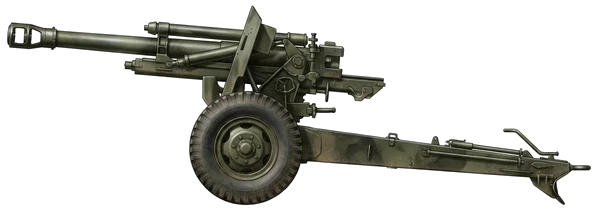
Description
The 122 mm howitzer M1938, designated M-30 and carrying the GRAU index 52-G-463, was a Soviet divisional howitzer developed by the design bureau of the Motovilikha Plants under F. F. Petrov. Work stemmed from a Red Army requirement issued in 1930 for a replacement for the 122 mm howitzers M1909 and M1910, whose modernized M1909/37 and M1910/30 forms retained the shortcomings of the original designs. An earlier attempt, the KB-2 "Lubok" adopted as the 122-mm howitzer model 1934, was cancelled after eight pieces. During the mid-1930s the Main Artillery Directorate considered switching to 105 mm, but existing 122 mm production lines and stocks of manufactured shells favoured retention of the older calibre, endorsed in 1937 by General Staff chief I. I. Egorov. Three competing designs were trialled in 1938–1939: the UZTM U-2, rejected for insufficient carriage strength and inferior ballistics; V. G. Grabin's F-25, closed by the GAU on 23 March 1939; and Petrov's M-30, adopted in September 1939 after repeated revisions.
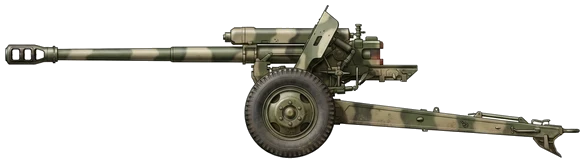
The barrel was of built-up construction, comprising liner, jacket and breech, with an interrupted-screw breechblock derived from the M1910/30 and forced cartridge case extraction. Recoil was absorbed by a hydraulic buffer and hydropneumatic recuperator; no muzzle brake was fitted. A panoramic sight served both indirect and direct fire. The split trail carriage used leaf spring suspension, which locked automatically when the trails were opened, and steel wheels with rubber tires, permitting towing by vehicle without a limber or by a six-horse team with one. Firing with trails closed was possible in emergencies at greatly reduced traverse. The same carriage was later used for the 152-mm howitzer M1943 (D-1).
Mass production began in 1940 at Plant No. 92 in Gorky and Plant No. 9 in Sverdlovsk and continued until 1955; Plant No. 9 also produced M-30S barrels for the SU-122 assault gun. Huta Stalowa Wola built the type in Poland from 1950 as the Wz.1938, and the People's Republic of China produced it as the Type 54, later mounted on the tracked Type 70 self-propelled howitzer. The M-30 also armed the SG-122 and the first four prototypes of the Romanian Mareșal tank destroyer.
The howitzer equipped rifle, mountain rifle, motorized, tank and cavalry divisions, with establishments repeatedly reorganized between 1939 and 1945, and served in howitzer brigades of the Reserve of the Main Command. It was employed mainly for indirect fire against personnel, field fortifications, minefields and wire; HE-fragmentation splinters could penetrate thin armour, and a HEAT shell was introduced in 1943.
Captured pieces served the Wehrmacht as the 12,2 cm s.F.H.396(r), some emplaced in the Atlantic Wall, and the Finnish Army as the 122 H 38, retained until the mid-1980s. Romania captured examples in 1941. Postwar the type was widely exported and saw combat with Egyptian and Syrian forces in the Arab-Israeli wars. It was superseded in Soviet service by the D-30 from 1960. Russian personnel released footage of M-30s in action during the invasion of Ukraine in August 2024.
Frequently Asked Questions
What type of vehicle is the M-30?
What is the weight of the M-30?
What is the maximum speed of the M-30?
How many crew members does the M-30 require?
How many M-30 have been built?
What weapons does the M-30 carry?
- AUG 152026 Created M-30 page created (specifications, overview, 9 operators)