Tigr
Introduced in 2006, the Russian Tigr is a 4x4 infantry mobility vehicle designed with armored variants for all-terrain troop transport. Key figures: weight 7.2 t, top speed 140 km/h, range 1,000 km, unit cost $0.16M. In service with 5 armies — Russia (2,000), Ukraine (37), Uzbekistan (30) and 2 others.
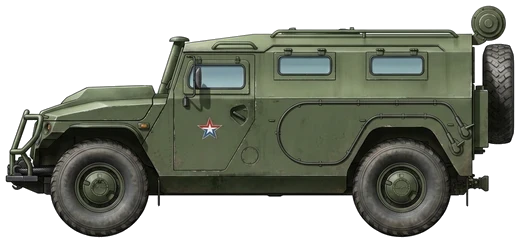
| Sub-type | Infantry Mobility Vehicle |
| Crew | 2 + 9, 10, or 11 depending on variant personnels |
| Range | 1000 km |
| Mass | 7.2 tons |
| Height | 2.4 m (7.9 ft) |
| Width | 2.33 m (7.6 ft) |
| Length | 5.7 m (18.7 ft) |
| Max. speed | 140 km/h (87 mph) |
| Engine | Cummins ISB 6.7 litre diesel engine, 385 hp |
| Weapon 1 | 7.62mm PKP Pecheneg machine gun |
| Weapon 2 | 12.7mm Kord heavy machine gun |
| Weapon 3 | .50 Cal M2HB machine gun |
| Weapon 4 | 30mm AGS-17 grenade launcher |
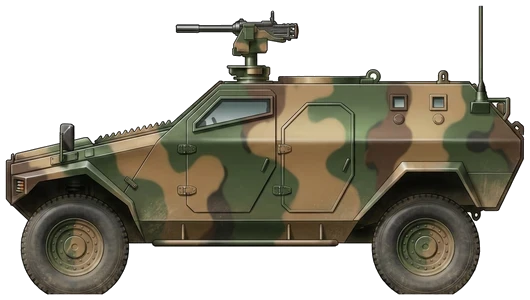
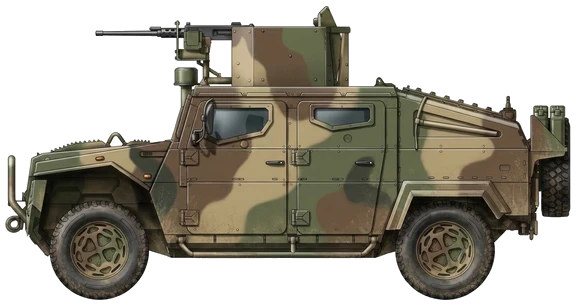
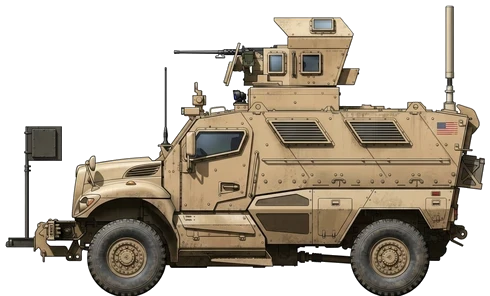
Description
The Tigr is a Russian 4×4 multipurpose all-terrain infantry mobility vehicle developed by the Military Industrial Company. First exhibited at the IDEX exhibition in 2001, pilot production commenced in 2004. The Russian Ground Forces adopted the GAZ-2975 variant in late 2006, entering official production in 2007. China co-produced variants under Beijing Yanjing Motor Company, deploying vehicles during the 2008 Beijing Olympics and the 2009 Xinjiang riots. In 2010, the upgraded Tigr-M variant was presented with a YaMZ-534 diesel engine, additional armor, and an NBC protection system, entering Russian service in 2013. Licensed manufacturing and derivative programs were also established in Belarus as the Lis-PM, in Slovakia, and in the United Arab Emirates as the Streit Group Falcon.
The vehicle utilizes a chassis frame construction with a front-engine, middle crew compartment, and rear cargo layout. Standard mobility features include independent all-wheel torsion suspension with hydraulic shock absorbers and stabilizer bars, power steering, central tire inflation, a two-speed transfer case with a locking center differential, limited-slip differentials, an engine block heater, and an electric winch. Armored variants incorporate 5 mm or 7 mm heat-treated armor plates, while variants like the Tigr-6A SPV add mine protection and shock-absorbing seats. Engine options include Cummins, YaMZ, GAZ, and Yuchai turbodiesels. Armament configurations include 7.62mm PKP or PKTM machine guns, 12.7mm Kord heavy machine guns, .50 Cal M2HB machine guns, 30mm AGS-17 grenade launchers, Kornet-D anti-tank missile systems, or Gibka-S air-defense launchers for Igla-S or Verba MANPADS. Multiple versions integrate the Arbalet-DM remote weapon station featuring TV, thermal imaging, and laser rangefinder capabilities. The chassis operates in desert, arctic, and mountain environments across ambient temperatures from -14°C to 50°C, with approach and departure angles of 52 degrees and a wading depth of 1.2 meters.
The Tigr is operated by Russia's armed forces and Ministry of Internal Affairs, alongside military and police operators in countries including Algeria, Armenia, Belarus, Chad, China, Republic of the Congo, Guinea, Kazakhstan, Kyrgyzstan, Libya, Nicaragua, Slovakia, Tajikistan, Uruguay, Uzbekistan, Yemen, and Zambia. Evaluation trials were conducted by Brazil and India. Combat deployments include Russian operations during the annexation of Crimea, the Syrian Civil War, monitoring duties in the Donbas region, and the Russian invasion of Ukraine. Ukrainian forces have also pressed captured Russian vehicles into operational service.
Frequently Asked Questions
What type of vehicle is the Tigr?
What is the weight of the Tigr?
What is the maximum speed of the Tigr?
What is the operational range of the Tigr?
How many crew members does the Tigr require?
What weapons does the Tigr carry?
- AUG 292026 Updated Re-filed as a protected mobility vehicle (was Light)
- AUG 112026 Created Page created: Tigr