MiG-15 Fagot
Summary
| Category | Combat Aircraft |
| Origin country | 🇨🇳 Ex-USSR |
| Manufacturer | Mikoyan-Gurevitch |
| First flight | 19 December 1947 |
| Year introduced | 1949 |
| Number produced | 17310 units |
| Average unit price | $0.2 million |
Technical specifications
| Version: MiG-15Bis Fagot-B | |
|---|---|
| Crew | 1 pilot |
| Operational range | 2,520 km (1,566 mi) |
| Maximum speed | 1075 km/h (668 mph) |
| Wing area | 20.6 m² (221.7 sqft) |
| Wingspan | 10.1 m (33.1 ft) |
| Height | 3.7 m (12.1 ft) |
| Length | 10.1 m (33.2 ft) |
| Service ceiling | 15,500 m (50,853 ft) |
| Empty weight | 3,580 kg (7,893 lbs) |
| Max. takeoff weight | 6,105 kg (13,459 lbs) |
| Climb rate | 50.0 m/s (164.0 ft/s) |
| Powerplant | 1 x turbojet Klimov VK-1 delivering 2700 kgf each |
| Ejection seat | Severin KS-1 |
Current operating countries
| Country | Units | ||
|---|---|---|---|

|
North Korea | 34 | |
All operators
Description
The Korean War, erupting on June 25, 1950, between North and South Korea, quickly drew in major global powers. Initially, the North Korean People's Army Air Force (KPAAF), equipped with a small number of Soviet aircraft and inexperienced pilots, faced the United Nations (UN) forces, primarily the United States, armed with propeller-driven and early jet aircraft. The situation shifted dramatically in October 1950 when China and the Soviet Union began to support North Korea. The Soviets supplied the advanced MiG-15 fighters and trained Korean and Chinese pilots. On November 1, 1950, the Soviet Air Forces' 64th Fighter Aviation Corps (64 IAK) unofficially joined the conflict, operating under the Chinese People's Liberation Army Air Force (PLAAF). This marked the beginning of jet-vs-jet battles, pitting the MiG-15 against UN aircraft. This intervention led to the area being named “MiG Alley”.
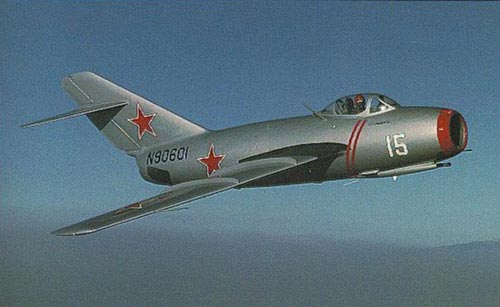
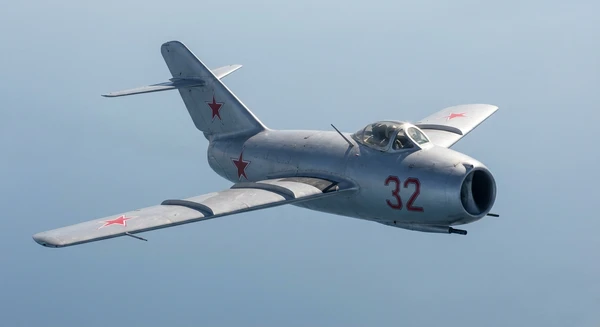
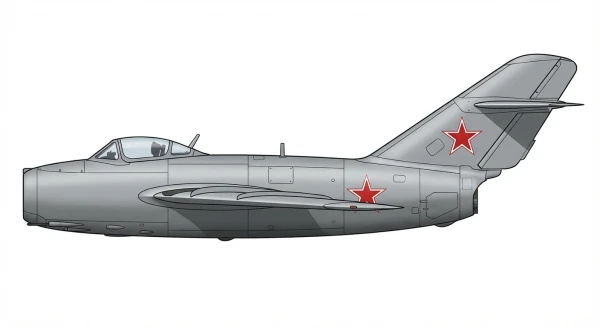
The Mikoyan-Gurevich MiG-15 was a Soviet-designed jet fighter aircraft. The swept wings allowed it to fly at high speeds approaching Mach 1, and its construction made extensive use of aluminum alloys. It was armed with heavy-caliber cannons, typically a 37 mm Nudelman N-37 cannon and two 23 mm Nudelman-Suranov NS-23 cannons, giving it significant firepower against enemy aircraft. The MiG-15 was equipped with radar gunsights to improve accuracy, though early models had relatively primitive avionics compared to some of their Western counterparts.
The aerial battles of "MiG Alley" saw the initial deployment of the MiG-15, primarily flown by North Korean, Chinese, and, covertly, Soviet pilots, against UN forces, including the US Air Force, Navy, and the Royal Australian Air Force. Early in the conflict, UN forces enjoyed air superiority with aircraft such as the P-51 Mustang and F-80 Shooting Star, but the introduction of the MiG-15 significantly challenged this. The UN response included transitioning to advanced jet fighters like the F-86 Sabre, which became the primary adversary of the MiG-15. The operational strengths of the MiG-15 included its high altitude performance and rapid rate of climb, while its weaknesses involved its limited radar capabilities and the relative inexperience of some pilots, particularly early in the conflict. The F-86, especially the later F-86F variant, proved a formidable opponent, gradually achieving air superiority through superior training, tactics, and technology.
Main Variants:
-
MiG-15: The initial production model, a high-subsonic jet fighter designed to intercept enemy aircraft.
-
MiG-15bis: An improved variant with a more powerful engine and enhanced avionics.
-
MiG-15UTI: A two-seat trainer version used for converting pilots to the MiG-15.
-
MiG-15SD: A later variant assessed by US pilots after a defection enabled first-hand examination.