F-16 Fighting Falcon vs JF-17 Thunder
F-16 Fighting Falcon vs JF-17 Thunder at a glance — top speed 2,178 vs 1,960 km/h, range 4,217 vs 900 km, max takeoff weight 19,200 vs 12,701 kg, built 4,604 vs 144 units.
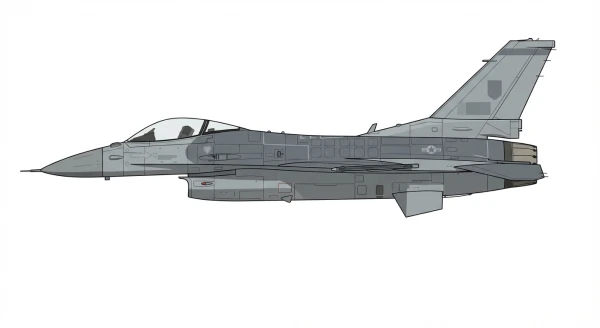
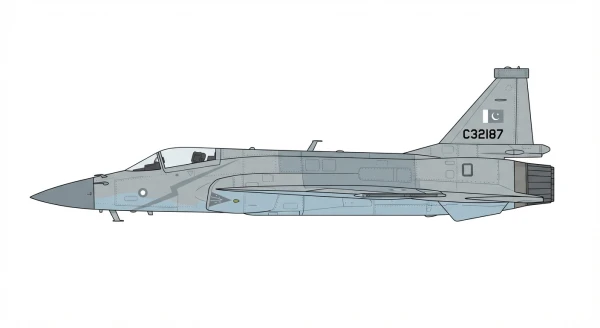
| F-16 Fighting Falcon | JF-17 Thunder | |
|---|---|---|
| Origin country | 🇺🇸 United States | 🇨🇳 China🇵🇰 Pakistan |
| Category | Combat Aircraft | Combat Aircraft |
| Manufacturer | General Dynamics | CAC/PAC |
| First flight | 2 February 1974 | 25 August 2003 |
| Year introduced | 1979 | 2007 |
| Number produced | 4604 units | 144 units |
| Average unit price | $18.8 million | $25 million |
| Wing area | 27.9 m² | 24.4 m² |
| Wingspan | 10.0 m | 9.0 m |
| Height | 4.9 m | 4.8 m |
| Length | 15.1 m | 14.0 m |
| Maximum speed | 2178 km/h | 1960 km/h |
| Operational range | 4,217 km | 900 km |
| Service ceiling | 15,240 m | 16,700 m |
| Max. takeoff weight | 19,200 kg | 12,701 kg |
| Empty weight | 8,570 kg | 6,411 kg |
| Total thrust | 1 x 12,701 kgf | 1 x 8,606 kgf |
Detailed Comparison
The F-16 Fighting Falcon, a product of the U.S. Lightweight Fighter program, is a mature, combat-proven platform with over 4,600 units built since the 1970s. In contrast, the Sino-Pakistani JF-17 Thunder is a 21st-century design conceived as a cost-effective, modern multi-role fighter for the Pakistan Air Force and the export market. The F-16's widespread adoption by over 25 nations provides a deep logistical and operational support base that the newer, less-produced JF-17 currently lacks.
Development and Design
The F-16 was revolutionary for its era, introducing a relaxed static stability/fly-by-wire flight control system, a side-mounted control stick, and a frameless bubble canopy. Its design philosophy prioritized kinematic performance and agility. The JF-17’s development was driven by affordability and self-sufficiency. It employs a more conventional aerodynamic layout but incorporates modern design features like a glass cockpit and, notably, open-architecture avionics using C++ for easier software integration and modification. The F-16 was designed around a powerful American engine and a vast arsenal of Western munitions, while the JF-17 was built around a Russian-derived Klimov RD-93 engine and tailored for Chinese and Pakistani weapon systems.
Specifications and Performances
The F-16 demonstrates superior performance metrics. Its General Electric F110 engine produces significantly more thrust with afterburner (12,946 kgp) than the JF-17’s RD-93 (8,563 kgp). This power advantage contributes to the F-16's higher maximum speed (2,410 km/h vs. 2,205 km/h) and service ceiling (18,288 m vs. 16,700 m). A key differentiator is payload capacity; the F-16’s much higher maximum takeoff weight (19,200 kg vs. 12,701 kg) allows it to carry a heavier and more diverse ordnance load on nine hardpoints, compared to the JF-17’s seven. This directly impacts its mission flexibility and combat persistence. While the JF-17 is a lighter airframe, it cannot match the F-16's overall energy-maneuverability and payload-range capabilities.
Deployment and usage
The F-16 possesses one of the most extensive combat records of any modern fighter, having been used in major conflicts from Operation Desert Storm to operations over the Balkans, Afghanistan, and Iraq. Its roles have included air superiority, ground attack, and Suppression of Enemy Air Defenses (SEAD). The JF-17's operational history is far more limited, with its most notable combat use occurring during the 2019 India-Pakistan border skirmishes. The upgrade paths for both aircraft are critical; the F-16V and JF-17 Block III variants both integrate AESA radars and advanced mission computers, significantly enhancing their sensor and data-processing capabilities and narrowing the technological gap between the two platforms.
Conclusion
The F-16 Fighting Falcon remains a formidable and highly refined 4th-generation fighter, representing a top-tier choice defined by its proven performance, vast weapons compatibility, and interoperability within NATO and allied forces. The JF-17 Thunder is a credible and pragmatic alternative for nations seeking modern multi-role capabilities without the financial or geopolitical commitments of acquiring Western aircraft. While its Block III variant offers advanced systems comparable to modern F-16s, the platform has yet to achieve the F-16's scale of production, combat validation, and global logistics footprint. The decision between them hinges on an operator's budget, strategic allegiances, and requirement for proven combat pedigree versus affordable modernity.