F-16 Fighting Falcon vs Typhoon
F-16 Fighting Falcon vs Typhoon at a glance — top speed 2,178 vs 2,495 km/h, range 4,217 vs 3,790 km, max takeoff weight 19,200 vs 23,500 kg, built 4,604 vs 589 units.
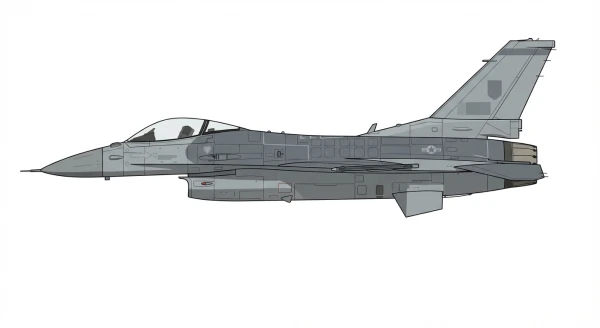
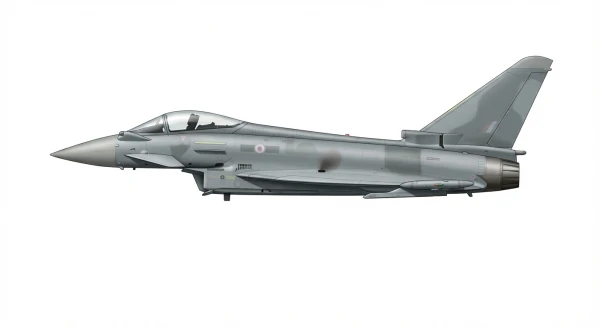
| F-16 Fighting Falcon | Typhoon | |
|---|---|---|
| Origin country | 🇺🇸 United States | 🇩🇪 Germany🇪🇸 Spain🇬🇧 United Kingdom🇮🇹 Italy |
| Category | Combat Aircraft | Combat Aircraft |
| Manufacturer | General Dynamics | Eurofighter |
| First flight | 2 February 1974 | 27 March 1994 |
| Year introduced | 1979 | 2003 |
| Number produced | 4604 units | 589 units |
| Average unit price | $18.8 million | $90 million |
| Wing area | 27.9 m² | 51.2 m² |
| Wingspan | 10.0 m | 11.0 m |
| Height | 4.9 m | 5.3 m |
| Length | 15.1 m | 16.0 m |
| Maximum speed | 2178 km/h | 2495 km/h |
| Operational range | 4,217 km | 3,790 km |
| Service ceiling | 15,240 m | 16,765 m |
| Max. takeoff weight | 19,200 kg | 23,500 kg |
| Empty weight | 8,570 kg | 11,000 kg |
| Total thrust | 1 x 12,701 kgf | 2 x 9,163 kgf |
Detailed Comparison
The General Dynamics F-16 Fighting Falcon and Eurofighter Typhoon were built for different air combat paradigms. The F-16 emerged from the US Lightweight Fighter program in the 1970s as a high-G, single-engine dogfighter that evolved into a multirole platform, while the Typhoon was conceived by a European consortium in the 1980s as a twin-engine interceptor meant to defeat Warsaw Pact aircraft before transitioning to strike missions.
Development and Design
The F-16 was built on energy-maneuverability theory, prioritizing sustained turn rates and cost-efficiency. General Dynamics integrated relaxed static stability, fly-by-wire controls, and a side-mounted stick to allow pilots to tolerate 9G maneuvers. Mass production economies scaled the platform to 4,604 units at a $75.0 million unit cost. The Eurofighter consortium (UK, Germany, Italy, Spain) prioritized kinematic dominance and high-altitude acceleration, selecting a canard-delta configuration. Workshare disputes delayed the Typhoon’s service entry until 2003, capping production at 589 units with an acquisition cost of $90.0 million.
Specifications and Performances
The Typhoon possesses a strict kinematic advantage over the F-16. Its twin Eurojet EJ200 turbofans produce 12,232 kgf of combined thrust, driving a 315.0 m/s climb rate compared to the F-16's 254.0 m/s. While both airframes reach similar top speeds (2,495 km/h for the Typhoon, 2,410 km/h for the F-16), the Typhoon's canard-delta layout and excess specific power give it an edge in high-altitude beyond-visual-range (BVR) engagements. The F-16, carrying an 8,570 kg empty weight against the Typhoon's 11,000 kg, relies on its blended wing-body and single F110 engine (7,777 kgf thrust) to optimize instantaneous turn performance at lower altitudes.
Deployment and usage
The F-16 has accumulated decades of contested combat data, establishing doctrine for modern tactical aviation.
- In Operation Desert Storm, USAF F-16s destroyed over 30 Iraqi aircraft on the ground and executed mass strike missions.
- Israeli F-16s routinely penetrate dense air defense networks in Lebanon and Syria.
- Specialized F-16 variants established the benchmark for the Suppression of Enemy Air Defenses (SEAD) using AGM-88 HARM.
The Typhoon’s operational record centers on air policing and strikes in uncontested airspace. British and Italian airframes flew ground-attack profiles during the 2011 Libyan intervention and Operation Shader in Iraq. Saudi Arabia deployed Typhoons for airstrikes in Yemen. While the Typhoon successfully integrated Storm Shadow and Brimstone munitions, it lacks the deep SEAD and dogfighting combat record of the American jet.
Conclusion
The Eurofighter Typhoon holds the edge in offensive counter-air and interception. Its twin-engine thrust, superior climb rate, and integration of the MBDA Meteor missile make it a more lethal BVR platform for air forces prioritizing localized air superiority. The F-16 dictates the standard for ground attack, SEAD, and fleet procurement. Its massive operator base, mature targeting pod integration, and lower acquisition cost make it the definitive choice for air forces requiring mass and proven air-to-ground survivability.