How Early-Warning Aircraft Radars Cover 360 Degrees: Rotodome, Fixed Side Arrays and Three-Face Designs
Canada's term sheet and NATO's joint buy both settle on an aircraft without the E-3's rotating saucer; the physics behind the three designs explains what the flat Erieye array gains in revisit rate and what it gives up ahead and astern.
On September 25, 2026, Canada's Defence Investment Agency and Saab signed a non-binding term sheet setting the framework for negotiations on six GlobalEye airborne early warning and control aircraft for the Royal Canadian Air Force. Both parties said the document "does not constitute a contract or commitment to procure aircraft," and no timeline or final cost was given, CBC News reported. The preliminary deal follows Canada's naming of Saab as preferred supplier on May 27, and it would give an air force that fields no airborne early warning aircraft its first such type.
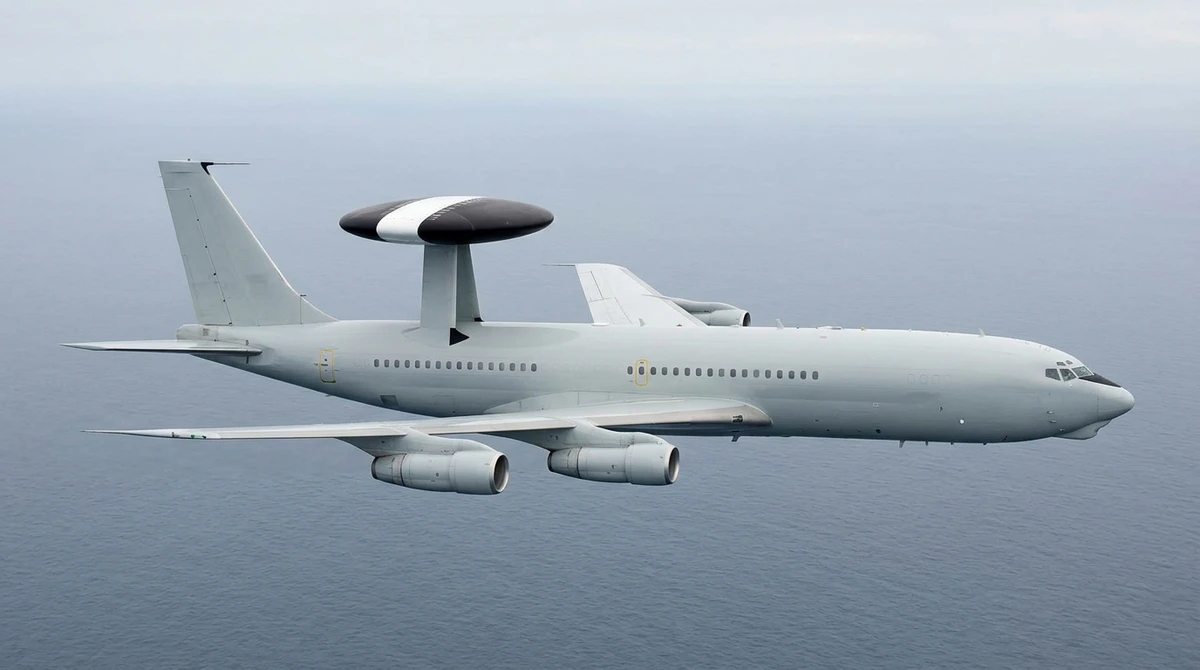
On July 7, eleven NATO allies announced they would jointly procure up to 10 GlobalEye to succeed the alliance's E-3 Sentry AWACS fleet, after NATO dropped the E-7 as presumptive successor in November 2025. The saucer turning slowly above the fuselage, the feature that made the AWACS instantly recognizable, is gone; a long, flat fairing on the spine of a business jet takes its place. The change reflects a different answer to the basic problem of airborne early warning, and a trade-off in coverage that Saab weighed and accepted.
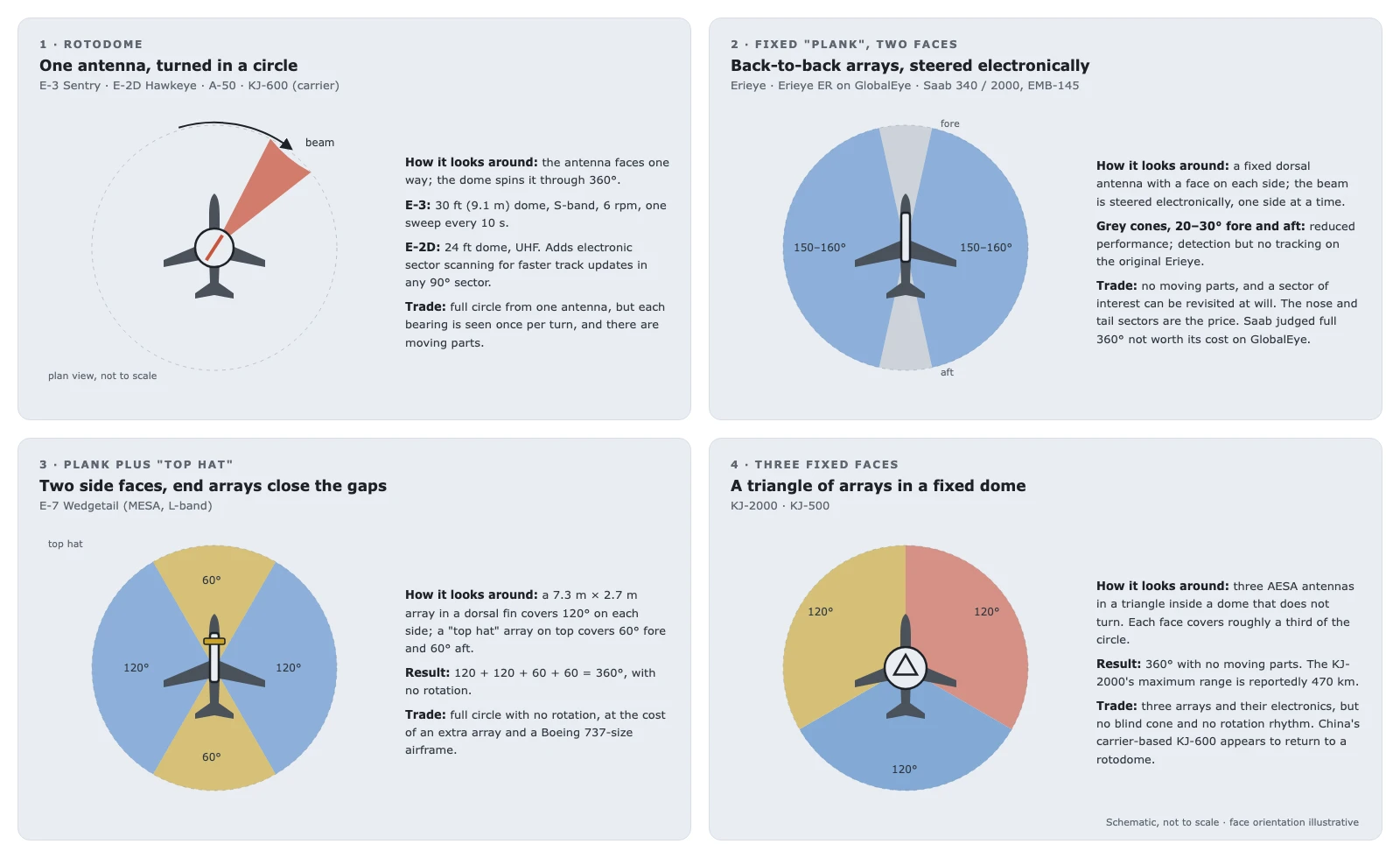
The problem is simple to state. A radar antenna sees where it points: it sends a beam in one direction and listens for the echo. An early warning aircraft, orbiting for hours over a region, needs the full 360 degrees around it, refreshed often enough to keep track of every moving object. Designers have settled on three answers:
- The rotodome: spin one antenna under a saucer-shaped dome.
- The plank: fix a flat, two-sided array along the top of the fuselage and steer its beam electronically.
- The triangle: fix three arrays inside a dome that never moves.
Rotating radars
The rotodome is the oldest and most familiar answer. The E-3 Sentry, built on the Boeing 707-320B airliner, carries what Aviation Week describes as a pulse-Doppler, mechanically scanned S-band radar, the AN/APY-1 or APY-2, "in a 30-ft. rotating dome suspended 11 ft. above the fuselage by a pair of struts." The dome is 6 feet (1.8 meters) thick, according to the US Air Force. Hydraulics turn it at six revolutions per minute, Aviation Week reports, so the antenna inside completes one full sweep every 10 seconds.
A single antenna covers the whole circle; the weakness is rhythm. The beam passes any given point once per rotation and cannot come back sooner: whatever happens in the 10 seconds between looks, the operators see only on the next pass. The US Air Force quotes an effective range of more than 200 miles for low-flying targets and farther for aircraft at medium and high altitude. GlobalMilitary.net counts 25 E-3s in national service in four countries, 14 of them with the United States, alongside NATO's jointly owned E-3A fleet, which is in no national total.
The US Navy's carrier-based E-2D Hawkeye, a twin-engine turboprop with a 24-foot rotodome, shows how the saucer can be modernized rather than abandoned. Its AN/APY-9 radar operates at UHF, a band Lockheed Martin calls "ideal for long range detection of stressing targets," and it adds electronic scanning to the mechanical rotation: according to Lockheed Martin, "Electronic Sector Scanning enables increased track update rates in any 90° sector." With 117 aircraft in service across five countries and 28 on order, the E-2 is the most numerous early warning type in GlobalMilitary.net's data.
Fixed side-looking arrays
The second answer removes the moving parts and accepts a gap. Saab's original Erieye, carried by Sweden's Saab 340, was, according to Key.Aero, the first airborne early warning radar to use an active electronically scanned antenna: an S-band, side-looking array of 192 solid-state transmit/receive modules, weighing 900 kg and housed in a 9-meter, plank-like radome on the aircraft's back. The array faces left and right, and its beam is formed and pointed electronically, so it can jump from one bearing to another at once rather than waiting for a rotation to bring it around. Key.Aero describes "the major advantage" this way: the antenna "allows sectors of interest to be scanned very frequently, while others are still being monitored."
The price is paid at the ends. A flat array looks sideways well and forward poorly. Key.Aero's account is precise: "The radar beam can be steered as required within a 150°-160° sector on each side of the aircraft (one side at a time). Outside these sectors, performance is reduced in forward and aft directions. Erieye has some ability to detect aircraft in the 20°-30° sectors fore and aft of the aircraft heading but has no track capability in these sectors." In plain terms, a target directly ahead of or behind the aircraft may be seen but not followed.
GlobalEye keeps the fairing and changes what is inside it. The Erieye ER antenna, 10 meters long according to Saab, uses gallium nitride technology to detect smaller and faster targets and offers 70 percent more range than the original, Key.Aero reports, while fitting inside the same roof-mounted radome. Saab quotes an instrumented range of 350 nautical miles (650 km) and detection of low-flying threats at more than 400 km when operating at 35,000 feet. The fore-and-aft gap remains, by choice. According to Key.Aero, "Saab examined the option of providing full 360° coverage, but found it offered limited operational benefit for the additional cost. Its omission allows the ER radar to fit into the existing dorsal fairing." Key.Aero lists a Leonardo Seaspray 7500E maritime search radar and a FLIR Star SAFIRE electro-optical sensor alongside the main array, on a Bombardier Global 6000/6500 airframe. GlobalEye first flew on March 14, 2018; the United Arab Emirates, its launch customer, flies the five in service, and Sweden has three on order and France two.
The E-7 Wedgetail, the type NATO set aside, uses the same plank principle but closes the gap. Northrop Grumman's L-band MESA is, in European Security & Defence's description, "a 7.3m x 2.7m AESA array mounted in a dorsal fin ... to provide 120 degree coverage on both sides of the aircraft, while a 'top hat' supporting array covers 60 degree sectors facing fore and aft." Two sides at 120 degrees and two ends at 60 make the full circle, with a fin and a cap on a Boeing 737 in place of a low fairing. That is the essence of how the E-7 and GlobalEye compare: complete coverage on a larger airframe against two narrow cones of reduced performance on a business jet. Fifteen E-7s are in service with Australia, South Korea, Turkey and the United Kingdom, and 28 are on order, 26 of them for the US Air Force.
Triangular fixed arrays
China took a third route. The KJ-2000 carries what looks like a rotodome, but the dome is fixed, and inside it, The War Zone reports, is "not a single radar but three active electronically scanned array (AESA) antennas in a triangular configuration." Each face covers its own arc and steers its beam electronically; together they cover the circle with no moving parts and no fore-and-aft cones. The type's maximum range is reportedly 470 km, according to The War Zone. The smaller KJ-500, on the Y-9 turboprop, repeats the arrangement with "three AESA antennas arranged in a triangular configuration to provide 360-degree coverage, as in the larger KJ-2000." China's air arms field 60 KJ-500s, 40 with the PLA Air Force and 20 with naval aviation, plus four KJ-2000s, a fleet that, as GlobalMilitary.net has reported, outnumbers the US Air Force's early warning aircraft.
For the buyers, the choice is made and the schedule is long. Saab has said it could bring GlobalEye into operational service with NATO in 2031, according to The War Zone. Canada has a framework for talks, six aircraft as the working number and, for now, neither a contract, a date nor a price. Both will receive an aircraft that refreshes its picture on demand rather than on a 10-second rotation and that keeps the reduced coverage ahead and behind that Key.Aero describes on the Erieye family, because Saab judged the full circle not worth the cost. The saucer answered the problem by turning; its successor answers it with electronics, and with a gap it chose to keep.
More News
All news →
Canada Signs Preliminary Deal With Saab for Six GlobalEye Early-Warning Aircraft
Saab and Canada's Defence Investment Agency signed a non-binding term sheet on September 25, 2026, setting the framework for negotiations on six GlobalEye airborne early warning aircraft for the Royal Canadian Air Force.
Boom or Drogue: Why the RAF Tanker Sent to Saudi Arabia Cannot Refuel Its F-15s
Britain announced on September 22, 2026 that it will send a Voyager tanker to Saudi Arabia, but its hose-and-drogue pods can serve only the Typhoons and Tornados, not the 232 F-15s that make up 60 percent of the Saudi combat fleet.
Nuclear vs Air-Independent Propulsion: How a Submarine Runs Without Air, and What Japan Is Weighing
After Japan's defense minister declined on September 11, 2026 to rule out nuclear-powered submarines, a technical explainer on how a reactor, a Stirling engine, a fuel cell and a lithium-ion battery each keep a boat under water, and what each one buys.
Japan Will Not Rule Out Nuclear-Powered Submarines as Six Navies Field 140 Between Them
Japan's defense minister said on 11 September 2026 that nuclear-powered submarines "will not be ruled out" in the year-end revision of the country's security documents, an option that would put the JMSDF alongside the six navies operating 140 nuclear boats today.

Only Four Air Forces Fly High-Altitude Surveillance Drones, and Japan Has Just Lost One of Its Three
A Japan Air Self-Defense Force RQ-4B Global Hawk went down over international waters north of Tottori prefecture on 15 September 2026, the first loss of a Japanese Global Hawk and one of only 39 high-altitude surveillance drones GlobalMilitary.net records in service worldwide.
South Korean Warships Serve in Seven Foreign Navies, but Only Three Bought Them New
Hanwha Ocean was named preferred bidder for the Royal Thai Navy's next frigate on September 9, 2026; GlobalMilitary.net's inventories count 15 Korean-designed warships in seven foreign navies, nine of them second-hand corvettes.