BTR-60
Summary
| Origin country | 🇷🇺 Russia |
| Category | Armored Personnel Carrier |
| Sub-type | Armoured personnel carrier |
| Manufacturer | GAZ |
| Number built | 25000 units |
Technical specifications
| Crew | 3 crew + 14 passengers personnels |
| Range | 500 km |
| Mass | 10.3 tons |
| Height | 2.31 m (7.6 ft) |
| Width | 2.825 m (9.3 ft) |
| Length | 7.56 m (24.8 ft) |
| Max. speed | 80 km/h (50 mph) |
| Engine | two six-cylinder gasoline GAZ-49B engines (180 hp combined) |
| Weapon 1 | KPVT 14.5 mm heavy machine gun |
| Weapon 2 | PKT 7.62 mm tank machine gun |
Historical operators
Profile of BTR-60
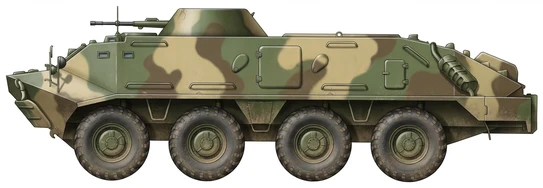
Description
The BTR-60 is a Soviet eight-wheeled armored personnel carrier developed in the late 1950s by the GAZ design bureau to replace the BTR-152 and BTR-40. Development was driven by the requirement for a roofed, amphibious transport with NBC protection for motor rifle divisions. The GAZ design, led by V. A. Dedkov, was selected over competing prototypes from ZIL and KAZ due to its lower production cost and simpler technological requirements for mass production. The vehicle entered Soviet service in December 1959 and was first publicly displayed in 1961.
The hull consists of welded steel armor providing protection against 7.62 mm small arms fire and shrapnel. The BTR-60 utilizes a layout with the crew in the front, the troop compartment in the center, and the engines in the rear. It is powered by two side-by-side 90 hp GAZ-49B gasoline engines; the right engine drives the second and fourth axles, while the left engine drives the first and third. This configuration allows the vehicle to remain mobile if one engine is disabled. The vehicle is fully amphibious, propelled by a rear-mounted water jet and stabilized by a front trim vane.
The initial BTR-60P version featured an open troop compartment for up to 16 soldiers. The BTR-60PA, introduced in 1963, added an armored roof and collective NBC protection. The BTR-60PAI and BTR-60PB variants incorporated a BPU-1 turret armed with a 14.5 mm KPVT heavy machine gun and a 7.62 mm PKT coaxial machine gun. The BTR-60PB also introduced improved sights and a side door for the troop compartment. Specialized models were developed for command, artillery observation, and air defense roles, including the BTR-60PU and the BTR-60PZ, the latter featuring a turret with high-angle elevation for anti-aircraft engagement.
Produced in large numbers, the BTR-60 was widely exported and has operated in dozens of countries. Its first combat use occurred during the 1969 Sino-Soviet border conflict, where vehicles experienced high loss rates from infantry anti-tank weapons. During the Soviet-Afghan War, gasoline engines suffered from power loss and overheating in high-altitude environments, and the limited turret elevation hindered engagement of targets on high ground. In Angola, BTR-60s were used for convoy protection and during the Battle of Cuito Cuanavale. Other engagements include the 1968 invasion of Czechoslovakia, the Yom Kippur War, the 1971 Indo-Pakistani War, and the First Chechen War. The vehicle is currently utilized in the Russo-Ukrainian War by both Russian and Ukrainian forces, including modernized variants such as the BTR-60D and Khorunzhyi.