A-37 Dragonfly
Vietnam War-era American light attack aircraft, extensively deployed in close air support and counter-insurgency operations. Key figures: top speed 816 km/h, range 1,628 km, service ceiling 12,730 m, max takeoff weight 6,350 kg, unit price $0.16M, built 577. In service with 5 air forces as of 2026 — Peru (20), Honduras (9), El Salvador (6) and 2 others.
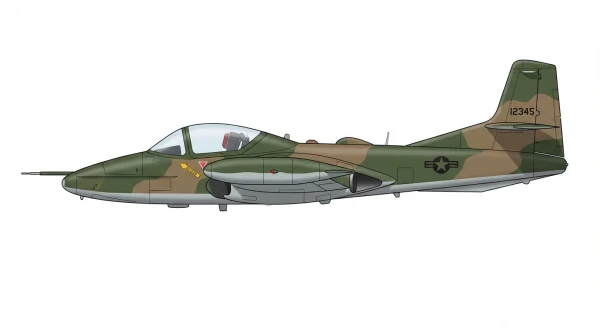
| Length | 8.6 m (28.3 ft) |
| Wingspan | 10.9 m (35.9 ft) |
| Height | 2.7 m (8.9 ft) |
| Wing area | 17.1 m² (184.0 sqft) |
| Empty weight | 2,817 kg (6,210 lbs) |
| Max. takeoff weight | 6,350 kg (13,999 lbs) |
| Powerplant | 2 × turbojets General Electric J85-GE-17A 2,586 kgf each |
| Ejection seat | Weber M2F2 |
| Maximum speed | 816 km/h (507 mph) |
| Operational range | 1,628 km (1,012 mi) |
| Service ceiling | 12,730 m (41,765 ft) |
| Climb rate | 35.5 m/s (116.5 ft/s) |


- Air-to-Air Short-Range Raytheon AIM-9 Sidewinder
- Pod Cluster Aerojet SUU-14/A
- Low-Drag Mk 82
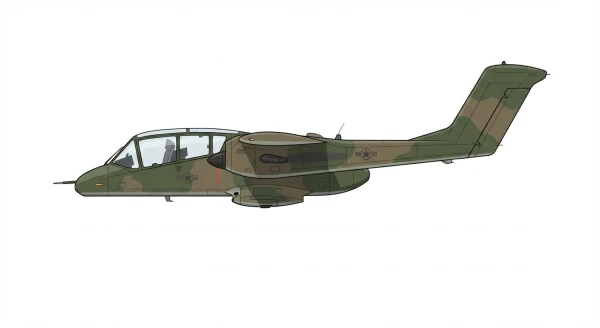
Description
The Cessna A-37 Dragonfly, nicknamed "Super Tweet", is a twin-jet light attack aircraft built by Cessna in the United States. Derived from the T-37 basic trainer, it was developed for the counter-insurgency (COIN) role during the Vietnam War and entered combat service in August 1967. It flew over 160,000 combat sorties in Southeast Asia and remained in Latin American service into the 2020s.
Development
In late 1962 the USAF Special Air Warfare Center at Hurlburt Field evaluated two T-37Cs for the COIN mission, seeking a jet replacement for the Douglas A-1 Skyraider. Cessna received a 1963 contract for two YAT-37D prototypes with strengthened wings, 360-litre tip tanks, rough-field landing gear and General Electric J85-J2/5 engines of 2,400 lbf each. The first YAT-37D flew in October 1964 and the second a year later. Interest lapsed until A-1 losses mounted, after which the USAF ordered 39 pre-production aircraft rebuilt from T-37Bs, designated A-37A. A contract for the improved A-37B followed in early 1967, initially for 57 aircraft and quickly raised to 127; 577 were eventually built at roughly a quarter of the unit cost of an F-4 Phantom II.
Design
The A-37B airframe was stressed for 6 g and a 4,000-hour fatigue life, with field experience showing 7,000 hours between overhauls. Power came from two J85-GE-17A turbojets of 2,850 lbf, canted outward and downward to improve single-engine handling; pilots were authorised to cruise on one engine to extend endurance. The aircraft was unpressurised and retained dual controls, the second seat carrying an observer on FAC missions. Survivability features included armoured ejection seats, nylon flak curtains, foam-filled self-sealing tanks and widely separated redundant elevator control runs. A nose-mounted probe allowed probe-and-drogue refuelling, unusual for a USAF type. Maintenance ran about two hours per flight hour.
Armament
A GAU-2B/A 7.62 mm minigun with 1,500 rounds was fitted in the right side of the nose, firing at 3,000 rounds per minute. Eight underwing pylons carried up to 5,800 lb of external stores: inner four rated at 860 lb, two intermediate at 600 lb and two outer at 500 lb. Munitions included Mk 81, Mk 82 and M117 bombs, BLU-1C/B and BLU-32B firebombs, CBU-12/22/24 cluster bombs, SUU-14 dispensers, LAU-3/A rocket pods, SUU-11/A minigun pods and AIM-9 Sidewinder. GPU-2/A 20 mm and AMD 30 mm cannon pods were tested but seldom used.
Operational History
Twenty-five A-37As deployed to Bien Hoa Air Base in August 1967 under the Combat Dragon programme, flying close air support, helicopter escort, FAC and night interdiction; none were lost to enemy fire. Bombing accuracy averaged 45 feet. Twenty-two USAF aircraft were lost in combat; the type never flew over North Vietnam. The RVNAF received 254 A-37Bs, of which 95 were captured and operated by the Vietnam People's Air Force, some used to attack Tan Son Nhut on 28 April 1975. USAF aircraft passed to Air National Guard and Reserve units as OA-37Bs, serving in Operation Just Cause in December 1989 and retiring in 1992. El Salvador received 21 A-37Bs and 9 OA-37Bs from 1983, losing two. Other operators included Chile (44), Ecuador (28), Peru (36), Colombia (16), Guatemala, Honduras, Thailand, South Korea, Uruguay and the Dominican Republic.
Variants
- YAT-37D: Two T-37Cs converted with J85 engines and six underwing pylons as prototypes, later redesignated YA-37A.
- A-37A: Cessna Model 318D, 39 T-37Bs rebuilt with J85-GE-5 engines, nose minigun and eight pylons.
- A-37B: Cessna Model 318E production version with J85-GE-17A engines, inflight refuelling, increased fuel and strengthened airframe; 577 built.
- OA-37B: Armed observation and forward air control conversion of the A-37B.
- B.J.6: Royal Thai Air Force designation for the A-37B.
Frequently Asked Questions
What type of aircraft is the A-37 Dragonfly?
What is the maximum speed of the A-37 Dragonfly?
What is the range of the A-37 Dragonfly?
When did the A-37 Dragonfly first fly?
How many A-37 Dragonfly have been built?
Which countries operate the A-37 Dragonfly?
How much does a A-37 Dragonfly cost?
What is the service ceiling of the A-37 Dragonfly?
- AUG 302026 Updated Description updated
- AUG 122026 Updated Range corrected to the ferry range with drop tanks
- APR 72026 Updated Sources and cross-references refreshed
- JAN 242026 Updated Thrust updated