Lockheed P-3 Orion
Summary
| Category | Military Special Mission Aircraft |
| Origin country | 🇺🇸 United States |
| Manufacturer | Lockheed |
| First flight | 19 August 1958 |
| Year introduced | 1962 |
| Number produced | 757 units |
| Average unit price | $36 million |
Technical specifications
| Version: P-3C | |
|---|---|
| Crew | 5 to 21 |
| Operational range | 2,491 km (1,548 mi) |
| Endurance | 12 hours |
| Maximum speed | 750 km/h (466 mph) |
| Wing area | 121 m² (1302.4 sqft) |
| Wingspan | 30.4 m (99.7 ft) |
| Height | 11.8 m (38.7 ft) |
| Length | 35.6 m (116.8 ft) |
| Service ceiling | 8,626 m (28,301 ft) |
| Empty weight | 35,017 kg (77,199 lbs) |
| Max. takeoff weight | 64,410 kg (142,000 lbs) |
| Climb rate | 16.0 m/s (52.5 ft/s) |
| Powerplant | 4 x turboprops Allison T56-A-14 delivering 3430 kW each |
Current operating countries
| Country | Units | ||
|---|---|---|---|

|
Japan | 49 | |

|
South Korea | 15 | |

|
Canada | 14 | |

|
Taiwan | 12 | |

|
United States | 8 | |

|
Pakistan | 6 | |

|
Portugal | 5 | |

|
Brazil | 3 | |

|
Iran | 3 | |

|
Chile | 2 | |

|
Argentina | 1 | |

|
Greece | 1 | |
All operators
1 recent event involving the P-3 Orion
| Date | Air Force | Aircraft | Active Δ | Ordered Δ |
|---|---|---|---|---|
| 10 Mar 2026 | 🇮🇷 Islamic Republic of Iran Air Force | P-3F | -1 | — |
| P-3F Orion maritime patrol aircraft destroyed on ground at Kerman Airport by USAF precision strike during Operation Epic Fury; confirmed by CENTCOM video footage. Details → | ||||
Armament
Missiles payload:
- Air-to-Surface AGM-65 Maverick
- Air-to-Surface AGM-84 Harpoon
Bombs payload:
- Thermonuclear B57 Mod 1
- Cluster Mk 20 Mod 0 Rockeye
- mine marine Mk 60
- Low-Drag Mk 82
- Low-Drag Mk 83
- Low-Drag Mk 84
- Anti-Submarine Mk 101 Lulu
Description
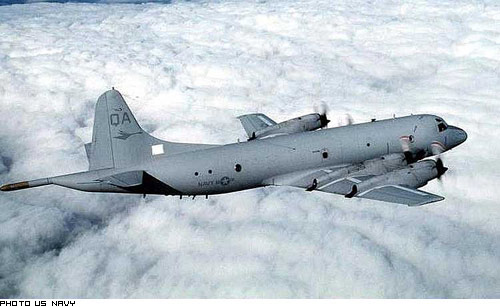
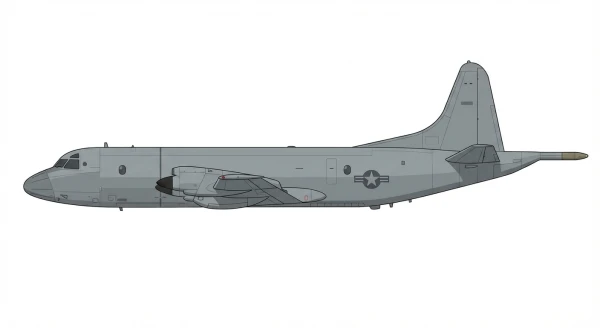
In August 1957, the U.S. Navy sought proposals for an advanced aircraft to replace the Lockheed P2V Neptune and Martin P5M Marlin for maritime patrol and anti-submarine warfare duties. Lockheed proposed a military version of its L-188 Electra, then still under development. In April 1958, Lockheed won the competition and was awarded an initial research-and-development contract in May. The prototype YP3V-1/YP-3A, modified from the third Electra airframe, first flew on 19 August 1958. While sharing the same design philosophy as the Electra, the aircraft featured structural differences tailored for its role, including a shorter fuselage ahead of the wings to accommodate an internal bomb bay, a pointed nose radome, a distinctive tail stinger or "MAD" boom for magnetic anomaly detection, and wing hardpoints. Production techniques were also enhanced. The Orion is powered by four Allison T56 turboprops, enabling a top speed comparable to propeller fighters or slow turbofan jets. The first production version, designated P3V-1, was launched on 15 April 1961, and deliveries to Patrol Squadrons VP-8 and VP-44 began in August 1962 at Naval Air Station Patuxent River, Maryland. On 18 September 1962, the U.S. military adopted a unified designation system, renaming the aircraft the P-3 Orion. A total of 757 P-3s were built.
The P-3 is equipped with an internal bomb bay located under the forward fuselage, capable of holding conventional Mark 50 or Mark 46 torpedoes and/or special weapons. Furthermore, underwing stations, or pylons, allow for a variety of armament configurations, including the AGM-84 Harpoon, AGM-84E SLAM, AGM-84H/K SLAM-ER, AGM-65 Maverick, 127 mm (5.0 in) Zuni rockets, and various sea mines, missiles, and gravity bombs. In total, the P-3 has 10 hardpoints (3 on each wing and 2 on each wing root) and eight internal bomb bay stations, amassing a capacity of 20,000 lb (9,100 kg).
Developed during the Cold War, the P-3's primary mission was to localize Soviet Navy ballistic missile and fast attack submarines detected by undersea surveillance systems and eliminate them in the event of full-scale war. At its height, the U.S. Navy’s P-3 community consisted of twenty-four active duty "Fleet" patrol squadrons. In October 1962, P-3As flew several blockade patrols in the vicinity of Cuba. Beginning in 1964, forward deployed P-3s began flying various missions under Operation Market Time from bases in the Philippines and Vietnam, primarily focusing on stemming the supply of materials to the Viet Cong by sea. The only confirmed combat loss of a P-3 occurred during Operation Market Time when a U.S. Navy P-3B of VP-26 was downed by anti-aircraft fire in the Gulf of Thailand in April 1968. On 2 August 1990, within 48 hours of Iraq's invasion of Kuwait, U.S. Navy P-3Cs were among the first American forces to arrive in the area, detecting Iraqi patrol boats and naval vessels attempting to move to Iranian waters. During Desert Shield, a P-3 using infrared imaging detected a ship with Iraqi markings beneath freshly-painted bogus Egyptian markings. In the late 1990s and early 2000s, the P-3's mission expanded to include battlespace surveillance both at sea and over land, during Operation Iraqi Freedom and Operation Enduring Freedom. Royal Australian Air Force AP-3Cs operated out of Minhad Air Base in the UAE from 2003 until their withdrawal in November 2012, conducting overland intelligence, surveillance and reconnaissance tasks in support of coalition troops across Afghanistan between 2008 and 2012. In 2011, several U.S. Navy P-3Cs, and two Canadian CP-140 Auroras, participated in maritime surveillance missions over Libyan waters, with one P-3C engaging a Libyan coast guard vessel. Six P-3Fs were delivered to the former Imperial Iranian Air Force in 1975 and 1976, and after the Iranian Revolution in 1979, they were used in the Tanker War phase of the Iran–Iraq War. The Pakistan Navy operated three P-3C Orions extensively during the Kargil conflict and conducted signals intelligence and bombing operations against Taliban and al-Qaeda operatives. The Spanish Air Force deployed P-3s to assist the international effort against piracy in Somalia, and since 2009, the Japan Maritime Self-Defense Force has deployed P-3s to Djibouti for anti-piracy patrols.
Main Variants:
-
WP-3D: Two P-3C aircraft modified on the production line for NOAA weather research, including hurricane hunting missions.
-
EP-3E Aries: P-3A and EP-3B aircraft converted into ELINT (Electronic Intelligence) aircraft for signals intelligence gathering.
-
EP-3E Aries II: P-3C aircraft converted into ELINT platforms with enhanced capabilities.
-
AP-3C: Royal Australian Air Force P-3C/W aircraft that underwent extensive upgrades, including new mission systems.
-
CP-140M Aurora: A long-range maritime reconnaissance and anti-submarine warfare aircraft for the Canadian Forces, based on the P-3C Orion airframe but incorporating the electronics suite of the Lockheed S-3 Viking.