M-46 Field Gun
Summary
| Origin country | 🇷🇺 Russia |
| Category | Towed Artillery |
| Sub-type | Towed Field Gun |
| Manufacturer | Perm Machine-Building Plant |
Technical specifications
| Crew | 8 personnels |
| Range | 27 km |
| Mass | 8.4 tons |
| Width | 2.45 m (8.0 ft) |
| Length | 11.84 m (38.8 ft) |
| Weapon 1 | 130 mm M-46 gun |
Historical operators
Profile of M-46 Field Gun
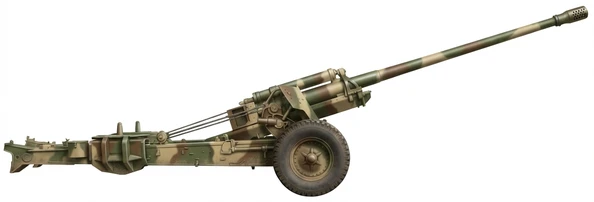
Description
The M-46 is a towed 130 mm artillery piece developed in the Soviet Union during the early 1950s. The design project was initiated in April 1946 at Factory No 172 (MOTZ) to replace several World War II-era field guns, including the 122 mm A-19 and 152 mm ML-20. Developed as part of a duplex system alongside the 152 mm M-47, the M-46 completed development in 1950 and entered series production in 1951. It was first observed by Western analysts in 1954. Although the D-74 122 mm field gun was developed as a competitor, the M-46 became the primary long-range gun in Soviet service until the introduction of new 152 mm systems in the 1970s.
The weapon is a derivative of the M-36 naval gun and features a 55-caliber barrel equipped with a tied jaw horizontal sliding-block breech and a pepperpot muzzle brake. Its recoil system consists of a hydro-pneumatic buffer located below the barrel and a recuperator above. The barrel is mounted on a split-trail carriage with deep box section trails and foam-filled road wheels. A small shield provides protection for the sights and crew. The sighting system includes a direct-fire anti-tank telescope, a panoramic periscopic indirect-fire sight, and a range drum for semi-direct fire. For night operations, the APN-3 sight can be utilized. For travel, the gun is towed via a two-wheeled limber with the barrel pulled back and locked between the trails.
Ammunition consists of separate-loading projectiles and metal cartridge cases. Projectile types include high-explosive fragmentation, armor-piercing solid shot, smoke, illuminating, and chemical rounds. Later developments introduced APHE, guided shells, and extended-range ammunition.
The M-46 has been widely exported and is operated by several countries. It was manufactured under license in China as the Type 59 and in Romania as the A412. In Soviet service, M-46 units were organized into Army and Front artillery brigades, often integrated with SNAR-2 radars for counter-battery fire. The weapon has seen combat in the Vietnam War, the Angolan Civil War, and the South African Border War. During conflicts in Angola, FAPLA and Cuban forces used the M-46 in counter-battery roles against South African artillery. It was employed during the Battle of Cuito Cuanavale to stall armored offensives and was used in the Uganda–Tanzania War. The gun has been deployed during the Russian invasion of Ukraine, with units reactivated from storage. Several nations have developed upgrade programs to convert the gun to 155 mm caliber or to create self-propelled variants using tracked or wheeled chassis.