King Air 350
American twin-turboprop utility aircraft, developed in the early 1970s and produced continuously since, widely used for civil transport, air ambulance, surveillance and military training roles. Key figures: top speed 578 km/h, range 3,345 km, service ceiling 10,668 m, max takeoff weight 6,804 kg, unit price $7.755M, built 4,442. In service with 30 air forces as of 2026 — United States (30), Saudi Arabia (17), Australia (12) and 27 others.
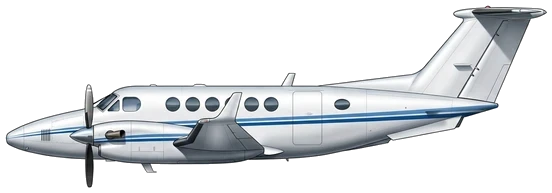
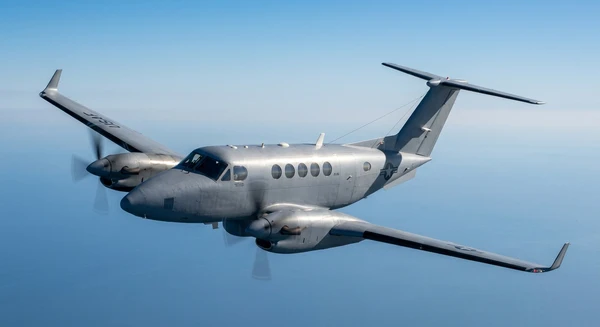
| Crew | 1–2 |
| Length | 14.2 m (46.7 ft) |
| Wingspan | 17.7 m (57.9 ft) |
| Height | 4.4 m (14.3 ft) |
| Empty weight | 4,516 kg (9,956 lbs) |
| Max. takeoff weight | 6,804 kg (15,000 lbs) |
| Powerplant | 2 × turboprops Pratt & Whitney Canada PT6A-60A 783 kW each |
| Maximum speed | 578 km/h (359 mph) |
| Operational range | 3,345 km (2,078 mi) |
| Endurance | 7 hours |
| Service ceiling | 10,668 m (35,000 ft) |
-
 United States
30
United States
30
-
 Saudi Arabia
17 +4
Saudi Arabia
17 +4
-
 Australia
12
Australia
12
-
 United Kingdom
12
United Kingdom
12
-
 Pakistan
11
Pakistan
11
-
 Japan
8
Japan
8
-
 Turkey
8
Turkey
8
-
 Iraq
7
Iraq
7
-
 Mexico
7
Mexico
7
-
 New Zealand
4
New Zealand
4
-
 Nigeria
4
Nigeria
4
-
 Canada
3
Canada
3
-
 Colombia
3
Colombia
3
-
 Ecuador
3
Ecuador
3
-
 Greece
3
Greece
3
-
 Peru
3
Peru
3
-
 France
2 +1
France
2 +1
-
 Ivory Coast
2
Ivory Coast
2
-
 Malaysia
2
Malaysia
2
-
 Mauritania
2
Mauritania
2
-
 Morocco
2
Morocco
2
-
 Sri Lanka
2
Sri Lanka
2
-
 Benin
1
Benin
1
-
 Guyana
1
Guyana
1
-
 Italy
1
Italy
1
-
 Jamaica
1
Jamaica
1
-
 Niger
1
Niger
1
-
 Paraguay
1
Paraguay
1
-
 Switzerland
1
Switzerland
1
-
 Uganda
1
Uganda
1
-
 Kuwait
0 +4
Kuwait
0 +4
Recent Events — King Air 350
3 events →
Description
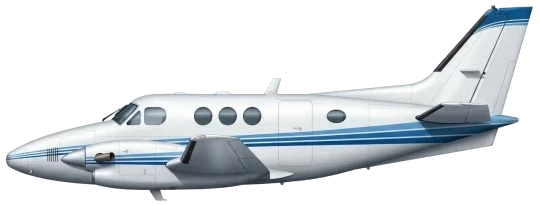
The Beechcraft King Air 350 is a twin-turboprop pressurized utility and special-mission aircraft produced in the United States by Beechcraft (later Hawker Beechcraft and Textron Aviation) as the Model B300. Introduced in 1990 as the Super King Air 350 — the "Super" prefix was dropped in 1996 — it is a stretched, winglet-equipped development of the Model 300 and is widely used for corporate transport, aerial survey, air ambulance, navaid calibration and intelligence, surveillance and reconnaissance work.
Development
The Model 300 originated as a cleaned-up B200 airframe with PT6A-60A engines in reshaped "pitot cowlings" and a maximum take-off weight of 14,000 lb. A Model 200 testbed (c/no. BB-343) flew with the new systems on October 6, 1981, the Model 300 prototype flew on September 3, 1983, and deliveries began in 1984; 247 were built, including 35 weight-limited 300LWs. The B300 added a 2.9 ft fuselage stretch, two extra cabin windows per side, a 3.4 ft span increase with winglets, and a 15,000 lb MTOW. The B300C with cargo door followed in 1990. Elliott Aviation's UltraQuiet active noise cancelling became standard in 1998, and Rockwell Collins Pro Line 21 avionics were announced in October 2003. The 350ER was announced at the Paris Air Show on June 13, 2005, and FAA certified on November 11, 2007. The 350i interior upgrade was announced in October 2008, with deliveries from December 2009; 687 B300s had been built by the end of 2009, including 42 350ERs. The 360 and 360ER, with autothrottle and digital pressurization control, were FAA certified in October 2020 and EASA certified in September 2021.
Design
The B300 has a low wing, T-tail and retractable tricycle landing gear, powered by two Pratt & Whitney Canada PT6A-60A turboprops of 1,050 shp. Maximum cruise is 312 kt at a 15,000 lb MTOW, ceiling 35,000 ft, and ferry range 1,806 nm; the 350ER raises MTOW to 16,500 lb with nacelle fuel tanks and Beechcraft 1900 landing gear, giving 2,670 nm range and providing ground clearance for a sensor belly pod. ISR-configured 350ERs have an armored cockpit floor and a forward-facing sensor operator console. NOAA's 350CER carries two downward-facing sensor ports supporting digital cameras, multispectral and hyperspectral sensors, topographic and bathymetric lidar, and gamma radiation detectors. Five 350CERs were modified before delivery with underwing hardpoints. The Blackhawk XP67A conversion substitutes PT6A-67A engines of 1,200 shp with five-blade composite propellers.
Operational History
The RAAF operates 16 aircraft with No. 32 and No. 38 Squadrons. The Japan Ground Self-Defense Force received nine B300s as the LR-2 between 1998 and 2004. The Iraqi Air Force ordered five 350ERs in March 2007. The RAF took four 350CERs as the Shadow R1, increased to six in July 2013; the Shadow R2 upgrade was cancelled in November 2025 over cost and performance failures. Four King Air 350s replaced Royal Navy Jetstream T2s in 2011 as the Avenger T1. The US Army acquired second-hand Model 300s modified for Task Force ODIN. In October 2018 the US State Department approved three 350ERs for Canada at an estimated $300 million. Losses include a Pakistan Army 350i at Rawalpindi on July 30, 2019, and a Nigerian Air Force 350i near Kaduna on May 21, 2021.
Variants
- Model 300: Baseline 14,000 lb MTOW version with PT6A-60A engines, produced alongside the 12,500 lb Model 300LW.
- Model B300 (King Air 350/350i): Stretched, winglet-equipped production model at 15,000 lb MTOW, later with Pro Line 21 avionics and an upgraded cabin.
- Model B300C (King Air 350C): B300 with rear fuselage cargo door, 35 built by the end of 2009 including one Swiss Air Force aerial survey aircraft.
- King Air 350ER: Extended-range special-mission model with nacelle fuel tanks, heavy-duty landing gear and 16,500 lb MTOW.
- King Air 360/360ER: 2020 update with autothrottle, digital pressurization and revised interior; ranges of 1,806 nm and 2,539 nm respectively.
Frequently Asked Questions
What type of aircraft is the King Air 350?
What is the maximum speed of the King Air 350?
What is the range of the King Air 350?
When did the King Air 350 first fly?
How many King Air 350 have been built?
Which countries operate the King Air 350?
How much does a King Air 350 cost?
What is the service ceiling of the King Air 350?
- AUG 292026 Updated First flight and entry into service corrected to the Model 350 (B300) dates
- AUG 202026 Created Page created with specifications, overview, origin and operators