North American F-86 Sabre
Summary
| Category | Combat Aircraft |
| Origin country | 🇺🇸 United States |
| Manufacturer | North American |
| First flight | 1 October 1947 |
| Year introduced | 1949 |
| Number produced | 9860 units |
| Average unit price | $1.2 million |
Technical specifications
| Version: CA-27 Sabre | |
|---|---|
| Crew | 1 pilot |
| Operational range | 2,454 km (1,525 mi) |
| Maximum speed | 1127 km/h (700 mph) |
| Wing area | 28.1 m² (302.5 sqft) |
| Wingspan | 11.3 m (37.1 ft) |
| Height | 4.4 m (14.4 ft) |
| Length | 11.4 m (37.5 ft) |
| Service ceiling | 15,850 m (52,001 ft) |
| Empty weight | 5,443 kg (12,000 lbs) |
| Max. takeoff weight | 9,621 kg (21,211 lbs) |
| Climb rate | 61.0 m/s (200.1 ft/s) |
| Powerplant | 1 x turbojet Rolls-Royce Avon 26 delivering 3402 kgf each |
Current operating countries
All operators
Armament
Missiles payload:
- Air-to-Air Short-Range Raytheon AIM-9 Sidewinder
Description
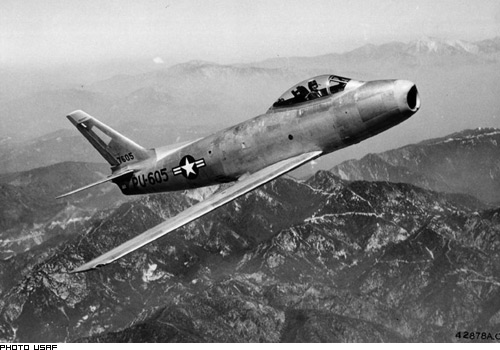
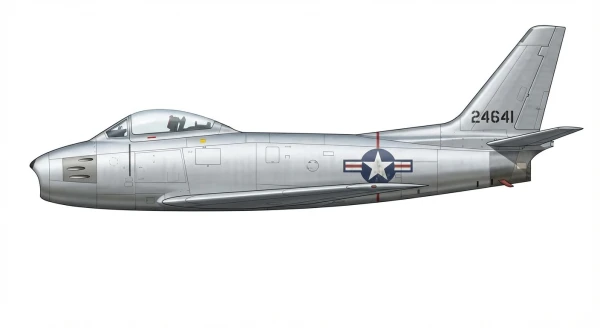
North American Aviation, having produced the P-51 Mustang during World War II, proposed its first jet fighter to the U.S. Navy in late 1944, resulting in the FJ-1 Fury. Initial proposals were drafted in mid-1944 for a medium-range, single-seat, high-altitude, jet-powered day escort fighter/fighter bomber. In early 1945, North American submitted four designs, with the USAAF selecting one and awarding a contract to build three XP-86 prototypes. By deleting requirements from the FJ-1 Fury and through other modifications, the XP-86 was lighter and faster, though early studies indicated similar performance to rivals XP-80 and XP-84. The XP-86 crucially failed to meet the required top speed of 600 mph (970 km/h). North American utilized flight research data seized from German aerodynamicists, which demonstrated that a thin, swept wing could reduce drag and delay compressibility issues. Despite resistance from some senior staff, the swept-wing concept was adopted, incorporating a 35° swept-back wing with modified NACA airfoils and an automatic slat design based on the Messerschmitt Me 262. The XP-86 prototype was rolled out on 8 August 1947, and its first flight occurred on 1 October 1947, with George Welch at the controls, from Muroc Dry Lake, California. Production began, and the F-86 was the primary U.S. air combat fighter during the Korean War, with significant numbers of the first three production models seeing combat.
The F-86 was produced as both a fighter-interceptor and fighter-bomber, with several variants introduced featuring different armaments and improvements. The XP-86 was initially fitted with a General Electric J35-C-3 jet engine producing 4,000 lbf (18 kN) of thrust, but later models like the F-86A-1 used the General Electric J47-GE-7 engine, increasing thrust to 5,200 lbf (23 kN). Both the interceptor and fighter-bomber versions carried six 0.50 in (12.7 mm) M3 Browning machine guns with electrically boosted feed in the nose, firing at a rate of 1,200 rounds per minute; later versions of the F-86H carried four 20 mm (0.79 in) cannon instead of machine guns. Armor-piercing (AP) and armor-piercing incendiary (API) rounds were used, with one armor-piercing incendiary tracer (APIT) for every five AP or API rounds, harmonized to converge at 1,000 ft (300 m) in front of the aircraft. Some F-86Fs were converted to carry the M39 cannon in place of the M3 .50 caliber machine guns. Some fighters used unguided 2.75-inch (70-millimeter) rockets on training missions, but 5-inch (127 mm) rockets were later carried on combat operations. The fighter-bomber version (F-86H) could carry up to 2,000 lb (910 kg) of bombs, including an external fuel-type tank that could carry napalm; the F-86H and some F-86F-35s had provisions for tactical nuclear attack. The F-86F-40-NA could carry 5,300 lb (2,400 kg) of payload on four external hardpoints. Early models used the Mark 18 manual-ranging computing gun sight, but the last 24 F-86A-5-Nas and F-86Es were equipped with the A-1CM gunsight-AN/APG-30 radar, which automatically computed a target's range. The F-86 could also be fitted with a pair of external jettisonable jet fuel tanks (four on the F-86F beginning in 1953) that extended the aircraft's range. A few F-86Fs were modified for improved performance via rocket boost.
The F-86 entered service with the USAF in 1949, becoming the primary air-to-air jet fighter used by the Americans in the Korean War, joining the 1st Fighter Wing's 94th Fighter Squadron. In response to the swept-wing MiG-15, three squadrons of F-86s were rushed to the Far East in December 1950, participating in early jet-to-jet combat. With the introduction of the F-86F in 1953, the F-86 and MiG-15 performance became more closely matched by the end of the war. No. 2 Squadron, South African Air Force (SAAF) also operated F-86s in Korea as part of the 18 FBW. From December 1954 to June 1956, the Republic of China Air Force received 160 ex-USAF F-86F-1-NA through F-86F-30-NA fighters. The ROCAF Sabres under Operation Black Magic were provided with the AIM-9 Sidewinder, which was employed against MiGs. In 1954, Pakistan started receiving the first of a total of 102 F-86F Sabres, which were operated by nine Pakistan Air Force (PAF) squadrons at various times. In 1961, the Forca Aerea Portuguesa (FAP) deployed some of its F-86F Sabres to Portuguese Guinea, being based at AB2 – Bissalanca Air Base, Bissau. The Philippine Air Force (PAF) first received F-86Fs in 1957, replacing the North American P-51 Mustang as their primary interceptor.
Main Variants:
-
F-86A: The initial production model, equipped with the General Electric J47-GE-7 engine delivering 5,200 lbf (23 kN) of thrust.
-
F-86D/L: An all-weather interceptor variant, originally designated F-95A, equipped with search radar, a larger fuselage, and an afterburning engine, armed with Mk. 4 unguided rockets.
-
F-86E: This variant featured an improved flight control system and an "all-flying tail" for enhanced high-speed maneuverability.
-
F-86F: Featured an uprated engine and a larger "6–3" wing without leading-edge slats, resulting in improved high-speed agility.
-
F-86H: This fighter-bomber model had a deeper fuselage, an uprated engine, longer wings, and a power-boosted tailplane, with the ability to carry up to 2,000 lb (910 kg) of bombs and a provision for nuclear weapons.