ZSU-23-4 "Shilka"
Soviet SPAAG, entering service in 1965, uses radar-guided 23mm autocannons to engage low-flying targets. Key figures: weight 19 t, top speed 50 km/h, range 450 km, unit cost $0.357M, built 6,500. In service with 40 armies — Afghanistan, Angola, Armenia and 37 others.
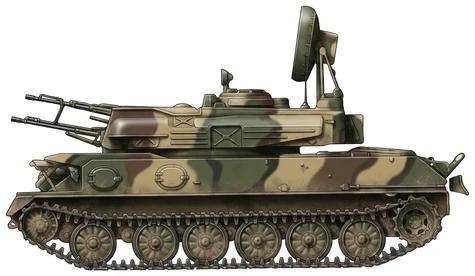
| Sub-type | Self-Propelled Anti-Aircraft Gun |
| Crew | 4 personnels |
| Range | 450 km |
| Mass | 19.0 tons |
| Height | 2.57 m (8.4 ft) |
| Width | 3.12 m (10.2 ft) |
| Length | 6.54 m (21.5 ft) |
| Max. speed | 50 km/h (31 mph) |
| Engine | V-6R Engine with 280 hp |
| Weapon 1 | 4s AZP-23 23mm gun |
Description
The ZSU-23-4 "Shilka" is a Soviet-designed self-propelled anti-aircraft gun (SPAAG). Development occurred between 1957 and 1960 to address limitations of the ZSU-57-2, which lacked radar and the capability to fire while in motion. Manufactured by the Ulyanovsk Mechanical Plant and Mytishchi Machine-Building Plant, the vehicle entered service in 1965. Its primary purpose was the air defense of military facilities, troop formations, and mechanized columns.
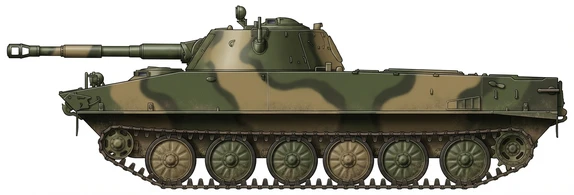
The vehicle utilizes the GM-575 tracked chassis, incorporating components from the PT-76 light tank. Protection is provided by welded steel armor on the hull and turret. Armament consists of four 2A7 23 mm liquid-cooled autocannons, collectively designated AZP-23 "Amur." These weapons provide a combined rate of fire of 3,400 to 4,000 rounds per minute and are supplied by 2,000 rounds of ammunition stowed in belts. The 360-degree rotating turret is fully stabilized, allowing the system to engage targets while the vehicle is in motion.
Fire control is managed by the RPK-2 "Tobol" radar system, which operates in the Ku band to detect and track aerial targets. An 1A7 SRP electro-mechanical computer calculates flight time and lead angles based on radar data. The vehicle is operated by a crew of four: commander, driver, gunner, and radar operator. For ground engagements, the cannons elevate from -4 to +85 degrees, a feature utilized in mountainous and urban combat. Power is supplied by a 6-cylinder diesel engine and a gas turbine auxiliary power unit.
The ZSU-23-4 was produced in large numbers and exported to Warsaw Pact members and other states. It has seen service in conflicts including the Yom Kippur War, the Iran-Iraq War, and the Soviet-Afghan War. During the Afghan conflict, the system was used for mountain combat to return fire against ambushes from high-elevation positions. It was also deployed in the Gulf War, the Chechen Wars, and the Russo-Ukrainian War. The system remains in service in several countries, and various operators have developed modernization packages including surface-to-air missiles and digital fire control systems.
Frequently Asked Questions
What type of vehicle is the ZSU-23-4 "Shilka"?
What is the weight of the ZSU-23-4 "Shilka"?
What is the maximum speed of the ZSU-23-4 "Shilka"?
What is the operational range of the ZSU-23-4 "Shilka"?
How many crew members does the ZSU-23-4 "Shilka" require?
How many ZSU-23-4 "Shilka" have been built?
What weapons does the ZSU-23-4 "Shilka" carry?
- JUL 272026 Updated Service entry year, number built and 2 more fields added
- JUL 232026 Updated Sources and cross-references refreshed
- APR 72026 Updated Description added
- JAN 172026 Updated Description added