BRDM-2
Summary
| Origin country | 🇷🇺 Russia |
| Category | Light Armoured Vehicle |
| Sub-type | Amphibious armoured scout car |
| Manufacturer | Gorky Automobile Plant (GAZ) |
| Number built | 7200 units |
Technical specifications
| Crew | 3 (commander, driver, gunner) personnels |
| Range | 1500 km |
| Mass | 6.9 tons |
| Height | 2.43 m (8.0 ft) |
| Width | 2.425 m (8.0 ft) |
| Length | 6.29 m (20.6 ft) |
| Max. speed | 100 km/h (62 mph) |
| Engine | GAZ-41 5.53L V8 petrol, 140 hp |
| Weapon 1 | 14.5 mm KPVT heavy machine gun |
| Weapon 2 | 7.62 mm PKT coaxial machine gun |
Historical operators
Profile of BRDM-2
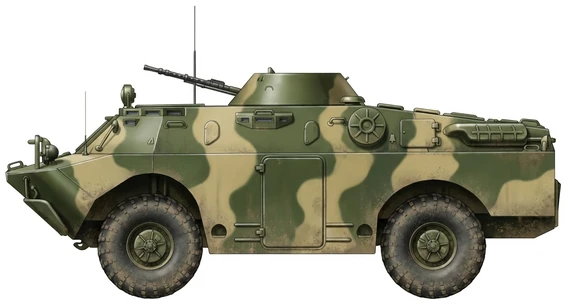
Description
The BRDM-2 (Boyevaya Razvedyvatelnaya Dozornaya Mashina) is a Soviet-designed amphibious armored scout car developed to replace the BRDM-1. Also designated BTR-40PB and GAZ 41-08, the vehicle entered service with the Soviet Army in 1962 and remained in production until 1989. The design was initiated to address several deficiencies identified in its predecessor, specifically the lack of a turret, the absence of an NBC protection system, and the lack of standard night vision equipment.
The vehicle features a box-like welded steel hull with a rear-mounted GAZ-41 gasoline V8 engine, which is separated from the forward crew compartment by an armored barrier. It carries a crew of four: driver, co-driver, commander, and gunner. For cross-country mobility, the BRDM-2 utilizes a centralized tire pressure regulation system and two pairs of retractable, chain-driven belly wheels intended for trench crossing. Amphibious capability is provided by a single rear-mounted water-jet and a retractable trim board at the bow. Armor protection is designed to resist small arms fire and shell fragments, with a maximum thickness of 14 mm.
Armament is mounted in a central conical BPU-1 turret, comprising a 14.5 mm KPVT heavy machine gun and a coaxial 7.62 mm PKT machine gun. The primary weapon has a daylight effective range of 2,000 m and can penetrate 30 mm of armor at 500 m. Later production versions featured increased gun elevation and improved cooling vents. Crew observation is facilitated by bulletproof windscreens with armored shutters, TNP-A periscopes, and infrared night vision devices for the driver and commander.
The BRDM-2 has been exported to dozens of countries across Europe, Asia, Africa, and the Middle East. It saw combat during the 1973 Yom Kippur War and the 1982 Lebanon War, where it was utilized by Syrian and Israeli forces. The vehicle was deployed during the Soviet-Afghan War, the Gulf War, and the Yugoslav Wars. In the Russo-Ukrainian War, both sides have utilized the BRDM-2 and its modernized variants. Poland operates several versions, including the Żbik and Szakal, which feature diesel engines and side doors to address ergonomic and protection concerns. Other operators include the Taliban in Afghanistan and various factions in the Syrian Civil War. Specialized variants were produced for radiological-chemical reconnaissance and as platforms for anti-tank and surface-to-air missiles.