HMMWV (Humvee)
Summary
| Origin country | 🇺🇸 United States |
| Category | Light Armoured Vehicle |
| Sub-type | Light Utility Vehicle |
| Manufacturer | AM General |
| Number built | 230000 units |
| Est. avg unit price | $0.2 million |
Technical specifications
| Crew | 4 personnels |
| Range | 480 km |
| Mass | 2.7 tons |
| Height | 1.83 m (6.0 ft) |
| Width | 2.16 m (7.1 ft) |
| Length | 4.57 m (15.0 ft) |
| Max. speed | 89 km/h (55 mph) |
| Engine | 6.5L V8 turbo-diesel |
| Weapon 1 | M2HB .50 cal machine gun |
| Weapon 2 | Mk 19 grenade launcher |
| Weapon 3 | M240 machine gun |
| Weapon 4 | BGM-71 TOW missile launcher |
Historical operators
Profile of HMMWV (Humvee)
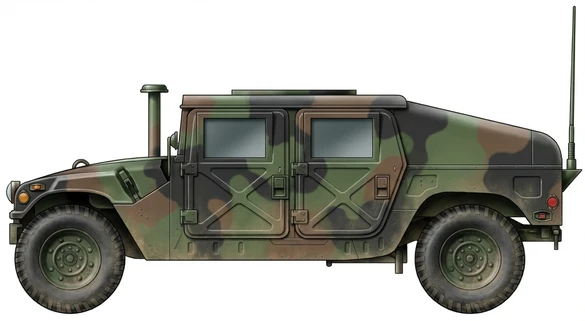
Description
The High Mobility Multipurpose Wheeled Vehicle (HMMWV) was developed by AM General to replace the U.S. military’s fleet of light tactical vehicles, including the M151 jeep, M561 Gama Goat, and various Commercial Utility Cargo Vehicles (CUCV). The program originated from the Combat Support Vehicle and High Mobility Weapons Carrier requirements of the late 1970s. The U.S. Army released draft specifications in 1979 for a single "jack-of-all-trades" platform capable of performing various roles across the Army, Marine Corps, and Air Force. AM General was awarded the initial production contract in March 1983 following competitive trials against Chrysler and Teledyne Continental.
The HMMWV is constructed on a steel frame with boxed rails and five cross members, featuring an aluminum cabin. The drivetrain is positioned between the frame rails to lower the center of gravity and provide high ground clearance. It utilizes independent double-wishbone suspension and helical gear-reduction hubs on all four wheels. Power is provided by General Motors V8 diesel engines, including 6.2-liter and 6.5-liter variants in naturally aspirated or turbocharged configurations. The vehicle employs Torsen torque-biasing differentials and radial tires with runflat devices.
Mission-specific variants include cargo and troop carriers, ambulances, shelter carriers, and weapons platforms. Armament options include the M2 heavy machine gun, Mk 19 grenade launcher, M240 machine gun, and TOW anti-tank missiles. These systems can be operated via manual mounts or the Common Remotely Operated Weapon Station (CROWS). While original models were unarmored, the M1114 and subsequent iterations integrated hardened steel and bullet-resistant glass. Supplemental armor kits, such as the Armor Survivability Kit (ASK) and Fragmentation (FRAG) series, were developed to increase protection against small arms and improvised explosive devices (IEDs).
The vehicle first saw combat during the 1989 invasion of Panama and was deployed extensively during the 1991 Gulf War. During the Iraq War and operations in Afghanistan, the HMMWV's vulnerability to asymmetric threats led to the fielding of up-armored variants and the eventual introduction of Mine-Resistant Ambush-Protected (MRAP) vehicles for frontline service. The HMMWV is widely exported and is operated by numerous countries, including Iraq, Mexico, Poland, and Ukraine. In 2015, the U.S. military selected the Oshkosh L-ATV under the Joint Light Tactical Vehicle (JLTV) program to replace the HMMWV in frontline roles, though the vehicle is expected to remain in the U.S. inventory in support and auxiliary roles until 2050.