MiG-23 Flogger
Soviet third-generation jet fighter, notable for its service during the Cold War, often deployed in interceptor and ground-attack roles. Key figures: top speed 2,500 km/h, range 2,360 km, service ceiling 18,000 m, max takeoff weight 17,800 kg, unit price $4M, built 5,047. In service with 5 air forces as of 2026 — North Korea (56), Angola (22), Ethiopia (9) and 2 others.
| Crew | 1 |
| Length | 16.7 m (54.8 ft) |
| Wingspan | 14.0 m (45.8 ft) |
| Height | 4.8 m (15.8 ft) |
| Wing area | 37 m² (398.3 sqft) |
| Empty weight | 10,230 kg (22,553 lbs) |
| Max. takeoff weight | 17,800 kg (39,242 lbs) |
| Powerplant | 1 × turbofan Tumansky R-35F-300 12,996 kgf each |
| Ejection seat | Mikoyan-Gourevitch KM-1 |
| Maximum speed | 2500 km/h (Mach 2.4) |
| Operational range | 2,360 km (1,466 mi) |
| Service ceiling | 18,000 m (59,055 ft) |
| Climb rate | 240.0 m/s (787.4 ft/s) |
| Takeoff distance | 450 m (1,476 ft) |


- Air-to-Air Medium-Range Vympel R-23 (AA-7 Apex)
- Air-to-Air Medium-Range Vympel R-24 (AA-7 Apex)
- Air-to-Air Short-Range Vympel R-60 / K-60 (AA-8 Aphid)
- Air-to-Surface Zvezda Kh-23 (AS-7 Kerry)
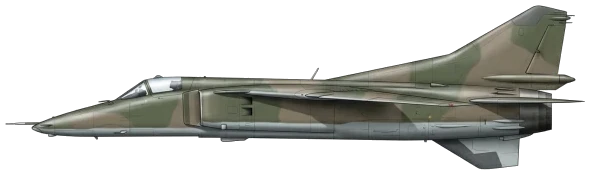
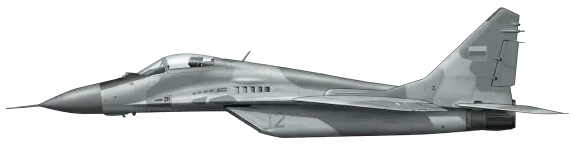
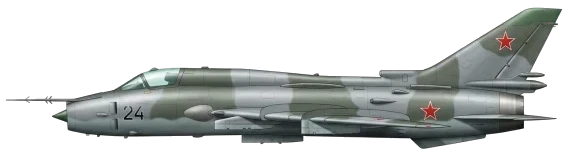
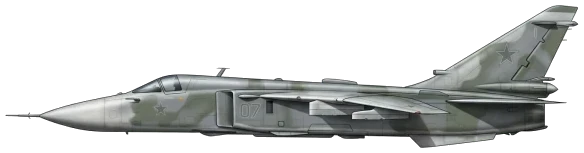
Description
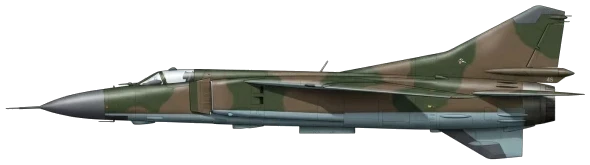
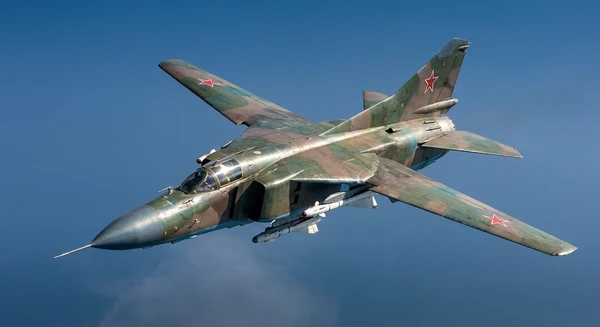
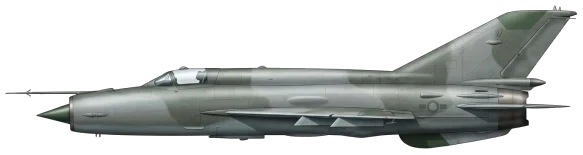
The Mikoyan-Gurevich MiG-23, known as the "Flogger" in NATO reporting name, is a Soviet variable-geometry (swing-wing) jet fighter developed in the late 1960s. The MiG-23 was designed to offer better performance, range, and payload capabilities compared to its predecessors, such as the MiG-21.
Development
Development of the MiG-23 began in the early 1960s, with the aim of creating a versatile jet fighter capable of adapting its wing configuration for optimal performance at different speeds and altitudes. The aircraft features a variable-geometry wing design, allowing the wings to sweep back for high-speed flight or extend for improved performance and maneuverability at low speeds. The first prototype of the MiG-23, designated 23-01, made its maiden flight in 1967.
Design
The MiG-23 is powered by a single Tumansky R-29 turbojet engine, which provides substantial thrust for high-speed flight and rapid acceleration. Its design incorporates a sleek fuselage, forward air intake, and a bubble canopy for excellent visibility. The MiG-23's avionics suite includes radar, radio, and navigation systems, as well as an advanced fire control system for targeting and engaging enemy aircraft. The aircraft's armament typically consists of a 23 mm GSh-23L cannon and a variety of air-to-air and air-to-ground missiles, as well as unguided rockets and bombs for ground attack missions.
Operational History
The MiG-23 entered service with the Soviet Air Force in 1970 and has participated in various conflicts, including the Soviet-Afghan War, Arab-Israeli conflicts, and the Iran-Iraq War. The MiG-23 has also been exported to numerous Soviet-aligned countries and served in several air forces around the world.
Variants
Several main versions of the MiG-23 have been produced, including:
-
MiG-23S: The initial production variant, with limited avionics suite and basic armament.
-
MiG-23M (Flogger B): A major production version with an improved radar system, upgraded avionics, and enhanced weapon-carrying capabilities.
-
MiG-23MF (Flogger B): An export variant of the MiG-23M, with downgraded avionics suite.
-
MiG-23ML (Flogger G): A further development with a lighter airframe, improved aerodynamics, and an upgraded engine.
In total, over 5,800 MiG-23 aircraft have been built, making it one of the most produced variable-geometry jet fighters in history.
Frequently Asked Questions
What type of aircraft is the MiG-23 Flogger?
What is the maximum speed of the MiG-23 Flogger?
What is the range of the MiG-23 Flogger?
When did the MiG-23 Flogger first fly?
How many MiG-23 Flogger have been built?
Which countries operate the MiG-23 Flogger?
How much does a MiG-23 Flogger cost?
What is the service ceiling of the MiG-23 Flogger?
- AUG 122026 Updated Range corrected to the ferry range with drop tanks
- AUG 12026 Updated Manufacturer updated
- JUL 232026 Updated Sources and cross-references refreshed
- JUN 262026 Updated Missiles updated
- APR 72026 Updated Sources and cross-references refreshed
- APR 52026 Updated Ejection seat added