M114 Howitzer
Summary
| Origin country | 🇺🇸 United States |
| Category | Towed Artillery |
| Sub-type | Towed Howitzer |
| Manufacturer | Rock Island Arsenal |
Technical specifications
| Range | 18 km |
| Engine | two 20 horsepower air-cooled engines |
| Weapon 1 | 155 mm 39 caliber barrel |
| Weapon 2 | 20 mm sub-caliber barrel insert |
Historical operators
Profile of M114 Howitzer
Description
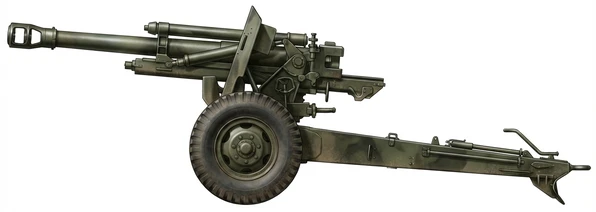
The M114 155 mm howitzer is a towed medium artillery piece developed for the United States Army. Its origins trace back to the post-World War I Westervelt Board, which established requirements for a new heavy howitzer to replace Great War-era designs. Early development resulted in several prototypes, including the M1920 and M1925, though these were not placed into production due to carriage failures or project cancellations. Development resumed in 1939, leading to the standardization of the Howitzer M1 on Carriage M1 in May 1941. Following World War II, the system was redesignated as the M114.
The M114 utilizes a 20-caliber barrel and an interrupted screw breech mechanism. The system is mounted on a split-trail carriage equipped with pneumatic tires. The initial M1 carriage featured electric brakes and a ratchet-driven firing pedestal, while the M1A1 variant transitioned to air brakes. The subsequent M1A2 carriage replaced the ratchet mechanism with a screw-jack system and modified the traveling lock. The howitzer fires separate-loading, bagged charge ammunition using up to seven propelling charges.
Post-war modernization led to several variants. The M114A2 incorporates a longer barrel with a modified rifling twist to extend projectile range. International variants include the M114/39, a modernization by the Netherlands and Denmark featuring a 39-caliber barrel, and the South Korean KM114A1, which is a reverse-engineered version capable of firing rocket-assisted projectiles. Yugoslavia produced a nearly identical copy designated the M65. The M114 also served as the armament for the M41 Howitzer Motor Carriage, a self-propelled variant based on the M24 Chaffee chassis.
The M114 saw combat with the United States Army during World War II, the Korean War, and the Vietnam War. It was eventually phased out of U.S. service in favor of the M198 howitzer. The system was exported to numerous nations and remains in service globally. It is currently operated by various armed forces in South America, Europe, the Middle East, and Asia, including Brazil, Greece, Pakistan, Turkey, and Taiwan. In 1997, the United States supplied M114A2 units to Bosnia-Herzegovina. More recently, the system has been the subject of transfer negotiations involving the Hellenic Army and Ukraine.