BN-2B Defender
Summary
| Category | Military Transport Aircraft |
| Origin country | 🇬🇧 United Kingdom |
| Manufacturer | Britten-Norman |
| First flight | 12 June 1965 |
| Year introduced | 1965 |
| Number produced | 1280 units |
| Average unit price | $2 million |
Technical specifications
| Version: BN-2B | |
|---|---|
| Crew | 1 pilot |
| Operational range | 1,400 km (870 mi) |
| Maximum speed | 264 km/h (164 mph) |
| Wing area | 31.3 m² (337.0 sqft) |
| Wingspan | 16.2 m (53.0 ft) |
| Height | 4.2 m (13.7 ft) |
| Length | 11.1 m (36.3 ft) |
| Service ceiling | 4,000 m (13,123 ft) |
| Empty weight | 1,825 kg (4,023 lbs) |
| Max. takeoff weight | 2,995 kg (6,603 lbs) |
| Powerplant | 2 x pistons engine Lycoming 0-540-E4C5 delivering 194 kW each |
Current operating countries
| Country | Units | ||
|---|---|---|---|

|
Philippines | 7 | |

|
Myanmar | 5 | |

|
Zimbabwe | 5 | |

|
India | 4 | |

|
Botswana | 2 | |

|
Guyana | 2 | |
| 🇦🇬 | Antigua and Barbuda | 1 | |
| 🇧🇿 | Belize | 1 | |

|
Indonesia | 1 | |

|
Cambodia | 1 | |

|
Malta | 1 | |

|
Nepal | 1 | |
All operators
Description
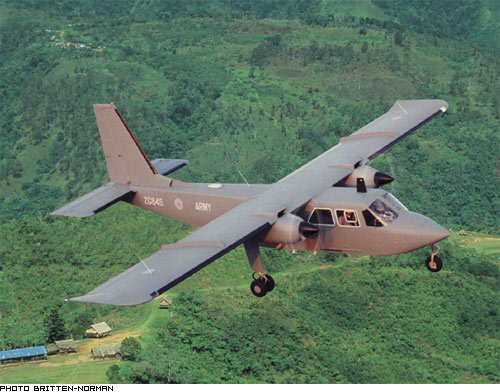
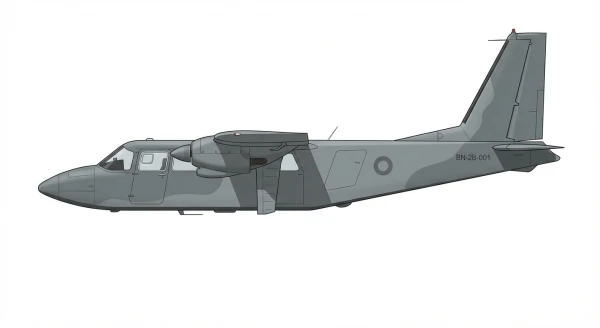
First flown in May 1970, the Defender was developed by Britten-Norman as the military version of the civilian Islander. It features a strengthened airframe with four underwing hardpoints, enabling it to carry up to 2,500 pounds (1,100 kg) of external stores such as fuel tanks, bombs, missiles, 7.62-mm (0.3-inch) machine-gun pods, rocket pods, flares, sensors, and other mission-specific equipment.
Several versions have been produced, including the BN-2 Piston Defender and the BN-2T Turbine Defender (also known as the Defender 2000). The enhanced BN-2T-4S, designated Defender 4000 (D4K), is an enlarged version intended for aerial surveillance and other roles. The Defender 4000 prototype first flew in 1995, with production commencing in 1997. This variant features a stretched fuselage, the enlarged wing from the Trislander, and a redesigned nose structure to accommodate sensors, along with an increased payload capacity compared to earlier Defender variants. For the British Army's ISTAR missions in Iraq, the Defender 4000 AL Mk 1 was equipped with a Wescam MX-15 Electro-Optical Infrared (EO/IR) turret, cabin-mounted cameras, COMINT, and C2 equipment. The Mk 2 variant introduced enhancements such as TCAS, EGPWS, improved DAS, an advanced avionics suite, and greater fuel capacity for extended endurance.
The Britten-Norman Defender has seen deployment across various theaters, serving in roles including counter-insurgency and search and rescue. The Mauritanian Air Force employed the Defender in the Western Sahara War. The Royal Cambodian Air Force utilized it in support of offensives against Khmer Rouge insurgents. In 1993, during the siege of Waco, the FBI deployed a Defender for electronic aerial surveillance. The Philippine Navy deployed one of its Defenders in the multinational search for Malaysia Airlines Flight 370. The British Army operated the Defender 4000 in Iraq, where it provided over 8,000 hours of support, and later trialed it in the Middle East for Counter-IED capabilities and deployed it to Afghanistan. Ultimately, the British Army transferred the Defender to the Royal Air Force, which retired the aircraft in July 2021.
Main Variants:
-
Maritime Defender: An armed variant configured for maritime patrol and reconnaissance.
-
Defender 4000: An enhanced version with a stretched fuselage and enlarged wing designed for roles such as urban surveillance, counter-terrorism, and maritime surveillance.
-
AEW Defender (BN-2T-4R): An Airborne Early Warning variant equipped with radar and other sensors for air surveillance.