BM-21 Grad
Summary
| Origin country | 🇷🇺 Russia |
| Category | Multiple Launch Rocket System |
| Sub-type | Self-propelled 122 mm multiple rocket launcher |
| Manufacturer | Motovilikha Plants |
Technical specifications
| Crew | three-member crew personnels |
| Range | 750 km |
| Max. speed | 75 km/h (47 mph) |
| Engine | water-cooled V8 180 hp gasoline engine |
| Weapon 1 | 40 launch tubes |
| Weapon 2 | 122 mm M-21OF rocket |
| Weapon 3 | 9M53F rocket |
| Weapon 4 | PRS-60 ammunition |
Historical operators
Profile of BM-21 Grad
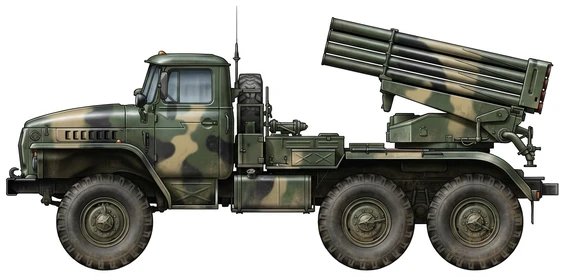
Description
The BM-21 Grad is a Soviet 122 mm multiple rocket launcher developed in the early 1960s. It entered service with the Soviet Army in 1963 as a replacement for the 140 mm BM-14 system. The designation BM stands for boyevaya mashina (combat vehicle), while the nickname Grad translates to "hail." The complete system, including the launch vehicle and M-21OF rocket, is designated the M-21 field-rocket system. In NATO countries, the system was initially identified as the M1964.
The system consists of a truck-mounted bank of 40 launch tubes arranged in a rectangular shape. Initially based on the Ural-375D 6x6 chassis, the launcher was later integrated onto the Ural-4320. A three-member crew can emplace the vehicle and prepare for firing within three minutes. Rockets are launched from the cab or via a remote trigger at the end of a cable. All 40 rockets can be discharged in as little as 20 seconds, fired individually or in salvos. Rockets are stabilized through a combination of tube rifling and primary fins. Available warheads include high-explosive fragmentation, incendiary, chemical, and cargo types for delivering anti-personnel or anti-tank mines. While the system possesses lower precision than conventional gun artillery, its effectiveness is derived from the volume of fire delivered over a wide area.
Numerous countries have developed indigenous variants and modernizations. Belarus operates the BM-21A BelGrad, which includes an additional rocket pack between the cab and launcher. China produces several versions, including the Type 81, the tracked Type 89, and the Type 90. Czechoslovakia developed the RM-70 on an 8x8 Tatra chassis, featuring an armored cab and an automated reload system. Poland’s WR-40 Langusta utilizes a digital fire control system and a Jelcz 6x6 chassis. Specialized versions include the BM-21V for airborne forces and the BM-21PD Damba for naval base protection. A single-round man-portable version, the Grad-P, was developed for special units and remains in use by various paramilitary forces.
The Grad saw its initial combat deployment during the 1969 Sino-Soviet border conflict. In 1975, its use during Operation Savannah halted the advance of South African troops. The system has been utilized in the Vietnam War, the Iran-Iraq War, and the Donbas conflict. It is currently employed by both sides in the War in Ukraine. Non-state actors, such as Hamas, have operated modified versions in engagements against Israel. The BM-21 and its derivatives are widely exported and remain in service with numerous nations across Eastern Europe, Asia, Africa, and the Middle East. In Russian service, the 9A52-4 Tornado is the intended replacement for the system.