J-7 Fishcan
Chinese jet fighter, notable for usage in the late Cold War era, widely deployed in the Third Taiwan Strait Crisis. Key figures: top speed 2,200 km/h, range 2,200 km, service ceiling 17,500 m, max takeoff weight 9,100 kg, unit price $2M, built 2,400. In service with 12 air forces as of 2026 — China (230), Pakistan (53), Bangladesh (35) and 9 others.
| Crew | 1 |
| Length | 14.0 m (45.8 ft) |
| Wingspan | 8.3 m (27.3 ft) |
| Height | 4.1 m (13.5 ft) |
| Wing area | 24.9 m² (267.8 sqft) |
| Empty weight | 5,292 kg (11,667 lbs) |
| Max. takeoff weight | 9,100 kg (20,062 lbs) |
| Powerplant | 1 × Liyang Wopen-13F afterburning turbojet 6,598 kgf each |
| Ejection seat | HTY-2 |
| Maximum speed | 2200 km/h (Mach 2.2) |
| Operational range | 2,200 km (1,367 mi) |
| Service ceiling | 17,500 m (57,415 ft) |
| Climb rate | 195.0 m/s (639.8 ft/s) |
-
 China
230
China
230
-
 Pakistan
53
Pakistan
53
-
 Bangladesh
35 +6
Bangladesh
35 +6
-
 North Korea
30
North Korea
30
-
 Iran
24
Iran
24
-
 Myanmar
18
Myanmar
18
-
 Sudan
12
Sudan
12
-
 Tanzania
11
Tanzania
11
-
 Namibia
9
Namibia
9
-
 Zimbabwe
9
Zimbabwe
9
-
 Nigeria
8
Nigeria
8
-
 Sri Lanka
5
Sri Lanka
5
Recent Events — J-7 Fishcan
4 events →
Description
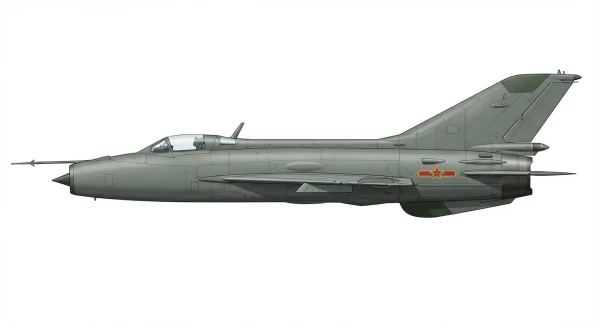
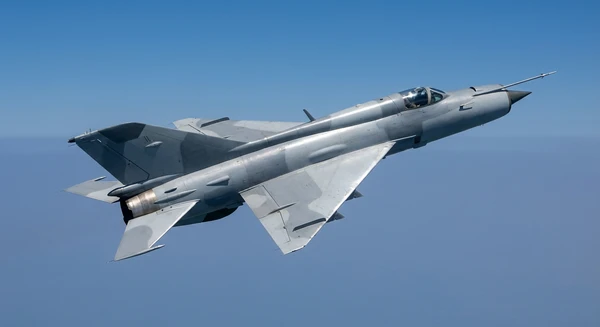
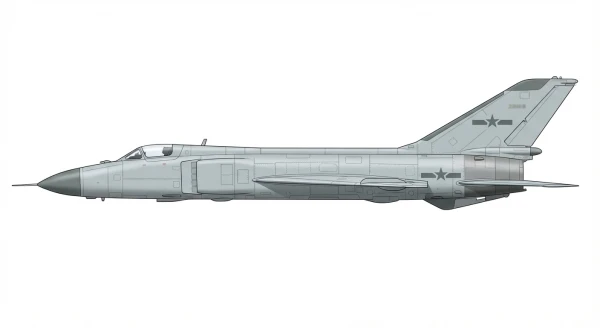
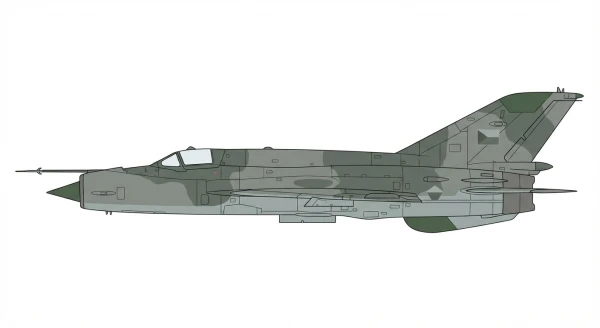
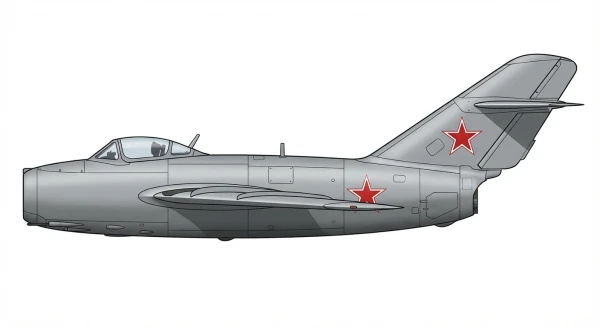
The J-7 Fishcan is a Chinese-built fighter aircraft that is a license-produced version of the Soviet Mikoyan-Gurevich MiG-21. Its development dates back to the late 1950s and early 1960s when China and the Soviet Union were allies. China acquired MiG-21s and eventually secured a license to produce its own variant, leading to the J-7. Production began in the 1960s, and the aircraft was formally introduced into the Chinese air force in 1966. The relationship between China and the Soviet Union soured later, but the J-7 continued to be produced and upgraded independently by China.
Design
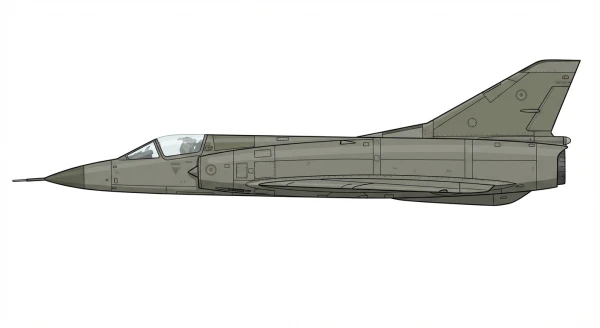
The J-7 Fishcan is characterized by its simple yet functional design, inspired by the Soviet MiG-21. The aircraft has a single-engine, single-seat configuration with a slender fuselage and a sharply pointed nose. It features a delta wing layout, which offers good maneuverability and speed but often at the expense of fuel efficiency and range. The aircraft is equipped with an afterburning turbojet engine, which provides it with a top speed of around Mach 2. A notable aspect of its design is the lack of advanced avionics and electronic systems, especially in the earlier versions, which makes it less capable in comparison to more modern fighter jets.
The cockpit is relatively cramped, offering limited visibility, which is a common trait for aircraft of its generation. Over the years, various versions have been produced that incorporate incremental improvements in radar, weaponry, and other systems, but the basic airframe has largely remained the same.
Armament
The weapon capabilities of the J-7 Fishcan are relatively basic, particularly when compared to modern multi-role fighters. It is typically equipped with a single internal cannon, usually a 30mm gun, for close-range combat. For beyond-visual-range (BVR) and medium-range engagements, it can carry air-to-air missiles, often of older designs like the PL-2, PL-5, or PL-8, depending on the variant and the timeframe. Some upgraded versions may be compatible with more advanced missile systems.
The aircraft also has the capacity to carry a limited amount of air-to-ground munitions, such as unguided bombs and rockets, making it capable of ground attack missions to some extent. However, the J-7's primary role has always been air defense, and it lacks the advanced targeting and multi-role capabilities found in more modern aircraft.
Operational History
The J-7 Fishcan has seen extensive operational service since its introduction in 1966, mainly with the People's Liberation Army Air Force (PLAAF) of China. It was produced in large numbers and has been exported to several countries, notably Pakistan, where it was produced locally as the F-7. During its early years, the J-7 primarily served as an air defense interceptor in the PLAAF, tasked with protecting Chinese airspace.
It has participated in various military exercises and limited skirmishes, but it has seldom seen intense combat. One notable instance was its use by the Vietnamese Air Force, which acquired a number of Chinese J-7s, during conflicts with China itself in the late 1970s. The aircraft has also been used in various other conflict zones, mainly by export customers, but its combat record is not particularly distinguished.
In the 1980s and 1990s, the J-7 began to show its age as more advanced aircraft came into service. Despite numerous upgrades to its avionics, radar, and weapon systems, it gradually became less relevant as a frontline fighter. In the PLAAF, it has largely been supplanted by more modern aircraft like the J-10 and J-11, although it continues to serve in secondary roles and in the air forces of countries with limited defense budgets.
As of today, the J-7 is largely considered obsolete for any sort of air combat against modern adversaries. However, it continues to serve in various capacities, including training and secondary defense roles, in some air forces.
Variants
-
J-7: This is the initial production version, closely modeled after the Soviet MiG-21F-13. It was fairly basic, featuring limited avionics and weapon capabilities.
-
J-7I: An improved version with better avionics and ejection seat, and an upgraded engine. It also featured slight modifications to the airframe for better performance.
-
J-7II: An upgraded J-7IG with a 720-liter belly tank and a new WP-7II batch 02 engine. Exhaust and operating temperatures rose by 100°C, a flaw that led to the grounding of all such models years after production ended. Production ceased in 1986 with 375 units built.
-
J-7E: A significantly upgraded variant with a double-delta wing design for improved aerodynamic performance. It also featured improved avionics and the ability to carry a broader range of weapons.
-
J-7G: An enhanced version of J-7E, featuring over 30 upgrades. It includes HOTAS and a Chinese variant of EL/M-2032 radar. However, due to a small nosecone, the radar's range is cut by about 60% to just over 60 km. Development ran from March 2002 to July 2004, with deliveries starting in November 2004.
Identified in 4 sorties in the official China-Taiwan Tensions activity reports between 2021 and 2021 — a floor, not a census: only sorties the source identified by type are counted, and how much it disclosed varies by year.
Frequently Asked Questions
What type of aircraft is the J-7 Fishcan?
What is the maximum speed of the J-7 Fishcan?
What is the range of the J-7 Fishcan?
When did the J-7 Fishcan first fly?
How many J-7 Fishcan have been built?
Which countries operate the J-7 Fishcan?
How much does a J-7 Fishcan cost?
What is the service ceiling of the J-7 Fishcan?
- AUG 122026 Updated Range corrected to the ferry range
- AUG 52026 Updated Thrust updated
- JUL 232026 Updated Sources and cross-references refreshed
- APR 72026 Updated Picture credits updated in a site-wide editorial pass
- APR 52026 Updated Ejection seat added
- OCT 222023 Updated Specifications and description reviewed